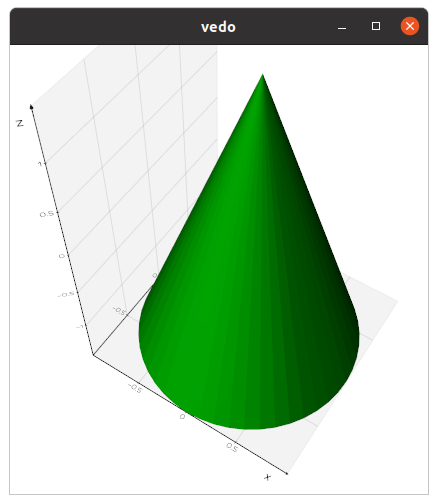
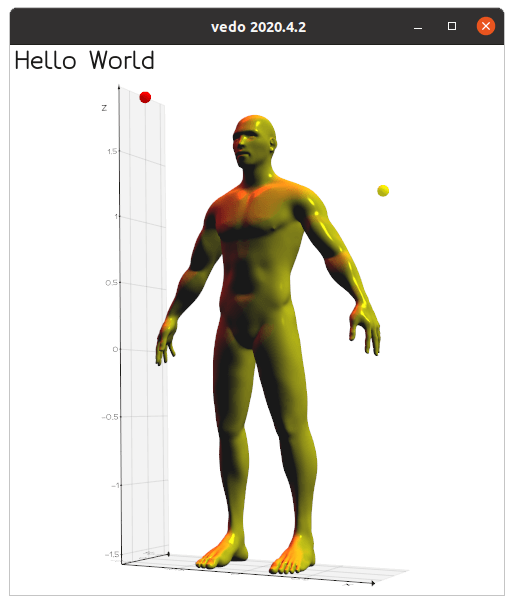
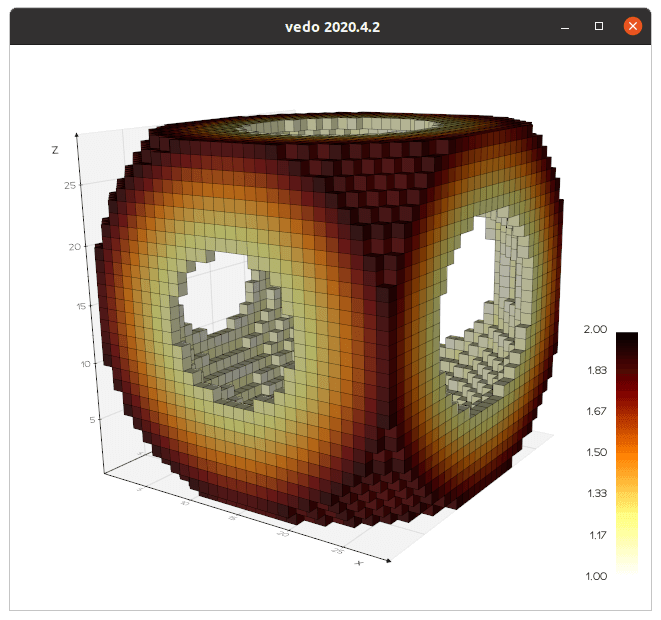
Analysis and visualization of 3D objects, point clouds and volumetric data.
vedo wraps the power of VTK and NumPy in an intuitive API for exploration,
publication-quality rendering, animation insight, and interactive scientific workflows.
$pip install vedo
Explore meshes, volumes, and scenes with an intuitive python toolkit.
vedo supports fast terminal-driven exploration and custom scientific visualization workflows.
vedo is used in a wide range of scientific contexts, from biology to engineering. Here are some
examples of how it has been used in the wild.
Latest publications
2026
L. Aviñó-Esteban et al., "Limblab: pipeline for 3D analysis and visualisation of limb bud
gene expression", BMC Bioinformatics 27(1): 6 (2026).
D. Krsikapa, I. Y. Kim, "Gradient-based optimization of component layout: addressing
accessibility and mounting in assembly system design", Journal of Mechanical Design
148(3): 031702 (2026).
2025
A. Kharlamova et al., "Spatial CAPTCHA: Generatively Benchmarking Spatial Reasoning for
Human-Machine Differentiation", arXiv preprint arXiv:2510.03863 (2025).
J. F. Fuhrmann et al., "Apical extracellular matrix regulates fold morphogenesis in the
Drosophila wing disc", bioRxiv 2025-09 (2025).
B. Li et al., "Three-dimensional spatial transcriptomics at isotropic resolution enabled
by generative deep learning", bioRxiv 2025-08 (2025).
T.-T. Hsu et al., "Shared Alteration of Whole-Brain Connectivity and Olfactory Deficits
in Multiple Autism Mouse Models", bioRxiv 2025-02 (2025).
A. Arrabi et al., "C-arm guidance: A self-supervised approach to automated positioning
during stroke thrombectomy", 2025 IEEE 22nd International Symposium on Biomedical
Imaging (ISBI).
L. Aviñó-Esteban, H. Cardona-Blaya, J. Sharpe, "Spatio-temporal reconstruction of gene
expression patterns in developing mice", Development 152: DEV204313 (2025), DOI.
B. Bortolon et al., "GRASPLAT: Enabling dexterous grasping through novel view
synthesis", 2025 IEEE/RSJ International Conference on Intelligent Robots and Systems
(IROS).
L. Carreira et al., "Targeted nano-energetic material exploration through active learning
algorithm implementation", Energetic Materials Frontiers 6(1): 3-13 (2025).
M. Chirillo et al., "PyReconstruct: A fully open-source, collaborative successor to
Reconstruct", Proceedings of the National Academy of Sciences 122(31): e2505822122
(2025).
B. Clayton et al., "A facile method to create continuum stochastic sheet-based cellular
materials", Additive Manufacturing: 104917 (2025).
A. Gross et al., "STRESS, an automated geometrical characterization of deformable
particles for in vivo measurements of cell and tissue mechanical stresses",
Scientific Reports 15(1): 28599 (2025).
A. Gauvain et al., "HydroModPy: A Python toolbox for deploying catchment-scale shallow
groundwater models" (2025).
K. N. Halwachs et al., "Effects of Stiffness and Degradability on Cardiac Fibroblast
Contractility and Extracellular Matrix Secretion in Three-Dimensional Hydrogel
Scaffolds", ACS Biomaterials Science & Engineering 11(11): 6521-6533 (2025).
R. Kliman et al., "Toward an Automated System for Nondestructive Estimation of Plant
Biomass", Plant Direct 9(3): e70043 (2025).
J. Laussu et al., "Deciphering the interplay between biology and physics with a finite
element method-implemented vertex organoid model: A tool for the mechanical analysis of
cell behavior on a spherical organoid shell", PLOS Computational Biology 21(1):
e1012681 (2025).
M. Mitelut et al., "Continuous monitoring and machine vision reveals that developing
gerbils exhibit structured social behaviors prior to the emergence of autonomy",
PLoS Biology 23(9): e3003348 (2025).
J.S. Posada et al., "morphoHeart: A quantitative tool for integrated 3D morphometric
analyses of heart and ECM during embryonic development", PLOS Biology 23(1) (2025),
DOI.
A. Prashanth, S. Hathwar, "Comparing the Effectiveness of Deep Learning Models Combined
with Loss Functions in Cardiac Segmentation" (2025).
M. Levin Thomas et al., "Banner cloud formation at the Matterhorn: Measurements versus
large-eddy simulations", Journal of the Atmospheric Sciences 82(8): 1661-1675
(2025).
H. Xu, "A Progressive Interactive Exploration Framework for Vector Field Data Guided by
Storylines", 2025 18th International Congress on Image and Signal Processing,
BioMedical Engineering and Informatics (CISP-BMEI).
S. M. Zahedi et al., "Comparative evaluation of neural networks and transfer learning for
predicting mechanical properties of 3D-printed bone scaffolds", Macromolecular
Materials and Engineering 310(10): e00073 (2025).
2024
C. Lei et al., "Automatic tooth arrangement with joint features of point and mesh
representations via diffusion probabilistic models", Computer Aided Geometric Design
111: 102293 (2024), Code.
S. Li et al., "MogaNet: Multi-order Gated Aggregation Network", International
Conference on Learning Representations (2024).
J. Cotterell et al., "Cell 3D Positioning by Optical encoding (C3PO) and its application
to spatial transcriptomics", bioRxiv 2024.03.12.584578 (2024), DOI.
D. Galvez Alcantara, "Development of a finite element framework for biological
applications" (2024).
M. Gazziro et al., "Fully Automated Ultra-Personalized 3D Printed Prosthetic
Breasts", American Journal of Biomedical Science & Research 20: 128-132 (2024).
I. G. Gonçalves, J. M. García-Aznar, "Neurorosettes: a novel computational modelling
framework to investigate the Homer-Wright rosette formation in neuroblastoma",
Computational Particle Mechanics 11(2): 565-577 (2024).
E. Guiltinan et al., "pySimFrac: A Python library for synthetic fracture generation and
analysis", Computers & Geosciences 191: 105665 (2024).
R. Haase et al., "Benchmarking large language models for bio-image analysis code
generation", bioRxiv 2024-04 (2024).
Y. Jiang, S. L. Bugby, J. E. Lees, "PMST: A custom Python-based Monte Carlo Simulation
Tool for research and system development in portable pinhole gamma cameras", Nuclear
Instruments and Methods in Physics Research Section A 1061: 169161 (2024).
D. Li, F. Pucci, M. Rooman, "Prediction of paratope-epitope pairs using convolutional
neural networks", International Journal of Molecular Sciences 25(10): 5434 (2024).
M. Marro, L. Moccozet, D. Vernez, "A numerical model for quantifying exposure to natural
and artificial light in human health research", Computers in Biology and Medicine
171: 108119 (2024).
M. Deepa Maheshvare et al., "Kiphynet: an online network simulation tool connecting
cellular kinetics and physiological transport", Metabolomics 20(5): 94 (2024).
S. Scholz et al., "Factors influencing pain medication and opioid use in patients with
musculoskeletal injuries: a retrospective insurance claims database study",
Scientific Reports 14(1): 1978 (2024).
J. Sultana, M. Naznin, T. R. Faisal, "SSDL - an automated semi-supervised deep learning
approach for patient-specific 3D reconstruction of proximal femur from QCT images",
Medical & Biological Engineering & Computing 62(5): 1409-1425 (2024).
S. Wang et al., "A 3D dental model dataset with pre/post-orthodontic treatment for
automatic tooth alignment", Scientific Data 11(1): 1277 (2024).
2023
S. Baumer et al., "Robocasting of ceramic Fischer-Koch S scaffolds for bone tissue
engineering", Journal of Functional Biomaterials 14(5): 251 (2023).
R. Blain et al., "A tridimensional atlas of the developing human head", Cell 186(26):
5910-5924 (2023).
B. Bogusławski et al., "Increasing brightness in multiphoton microscopy with a
low-repetition-rate, wavelength-tunable femtosecond fiber laser", Optics Continuum
3(1): 22-35 (2023).
G. Gust et al., "3D Analytics: Opportunities and Guidelines for Information Systems
Research", arXiv preprint arXiv:2308.08560 (2023).
T.-T. Hsu, C.-Y. Wang, Y.-P. Hsueh, "Tbr1 autism mouse model displays altered structural
and functional amygdalar connectivity and abnormal whole-brain synchronization",
bioRxiv 2023-07 (2023).
J. Laussu et al., "Deciphering interplay between biology and physics: finite element
method-implemented vertex organoid model raises the challenge", bioRxiv 2023-05
(2023).
Y. Li et al., "Research on the evolutionary history of the morphological structure of
cotton seeds: a new perspective based on high-resolution micro-CT technology",
Frontiers in Plant Science 14: 1219476 (2023).
S. Monji-Azad et al., "SimTool: A toolset for soft body simulation using Flex and Unreal
Engine", Software Impacts 17: 100521 (2023).
S. Triarjo et al., "Automatic 3D digital dental landmark based on point transformation
weight", 2023 International Conference on Artificial Intelligence in Information and
Communication (ICAIIC).
V. Zinchenko et al., "MorphoFeatures for unsupervised exploration of cell types, tissues,
and organs in volume electron microscopy", eLife 12: e80918 (2023).
2022
M. Blanc et al., "A dynamic and expandable digital 3D-atlas maker for monitoring the
temporal changes in tissue growth during hindbrain morphogenesis", eLife 11: e78300
(2022).
G. Dalmasso et al., "4D reconstruction of murine developmental trajectories using
spherical harmonics", Developmental Cell 57, 1-11 September 2022, DOI.
M. Deepa Maheshvare et al., "A Graph-Based Framework for Multiscale Modeling of
Physiological Transport", Frontiers in Network Physiology 1: 802881 (2022), DOI.
M. Erber et al., "Geometry-based assurance of directional solidification for complex
topology-optimized castings using the medial axis transform", Computer-Aided Design
152: 103394 (2022).
J. Hellar et al., "Manifold approximating graph interpolation of cardiac local activation
time", IEEE Transactions on Biomedical Engineering 69(10): 3253-3264 (2022).
A. Jaeschke, H. Eckert, L. J. Bray, "Qiber3D - an open-source software package for the
quantitative analysis of networks from 3D image stacks", GigaScience 11: giab091
(2022).
J. Klatzow, G. Dalmasso, N. Martínez-Abadías, J. Sharpe, V. Uhlmann, "µMatch: 3D shape
correspondence for microscopy data", Frontiers in Computer Science (2022), DOI.
N. Lamb et al., "DeepJoin: Learning a Joint Occupancy, Signed Distance, and Normal Field
Function for Shape Repair", ACM Transactions on Graphics 41(6) (2022), DOI.
J. E. Santos et al., "MPLBM-UT: Multiphase LBM library for permeable media analysis",
SoftwareX 18: 101097 (2022).
D. J. E. Waibel et al., "Capturing Shape Information with Multi-scale Topological Loss
Terms for 3D Reconstruction", Lecture Notes in Computer Science 13434 (2022), DOI.
2021
F. Claudi, A. L. Tyson, T. Branco, "Brainrender. A python based software for
visualisation of neuroanatomical and morphological data.", eLife 10: e65751 (2021),
DOI.
F. Claudi, T. Branco, "Differential geometry methods for constructing manifold-targeted
recurrent neural networks", bioRxiv 2021.10.07.463479 (2021), DOI.
X. Lu et al., "3D electromagnetic modeling of graphitic faults in the Athabasca Basin
using a finite-volume time-domain approach with unstructured grids", Geophysics
(2021), DOI.
S. Ortiz-Laverde et al., "Proposal of an open-source computational toolbox for solving
PDEs in the context of chemical reaction engineering using FEniCS and complementary
components", Heliyon 7(1) (2021).
J. Paglia et al., "TRACER: a toolkit to register and visualize anatomical coordinates in
the rat brain", bioRxiv 2021-10 (2021).
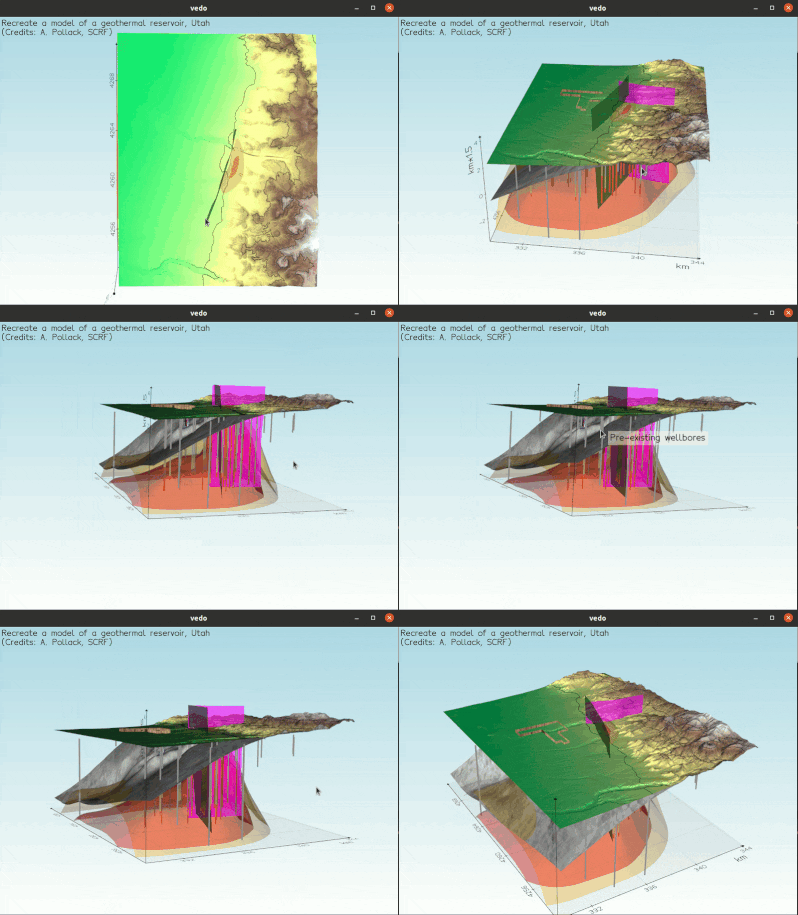
A. Pollack et al., "Stochastic inversion of gravity, magnetic, tracer, lithology, and
fault data for geologically realistic structural models: Patua Geothermal Field case
study", Geothermics 95 (2021), DOI.
2020
J. S. Bennett, D. Sijacki, "Resolving shocks and filaments in galaxy formation
simulations: effects on gas properties and star formation in the circumgalactic
medium", Monthly Notices of the Royal Astronomical Society 499(1) (2020), DOI.
J. D. P. Deshapriya et al., "Spectral analysis of craters on (101955) Bennu", Icarus
(2020), DOI.
2018
X. Diego et al., "Key features of Turing systems are determined purely by network
topology", Physical Review X 8, 021071 (2018), DOI.
M. Musy, K. Flaherty et al., "A Quantitative Method for Staging Mouse Limb Embryos based
on Limb Morphometry", Development 145(7): dev154856 (2018), DOI.
G. Dalmasso, "A four-dimensional growing mouse limb bud reconstruction", talk at SEBD.
M. Musy, "vedo. A python module for scientific analysis and visualization of 3D
data", seminar at MOIA (Microscopy Optics and Image Analysis), Heidelberg, November
2021.
Cite vedo
M. Musy et al., "vedo, a python module for scientific analysis and visualization of 3D
objects and point clouds",
Zenodo, 10.5281/zenodo.2561401.