Skip to content

vedo.pointcloud

Volumes

core

Points

Bases: PointsVisual, PointAlgorithms, PointTransformMixin, PointAnalyzeMixin, PointReconstructMixin, PointCutMixin

Work with point clouds.

Source code in vedo/pointcloud/core.py
 40
 41
 42
 43
 44
 45
 46
 47
 48
 49
 50
 51
 52
 53
 54
 55
 56
 57
 58
 59
 60
 61
 62
 63
 64
 65
 66
 67
 68
 69
 70
 71
 72
 73
 74
 75
 76
 77
 78
 79
 80
 81
 82
 83
 84
 85
 86
 87
 88
 89
 90
 91
 92
 93
 94
 95
 96
 97
 98
 99
100
101
102
103
104
105
106
107
108
109
110
111
112
113
114
115
116
117
118
119
120
121
122
123
124
125
126
127
128
129
130
131
132
133
134
135
136
137
138
139
140
141
142
143
144
145
146
147
148
149
150
151
152
153
154
155
156
157
158
159
160
161
162
163
164
165
166
167
168
169
170
171
172
173
174
175
176
177
178
179
180
181
182
183
184
185
186
187
188
189
190
191
192
193
194
195
196
197
198
199
200
201
202
203
204
205
206
207
208
209
210
211
212
213
214
215
216
217
218
219
220
221
222
223
224
225
226
227
228
229
230
231
232
233
234
235
236
237
238
239
240
241
242
243
244
245
246
247
248
249
250
251
252
253
254
255
256
257
258
259
260
261
262
263
264
265
266
267
268
269
270
271
272
273
274
275
276
277
278
279
280
281
282
283
284
285
286
287
288
289
290
291
292
293
294
295
296
297
298
299
300
301
302
303
304
305
306
307
308
309
310
311
312
313
314
315
316
317
318
319
320
321
322
323
324
325
326
327
328
329
330
331
332
333
334
335
336
337
338
339
340
341
342
343
344
345
346
347
348
349
350
351
352
353
354
355
356
357
358
359
360
361
362
363
364
365
366
367
368
369
370
371
372
373
374
375
376
377
378
379
380
381
382
383
384
385
386
387
388
389
390
391
392
393
394
395
396
397
398
399
400
401
402
403
404
405
406
407
408
409
410
411
412
413
414
415
416
417
418
419
420
421
422
423
424
425
426
427
428
429
430
431
432
433
434
435
436
437
438
439
440
441
442
443
444
445
446
447
448
449
450
451
452
453
454
455
456
457
458
459
460
461
462
463
464
465
466
467
468
469
470
471
472
473
474
475
476
477
478
479
480
481
482
483
484
485
486
487
488
489
490
491
492
493
494
495
496
497
498
499
500
class Points(
    PointsVisual,
    PointAlgorithms,
    PointTransformMixin,
    PointAnalyzeMixin,
    PointReconstructMixin,
    PointCutMixin,
):
    """Work with point clouds."""

    def __init__(self, inputobj=None, r=4, c=(0.2, 0.2, 0.2), alpha=1):
        """
        Build an object made of only vertex points for a list of 2D/3D points.
        Both shapes (N, 3) or (3, N) are accepted as input, if N>3.

        Args:
            inputobj (list, tuple):
            r (int):
                Point radius in units of pixels.
            c (str, list):
                Color name or rgb tuple.
            alpha (float):
                Transparency in range [0,1].

        Examples:
            ```python
            from vedo import *

            def fibonacci_sphere(n):
                s = np.linspace(0, n, num=n, endpoint=False)
                theta = s * 2.399963229728653
                y = 1 - s * (2/(n-1))
                r = np.sqrt(1 - y * y)
                x = np.cos(theta) * r
                z = np.sin(theta) * r
                return np._c[x,y,z]

            Points(fibonacci_sphere(1000)).show(axes=1).close()
            ```
            ![](https://vedo.embl.es/images/feats/fibonacci.png)
        """
        # print("INIT POINTS")
        super().__init__()

        self.name = ""
        self.filename = ""
        self.file_size = ""

        self.info = {}
        self.time = time.time()

        self.transform = LinearTransform()

        self.point_locator = None
        self.cell_locator = None
        self.line_locator = None

        self.actor = vtki.vtkActor()
        self.properties = self.actor.GetProperty()
        self.properties_backface = self.actor.GetBackfaceProperty()
        self.mapper = vtki.new("PolyDataMapper")
        self.dataset = vtki.vtkPolyData()
        self.actor.SetMapper(self.mapper)
        self.mapper.SetInputData(self.dataset)

        # Create weakref so actor can access this object (eg to pick/remove):
        self.actor.retrieve_object = weak_ref_to(self)

        try:
            if vedo.settings.enable_rendering_points_as_spheres:
                self.properties.RenderPointsAsSpheresOn()
        except AttributeError:
            pass

        if inputobj is None:  ####################
            return
        ##########################################

        self.name = "Points"

        ######
        if isinstance(inputobj, vtki.vtkActor):
            self.dataset.DeepCopy(inputobj.GetMapper().GetInput())
            pr = vtki.vtkProperty()
            pr.DeepCopy(inputobj.GetProperty())
            self.actor.SetProperty(pr)
            self.properties = pr
            self.mapper.SetScalarVisibility(inputobj.GetMapper().GetScalarVisibility())

        elif isinstance(inputobj, vtki.vtkPolyData):
            self.dataset = inputobj
            if self.dataset.GetNumberOfCells() == 0:
                carr = vtki.vtkCellArray()
                for i in range(self.dataset.GetNumberOfPoints()):
                    carr.InsertNextCell(1)
                    carr.InsertCellPoint(i)
                self.dataset.SetVerts(carr)

        elif isinstance(inputobj, Points):
            self.dataset = inputobj.dataset
            self.copy_properties_from(inputobj)

        elif utils.is_sequence(inputobj):  # passing point coords
            self.dataset = utils.buildPolyData(utils.make3d(inputobj))

        elif input_utils.is_path_like(inputobj):
            inpath = input_utils.as_path(inputobj)
            verts = vedo.file_io.load(inpath)
            self.filename = str(inpath)
            self.dataset = verts.dataset

        elif "meshlib" in str(type(inputobj)):
            from meshlib import mrmeshnumpy as mn

            self.dataset = utils.buildPolyData(mn.toNumpyArray(inputobj.points))

        else:
            # try to extract the points from a generic VTK input data object
            try:
                self.dataset = input_utils.points_polydata_from_dataset(inputobj)
            except Exception as e:
                vedo.logger.error(
                    f"cannot build Points from type {type(inputobj)}: {e}"
                )
                raise RuntimeError() from e

        self.actor.SetMapper(self.mapper)
        self.mapper.SetInputData(self.dataset)

        self.properties.SetColor(colors.get_color(c))
        self.properties.SetOpacity(alpha)
        self.properties.SetRepresentationToPoints()
        self.properties.SetPointSize(r)
        self.properties.LightingOff()

        self.pipeline = utils.OperationNode(
            self, parents=[], comment=f"#pts {self.dataset.GetNumberOfPoints()}"
        )

    def _update(self, polydata, reset_locators=True) -> Self:
        """Overwrite the polygonal dataset with a new vtkPolyData."""
        self.dataset = polydata
        self.actor.SetMapper(self.mapper)
        self.mapper.SetInputData(self.dataset)
        self.mapper.Modified()
        if reset_locators:
            self.point_locator = None
            self.line_locator = None
            self.cell_locator = None
        return self

    _summary_color = "green"

    def _summary_rows(self):
        rows = []

        if self.name:
            rows.append(("name", self.name))
            if self.info.get("legend"):
                rows.append(("legend", self.info["legend"]))

        if self.filename:
            rows.append(("file name", self.filename))

        if not self.mapper.GetScalarVisibility():
            col = utils.precision(self.properties.GetColor(), 3)
            cname = vedo.colors.get_color_name(self.properties.GetColor())
            rows.append(
                ("color", f"{cname}, rgb={col}, alpha={self.properties.GetOpacity()}")
            )
            if self.actor.GetBackfaceProperty():
                bcol = self.actor.GetBackfaceProperty().GetDiffuseColor()
                cname = vedo.colors.get_color_name(bcol)
                rows.append(
                    ("backface color", f"{cname}, rgb={utils.precision(bcol, 3)}")
                )

        npt = self.dataset.GetNumberOfPoints()
        npo = self.dataset.GetNumberOfPolys()
        nln = self.dataset.GetNumberOfLines()
        elements = f"vertices={npt:,} polygons={npo:,} lines={nln:,}"
        if self.dataset.GetNumberOfStrips():
            elements += f", strips={self.dataset.GetNumberOfStrips():,}"
        rows.append(("elements", elements))

        if self.dataset.GetNumberOfPieces() > 1:
            rows.append(("pieces", str(self.dataset.GetNumberOfPieces())))

        rows.append(("position", utils.precision(self.pos(), 6)))
        try:
            rows.append(("scaling", utils.precision(self.transform.get_scale(), 6)))
        except AttributeError:
            pass

        if self.npoints:
            rows.append(
                (
                    "size",
                    "average="
                    + utils.precision(self.average_size(), 6)
                    + ", diagonal="
                    + utils.precision(self.diagonal_size(), 6),
                )
            )
            rows.append(("center of mass", utils.precision(self.center_of_mass(), 6)))

        bnds = self.bounds()
        bx1, bx2 = utils.precision(bnds[0], 3), utils.precision(bnds[1], 3)
        by1, by2 = utils.precision(bnds[2], 3), utils.precision(bnds[3], 3)
        bz1, bz2 = utils.precision(bnds[4], 3), utils.precision(bnds[5], 3)
        rows.append(("bounds", f"x=({bx1}, {bx2}), y=({by1}, {by2}), z=({bz1}, {bz2})"))

        point_data = self.dataset.GetPointData()
        point_scalars = point_data.GetScalars()
        point_vectors = point_data.GetVectors()
        point_tensors = point_data.GetTensors()
        for key in self.pointdata.keys():
            arr = self.pointdata[key]
            dim = arr.shape[1] if arr.ndim > 1 else 1
            mark_active = "pointdata"
            if point_scalars and point_scalars.GetName() == key:
                mark_active += " *"
            elif point_vectors and point_vectors.GetName() == key:
                mark_active += " **"
            elif point_tensors and point_tensors.GetName() == key:
                mark_active += " ***"
            value = f'"{key}" ({arr.dtype}), dim={dim}'
            if dim == 1 and len(arr) > 0:
                if "int" in arr.dtype.name:
                    rng = f"{arr.min()}, {arr.max()}"
                else:
                    rng = (
                        utils.precision(arr.min(), 3)
                        + ", "
                        + utils.precision(arr.max(), 3)
                    )
                value += f", range=({rng})"
            rows.append((mark_active, value))

        cell_data = self.dataset.GetCellData()
        cell_scalars = cell_data.GetScalars()
        cell_vectors = cell_data.GetVectors()
        cell_tensors = cell_data.GetTensors()
        for key in self.celldata.keys():
            arr = self.celldata[key]
            dim = arr.shape[1] if arr.ndim > 1 else 1
            mark_active = "celldata"
            if cell_scalars and cell_scalars.GetName() == key:
                mark_active += " *"
            elif cell_vectors and cell_vectors.GetName() == key:
                mark_active += " **"
            elif cell_tensors and cell_tensors.GetName() == key:
                mark_active += " ***"
            value = f'"{key}" ({arr.dtype}), dim={dim}'
            if dim == 1 and len(arr) > 0:
                if "int" in arr.dtype.name:
                    rng = f"{arr.min()}, {arr.max()}"
                else:
                    rng = (
                        utils.precision(arr.min(), 3)
                        + ", "
                        + utils.precision(arr.max(), 3)
                    )
                value += f", range=({rng})"
            rows.append((mark_active, value))

        for key in self.metadata.keys():
            arr = self.metadata[key]
            if len(arr) > 3:
                rows.append(("metadata", f'"{key}" ({len(arr)} values)'))
            else:
                rows.append(("metadata", f'"{key}" = {arr}'))

        if self.picked3d is not None:
            idp = self.closest_point(self.picked3d, return_point_id=True)
            idc = self.closest_point(self.picked3d, return_cell_id=True)
            rows.append(
                (
                    "clicked point",
                    f"{utils.precision(self.picked3d, 6)}, pointID={idp}, cellID={idc}",
                )
            )

        return rows

    def __str__(self):
        return summary_string(self, self._summary_rows(), color=self._summary_color)

    def __repr__(self):
        return self.__str__()

    def __rich__(self):
        return summary_panel(self, self._summary_rows(), color=self._summary_color)

    def print(self):
        """Print object info."""
        print(self)
        return self

    def _repr_html_(self):
        """
        HTML representation of the Point cloud object for Jupyter Notebooks.

        Returns:
            HTML text with the image and some properties.
        """
        import io
        import base64
        from PIL import Image

        library_name = "vedo.pointcloud.Points"
        help_url = "https://vedo.embl.es/docs/vedo/pointcloud.html#Points"

        arr = self.thumbnail()
        im = Image.fromarray(arr)
        buffered = io.BytesIO()
        im.save(buffered, format="PNG", quality=100)
        encoded = base64.b64encode(buffered.getvalue()).decode("utf-8")
        url = "data:image/png;base64," + encoded
        image = f"<img src='{url}'></img>"

        bounds = "<br/>".join(
            [
                utils.precision(min_x, 4) + " ... " + utils.precision(max_x, 4)
                for min_x, max_x in zip(self.bounds()[::2], self.bounds()[1::2])
            ]
        )
        average_size = "{size:.3f}".format(size=self.average_size())

        help_text = ""
        if self.name:
            help_text += f"<b> {self.name}: &nbsp&nbsp</b>"
        help_text += (
            '<b><a href="' + help_url + '" target="_blank">' + library_name + "</a></b>"
        )
        if self.filename:
            dots = ""
            if len(self.filename) > 30:
                dots = "..."
            help_text += f"<br/><code><i>({dots}{self.filename[-30:]})</i></code>"

        pdata = ""
        if self.dataset.GetPointData().GetScalars():
            if self.dataset.GetPointData().GetScalars().GetName():
                name = self.dataset.GetPointData().GetScalars().GetName()
                pdata = (
                    "<tr><td><b> point data array </b></td><td>" + name + "</td></tr>"
                )

        cdata = ""
        if self.dataset.GetCellData().GetScalars():
            if self.dataset.GetCellData().GetScalars().GetName():
                name = self.dataset.GetCellData().GetScalars().GetName()
                cdata = (
                    "<tr><td><b> cell data array </b></td><td>" + name + "</td></tr>"
                )

        allt = [
            "<table>",
            "<tr>",
            "<td>",
            image,
            "</td>",
            "<td style='text-align: center; vertical-align: center;'><br/>",
            help_text,
            "<table>",
            "<tr><td><b> bounds </b> <br/> (x/y/z) </td><td>"
            + str(bounds)
            + "</td></tr>",
            "<tr><td><b> center of mass </b></td><td>"
            + utils.precision(self.center_of_mass(), 3)
            + "</td></tr>",
            "<tr><td><b> average size </b></td><td>" + str(average_size) + "</td></tr>",
            "<tr><td><b> nr. points </b></td><td>" + str(self.npoints) + "</td></tr>",
            pdata,
            cdata,
            "</table>",
            "</table>",
        ]
        return "\n".join(allt)

    def __add__(self, meshs):
        """
        Add two meshes or a list of meshes together to form an `Assembly` object.
        """
        if isinstance(meshs, list):
            alist = [self]
            for l in meshs:
                if isinstance(l, vedo.Assembly):
                    alist += l.unpack()
                else:
                    alist.append(l)
            return vedo.assembly.Assembly(alist)

        if isinstance(meshs, vedo.Assembly):
            return meshs + self  # use Assembly.__add__

        return vedo.assembly.Assembly([self, meshs])

    def polydata(self):
        """
        Obsolete. Use property `.dataset` instead.
        Returns the underlying `vtkPolyData` object.
        """
        vedo.logger.warning(
            "Call to .polydata() is obsolete, use property .dataset instead."
        )
        return self.dataset

    def __copy__(self):
        return self.clone(deep=False)

    def __deepcopy__(self, memo):
        return self.clone(deep=memo)

    def copy(self, deep=True) -> Self:
        """Return a copy of the object. Alias of `clone()`."""
        return self.clone(deep=deep)

    def clone(self, deep=True) -> Self:
        """
        Clone a `PointCloud` or `Mesh` object to make an exact copy of it.
        Alias of `copy()`.

        Args:
            deep (bool):
                if False return a shallow copy of the mesh without copying the points array.

        Examples:
            - [mirror.py](https://github.com/marcomusy/vedo/tree/master/examples/basic/mirror.py)

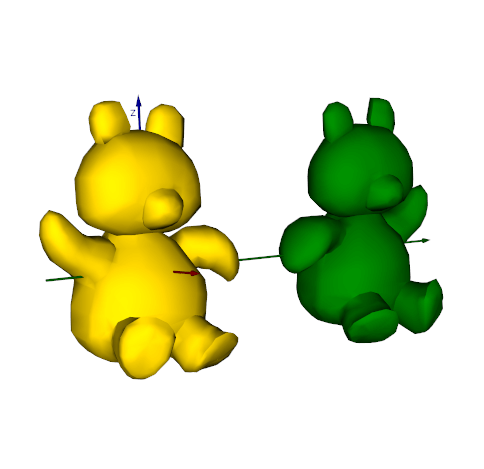
               ![](https://vedo.embl.es/images/basic/mirror.png)
        """
        poly = vtki.vtkPolyData()
        if deep or isinstance(
            deep, dict
        ):  # if a memo object is passed this checks as True
            poly.DeepCopy(self.dataset)
        else:
            poly.ShallowCopy(self.dataset)

        if isinstance(self, vedo.Mesh):
            cloned = vedo.Mesh(poly)
        else:
            cloned = Points(poly)

        cloned.transform = self.transform.clone()

        cloned.copy_properties_from(self)

        cloned.name = str(self.name)
        cloned.filename = str(self.filename)
        cloned.info = dict(self.info)
        cloned.pipeline = utils.OperationNode(
            "clone", parents=[self], shape="diamond", c="#edede9"
        )

        if isinstance(deep, dict):
            deep[id(self)] = cloned

        return cloned

clone(deep=True)

Clone a PointCloud or Mesh object to make an exact copy of it. Alias of copy().

Parameters:

Name Type Description Default
deep bool

if False return a shallow copy of the mesh without copying the points array.

True

Examples:

Source code in vedo/pointcloud/core.py
459
460
461
462
463
464
465
466
467
468
469
470
471
472
473
474
475
476
477
478
479
480
481
482
483
484
485
486
487
488
489
490
491
492
493
494
495
496
497
498
499
500
def clone(self, deep=True) -> Self:
    """
    Clone a `PointCloud` or `Mesh` object to make an exact copy of it.
    Alias of `copy()`.

    Args:
        deep (bool):
            if False return a shallow copy of the mesh without copying the points array.

    Examples:
        - [mirror.py](https://github.com/marcomusy/vedo/tree/master/examples/basic/mirror.py)

           ![](https://vedo.embl.es/images/basic/mirror.png)
    """
    poly = vtki.vtkPolyData()
    if deep or isinstance(
        deep, dict
    ):  # if a memo object is passed this checks as True
        poly.DeepCopy(self.dataset)
    else:
        poly.ShallowCopy(self.dataset)

    if isinstance(self, vedo.Mesh):
        cloned = vedo.Mesh(poly)
    else:
        cloned = Points(poly)

    cloned.transform = self.transform.clone()

    cloned.copy_properties_from(self)

    cloned.name = str(self.name)
    cloned.filename = str(self.filename)
    cloned.info = dict(self.info)
    cloned.pipeline = utils.OperationNode(
        "clone", parents=[self], shape="diamond", c="#edede9"
    )

    if isinstance(deep, dict):
        deep[id(self)] = cloned

    return cloned

copy(deep=True)

Return a copy of the object. Alias of clone().

Source code in vedo/pointcloud/core.py
455
456
457
def copy(self, deep=True) -> Self:
    """Return a copy of the object. Alias of `clone()`."""
    return self.clone(deep=deep)

polydata()

Obsolete. Use property .dataset instead. Returns the underlying vtkPolyData object.

Source code in vedo/pointcloud/core.py
439
440
441
442
443
444
445
446
447
def polydata(self):
    """
    Obsolete. Use property `.dataset` instead.
    Returns the underlying `vtkPolyData` object.
    """
    vedo.logger.warning(
        "Call to .polydata() is obsolete, use property .dataset instead."
    )
    return self.dataset

print()

Print object info.

Source code in vedo/pointcloud/core.py
334
335
336
337
def print(self):
    """Print object info."""
    print(self)
    return self

Point(pos=(0, 0, 0), r=12, c='red', alpha=1.0)

Build a point at position of radius size r, color c and transparency alpha.

Source code in vedo/pointcloud/core.py
35
36
37
def Point(pos=(0, 0, 0), r=12, c="red", alpha=1.0) -> Points:
    """Build a point at position of radius size `r`, color `c` and transparency `alpha`."""
    return Points([[0, 0, 0]], r=r, c=c, alpha=alpha).pos(pos)

analyze

PointAnalyzeMixin

Source code in vedo/pointcloud/analyze.py
  17
  18
  19
  20
  21
  22
  23
  24
  25
  26
  27
  28
  29
  30
  31
  32
  33
  34
  35
  36
  37
  38
  39
  40
  41
  42
  43
  44
  45
  46
  47
  48
  49
  50
  51
  52
  53
  54
  55
  56
  57
  58
  59
  60
  61
  62
  63
  64
  65
  66
  67
  68
  69
  70
  71
  72
  73
  74
  75
  76
  77
  78
  79
  80
  81
  82
  83
  84
  85
  86
  87
  88
  89
  90
  91
  92
  93
  94
  95
  96
  97
  98
  99
 100
 101
 102
 103
 104
 105
 106
 107
 108
 109
 110
 111
 112
 113
 114
 115
 116
 117
 118
 119
 120
 121
 122
 123
 124
 125
 126
 127
 128
 129
 130
 131
 132
 133
 134
 135
 136
 137
 138
 139
 140
 141
 142
 143
 144
 145
 146
 147
 148
 149
 150
 151
 152
 153
 154
 155
 156
 157
 158
 159
 160
 161
 162
 163
 164
 165
 166
 167
 168
 169
 170
 171
 172
 173
 174
 175
 176
 177
 178
 179
 180
 181
 182
 183
 184
 185
 186
 187
 188
 189
 190
 191
 192
 193
 194
 195
 196
 197
 198
 199
 200
 201
 202
 203
 204
 205
 206
 207
 208
 209
 210
 211
 212
 213
 214
 215
 216
 217
 218
 219
 220
 221
 222
 223
 224
 225
 226
 227
 228
 229
 230
 231
 232
 233
 234
 235
 236
 237
 238
 239
 240
 241
 242
 243
 244
 245
 246
 247
 248
 249
 250
 251
 252
 253
 254
 255
 256
 257
 258
 259
 260
 261
 262
 263
 264
 265
 266
 267
 268
 269
 270
 271
 272
 273
 274
 275
 276
 277
 278
 279
 280
 281
 282
 283
 284
 285
 286
 287
 288
 289
 290
 291
 292
 293
 294
 295
 296
 297
 298
 299
 300
 301
 302
 303
 304
 305
 306
 307
 308
 309
 310
 311
 312
 313
 314
 315
 316
 317
 318
 319
 320
 321
 322
 323
 324
 325
 326
 327
 328
 329
 330
 331
 332
 333
 334
 335
 336
 337
 338
 339
 340
 341
 342
 343
 344
 345
 346
 347
 348
 349
 350
 351
 352
 353
 354
 355
 356
 357
 358
 359
 360
 361
 362
 363
 364
 365
 366
 367
 368
 369
 370
 371
 372
 373
 374
 375
 376
 377
 378
 379
 380
 381
 382
 383
 384
 385
 386
 387
 388
 389
 390
 391
 392
 393
 394
 395
 396
 397
 398
 399
 400
 401
 402
 403
 404
 405
 406
 407
 408
 409
 410
 411
 412
 413
 414
 415
 416
 417
 418
 419
 420
 421
 422
 423
 424
 425
 426
 427
 428
 429
 430
 431
 432
 433
 434
 435
 436
 437
 438
 439
 440
 441
 442
 443
 444
 445
 446
 447
 448
 449
 450
 451
 452
 453
 454
 455
 456
 457
 458
 459
 460
 461
 462
 463
 464
 465
 466
 467
 468
 469
 470
 471
 472
 473
 474
 475
 476
 477
 478
 479
 480
 481
 482
 483
 484
 485
 486
 487
 488
 489
 490
 491
 492
 493
 494
 495
 496
 497
 498
 499
 500
 501
 502
 503
 504
 505
 506
 507
 508
 509
 510
 511
 512
 513
 514
 515
 516
 517
 518
 519
 520
 521
 522
 523
 524
 525
 526
 527
 528
 529
 530
 531
 532
 533
 534
 535
 536
 537
 538
 539
 540
 541
 542
 543
 544
 545
 546
 547
 548
 549
 550
 551
 552
 553
 554
 555
 556
 557
 558
 559
 560
 561
 562
 563
 564
 565
 566
 567
 568
 569
 570
 571
 572
 573
 574
 575
 576
 577
 578
 579
 580
 581
 582
 583
 584
 585
 586
 587
 588
 589
 590
 591
 592
 593
 594
 595
 596
 597
 598
 599
 600
 601
 602
 603
 604
 605
 606
 607
 608
 609
 610
 611
 612
 613
 614
 615
 616
 617
 618
 619
 620
 621
 622
 623
 624
 625
 626
 627
 628
 629
 630
 631
 632
 633
 634
 635
 636
 637
 638
 639
 640
 641
 642
 643
 644
 645
 646
 647
 648
 649
 650
 651
 652
 653
 654
 655
 656
 657
 658
 659
 660
 661
 662
 663
 664
 665
 666
 667
 668
 669
 670
 671
 672
 673
 674
 675
 676
 677
 678
 679
 680
 681
 682
 683
 684
 685
 686
 687
 688
 689
 690
 691
 692
 693
 694
 695
 696
 697
 698
 699
 700
 701
 702
 703
 704
 705
 706
 707
 708
 709
 710
 711
 712
 713
 714
 715
 716
 717
 718
 719
 720
 721
 722
 723
 724
 725
 726
 727
 728
 729
 730
 731
 732
 733
 734
 735
 736
 737
 738
 739
 740
 741
 742
 743
 744
 745
 746
 747
 748
 749
 750
 751
 752
 753
 754
 755
 756
 757
 758
 759
 760
 761
 762
 763
 764
 765
 766
 767
 768
 769
 770
 771
 772
 773
 774
 775
 776
 777
 778
 779
 780
 781
 782
 783
 784
 785
 786
 787
 788
 789
 790
 791
 792
 793
 794
 795
 796
 797
 798
 799
 800
 801
 802
 803
 804
 805
 806
 807
 808
 809
 810
 811
 812
 813
 814
 815
 816
 817
 818
 819
 820
 821
 822
 823
 824
 825
 826
 827
 828
 829
 830
 831
 832
 833
 834
 835
 836
 837
 838
 839
 840
 841
 842
 843
 844
 845
 846
 847
 848
 849
 850
 851
 852
 853
 854
 855
 856
 857
 858
 859
 860
 861
 862
 863
 864
 865
 866
 867
 868
 869
 870
 871
 872
 873
 874
 875
 876
 877
 878
 879
 880
 881
 882
 883
 884
 885
 886
 887
 888
 889
 890
 891
 892
 893
 894
 895
 896
 897
 898
 899
 900
 901
 902
 903
 904
 905
 906
 907
 908
 909
 910
 911
 912
 913
 914
 915
 916
 917
 918
 919
 920
 921
 922
 923
 924
 925
 926
 927
 928
 929
 930
 931
 932
 933
 934
 935
 936
 937
 938
 939
 940
 941
 942
 943
 944
 945
 946
 947
 948
 949
 950
 951
 952
 953
 954
 955
 956
 957
 958
 959
 960
 961
 962
 963
 964
 965
 966
 967
 968
 969
 970
 971
 972
 973
 974
 975
 976
 977
 978
 979
 980
 981
 982
 983
 984
 985
 986
 987
 988
 989
 990
 991
 992
 993
 994
 995
 996
 997
 998
 999
1000
1001
1002
1003
1004
1005
1006
1007
1008
1009
1010
1011
1012
1013
1014
1015
1016
1017
1018
1019
1020
1021
1022
1023
1024
1025
1026
1027
1028
1029
1030
1031
1032
1033
1034
1035
1036
1037
1038
1039
1040
1041
1042
1043
1044
1045
1046
1047
1048
1049
1050
1051
1052
1053
1054
1055
1056
1057
1058
1059
1060
1061
1062
1063
1064
1065
1066
1067
1068
1069
1070
1071
1072
1073
1074
1075
1076
1077
1078
1079
1080
1081
1082
1083
1084
1085
1086
1087
1088
1089
1090
1091
1092
1093
1094
1095
1096
1097
1098
1099
1100
1101
1102
1103
1104
1105
1106
1107
1108
1109
1110
1111
1112
1113
1114
1115
1116
1117
1118
1119
1120
1121
1122
1123
1124
1125
1126
1127
1128
1129
1130
1131
1132
1133
1134
1135
1136
1137
1138
1139
1140
1141
1142
1143
1144
1145
1146
1147
1148
1149
1150
1151
1152
1153
1154
1155
1156
1157
1158
1159
1160
1161
1162
1163
1164
1165
1166
1167
1168
1169
1170
1171
1172
1173
1174
1175
1176
1177
1178
1179
1180
1181
1182
1183
1184
1185
1186
1187
1188
1189
1190
1191
1192
1193
1194
1195
1196
1197
1198
1199
1200
1201
1202
1203
1204
1205
1206
1207
1208
1209
1210
1211
1212
1213
1214
1215
1216
1217
1218
1219
1220
1221
1222
1223
1224
1225
1226
1227
1228
1229
1230
1231
1232
1233
1234
1235
1236
1237
1238
1239
1240
1241
1242
1243
1244
1245
1246
1247
1248
1249
1250
1251
1252
1253
1254
1255
1256
1257
1258
1259
1260
1261
1262
1263
1264
1265
1266
1267
1268
1269
1270
1271
1272
1273
1274
1275
1276
1277
1278
1279
class PointAnalyzeMixin:
    def compute_normals_with_pca(
        self, n=20, orientation_point=None, invert=False
    ) -> Self:
        """
        Generate point normals using PCA (principal component analysis).
        This algorithm estimates a local tangent plane around each sample point p
        by considering a small neighborhood of points around p, and fitting a plane
        to the neighborhood (via PCA).

        Args:
            n (int):
                neighborhood size to calculate the normal
            orientation_point (list):
                adjust the +/- sign of the normals so that
                the normals all point towards a specified point. If None, perform a traversal
                of the point cloud and flip neighboring normals so that they are mutually consistent.
            invert (bool):
                flip all normals
        """
        if n < 1:
            raise ValueError("compute_normals_with_pca(): n must be >= 1")

        poly = self.dataset
        pcan = vtki.new("PCANormalEstimation")
        pcan.SetInputData(poly)
        pcan.SetSampleSize(n)

        if orientation_point is not None:
            pcan.SetNormalOrientationToPoint()
            pcan.SetOrientationPoint(orientation_point)
        else:
            pcan.SetNormalOrientationToGraphTraversal()

        if invert:
            pcan.FlipNormalsOn()
        pcan.Update()

        varr = pcan.GetOutput().GetPointData().GetNormals()
        varr.SetName("Normals")
        self.dataset.GetPointData().SetNormals(varr)
        self.dataset.GetPointData().Modified()
        return self

    def compute_acoplanarity(self, n=25, radius=None, on="points") -> Self:
        """
        Compute acoplanarity which is a measure of how much a local region of the mesh
        differs from a plane.

        The information is stored in a `pointdata` or `celldata` array with name 'Acoplanarity'.

        Either `n` (number of neighbour points) or `radius` (radius of local search) can be specified.
        If a radius value is given and not enough points fall inside it, then a -1 is stored.

        Examples:
            ```python
            from vedo import *
            msh = ParametricShape('RandomHills')
            msh.compute_acoplanarity(radius=0.1, on='cells')
            msh.cmap("coolwarm", on='cells').add_scalarbar()
            msh.show(axes=1).close()
            ```
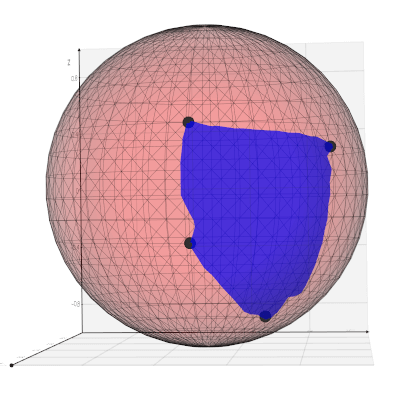
            ![](https://vedo.embl.es/images/feats/acoplanarity.jpg)
        """
        if not n and radius is None:
            raise ValueError("compute_acoplanarity(): set either n or radius")

        acoplanarities = []
        if "point" in on:
            pts = self.coordinates
            search_obj = self
        elif "cell" in on:
            pts = self.cell_centers().coordinates
            search_obj = vedo.Points(pts)
        else:
            raise ValueError(
                f"In compute_acoplanarity() set on to either 'cells' or 'points', not {on}"
            )

        for p in utils.progressbar(pts, delay=5, width=15, title=f"{on} acoplanarity"):
            if n:
                data = search_obj.closest_point(p, n=n)
                npts = len(data)
            elif radius is not None:
                data = search_obj.closest_point(p, radius=radius)
                npts = len(data)

            try:
                data = np.asarray(data)
                center = data.mean(axis=0)
                res = np.linalg.svd(data - center)
                acoplanarities.append(res[1][2] / npts)
            except (np.linalg.LinAlgError, ValueError, TypeError, IndexError):
                acoplanarities.append(-1.0)

        if "point" in on:
            self.pointdata["Acoplanarity"] = np.array(acoplanarities, dtype=float)
        else:
            self.celldata["Acoplanarity"] = np.array(acoplanarities, dtype=float)
        return self

    def distance_to(
        self, pcloud, signed=False, invert=False, name="Distance"
    ) -> np.ndarray:
        """
        Computes the distance from one point cloud or mesh to another point cloud or mesh.
        This new `pointdata` array is saved with default name "Distance".

        Keywords `signed` and `invert` are used to compute signed distance,
        but the mesh in that case must have polygonal faces (not a simple point cloud),
        and normals must also be computed.

        Examples:
            - [distance2mesh.py](https://github.com/marcomusy/vedo/tree/master/examples/basic/distance2mesh.py)

                ![](https://vedo.embl.es/images/basic/distance2mesh.png)
        """
        if pcloud.dataset.GetNumberOfPolys():
            poly1 = self.dataset
            poly2 = pcloud.dataset
            df = vtki.new("DistancePolyDataFilter")
            df.ComputeSecondDistanceOff()
            df.SetInputData(0, poly1)
            df.SetInputData(1, poly2)
            df.SetSignedDistance(signed)
            df.SetNegateDistance(invert)
            df.Update()
            scals = df.GetOutput().GetPointData().GetScalars()
            dists = utils.vtk2numpy(scals)

        else:  # has no polygons
            if signed:
                vedo.logger.warning(
                    "distance_to() called with signed=True but input object has no polygons"
                )

            if not pcloud.point_locator:
                pcloud.point_locator = vtki.new("PointLocator")
                pcloud.point_locator.SetDataSet(pcloud.dataset)
                pcloud.point_locator.BuildLocator()

            ids = []
            ps1 = self.coordinates
            ps2 = pcloud.coordinates
            for p in ps1:
                pid = pcloud.point_locator.FindClosestPoint(p)
                ids.append(pid)

            deltas = ps2[ids] - ps1
            dists = np.linalg.norm(deltas, axis=1).astype(np.float32)
            scals = utils.numpy2vtk(dists)

        scals.SetName(name)
        self.dataset.GetPointData().AddArray(scals)
        self.dataset.GetPointData().SetActiveScalars(scals.GetName())
        rng = scals.GetRange()
        self.mapper.SetScalarRange(rng[0], rng[1])
        self.mapper.ScalarVisibilityOn()

        self.pipeline = utils.OperationNode(
            "distance_to",
            parents=[self, pcloud],
            shape="cylinder",
            comment=f"#pts {self.dataset.GetNumberOfPoints()}",
        )
        return dists

    def clean(self) -> Self:
        """Clean pointcloud or mesh by removing coincident points."""
        cpd = vtki.new("CleanPolyData")
        cpd.PointMergingOn()
        cpd.ConvertLinesToPointsOff()
        cpd.ConvertPolysToLinesOff()
        cpd.ConvertStripsToPolysOff()
        cpd.SetInputData(self.dataset)
        cpd.Update()
        self._update(cpd.GetOutput())
        self.pipeline = utils.OperationNode(
            "clean", parents=[self], comment=f"#pts {self.dataset.GetNumberOfPoints()}"
        )
        return self

    def subsample(self, fraction: float, absolute=False) -> Self:
        """
        Subsample a point cloud by requiring that the points
        or vertices are far apart at least by the specified fraction of the object size.
        If a Mesh is passed the polygonal faces are not removed
        but holes can appear as their vertices are removed.

        Examples:
            - [moving_least_squares1D.py](https://github.com/marcomusy/vedo/tree/master/examples/advanced/moving_least_squares1D.py)

                ![](https://vedo.embl.es/images/advanced/moving_least_squares1D.png)

            - [recosurface.py](https://github.com/marcomusy/vedo/tree/master/examples/advanced/recosurface.py)

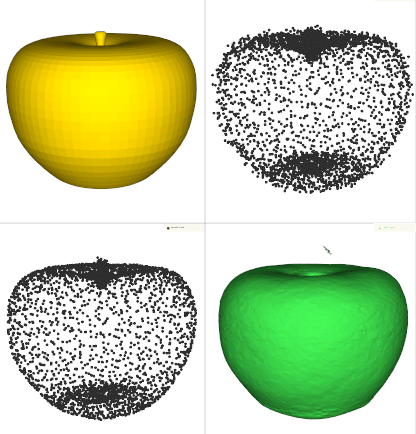
                ![](https://vedo.embl.es/images/advanced/recosurface.png)
        """
        if not absolute:
            if fraction > 1:
                vedo.logger.warning(
                    f"subsample(fraction=...), fraction must be < 1, but is {fraction}"
                )
            if fraction <= 0:
                return self

        cpd = vtki.new("CleanPolyData")
        cpd.PointMergingOn()
        cpd.ConvertLinesToPointsOn()
        cpd.ConvertPolysToLinesOn()
        cpd.ConvertStripsToPolysOn()
        cpd.SetInputData(self.dataset)
        if absolute:
            cpd.SetTolerance(fraction / self.diagonal_size())
            # cpd.SetToleranceIsAbsolute(absolute)
        else:
            cpd.SetTolerance(fraction)
        cpd.Update()

        ps = 2
        if self.properties.GetRepresentation() == 0:
            ps = self.properties.GetPointSize()

        self._update(cpd.GetOutput())
        self.ps(ps)

        self.pipeline = utils.OperationNode(
            "subsample",
            parents=[self],
            comment=f"#pts {self.dataset.GetNumberOfPoints()}",
        )
        return self

    def threshold(self, scalars: str, above=None, below=None, on="points") -> Self:
        """
        Extracts cells where scalar value satisfies threshold criterion.

        Args:
            scalars (str):
                name of the scalars array.
            above (float):
                minimum value of the scalar
            below (float):
                maximum value of the scalar
            on (str):
                if 'cells' assume array of scalars refers to cell data.

        Examples:
            - [mesh_threshold.py](https://github.com/marcomusy/vedo/tree/master/examples/basic/mesh_threshold.py)
        """
        if above is None and below is None:
            raise ValueError("threshold(): specify at least one of above or below")
        if above is not None and below is not None and above > below:
            raise ValueError("threshold(): above cannot be greater than below")

        thres = vtki.new("Threshold")
        thres.SetInputData(self.dataset)

        if on.startswith("c"):
            asso = vtki.vtkDataObject.FIELD_ASSOCIATION_CELLS
        else:
            asso = vtki.vtkDataObject.FIELD_ASSOCIATION_POINTS

        thres.SetInputArrayToProcess(0, 0, 0, asso, scalars)

        if above is None and below is not None:
            try:  # vtk 9.2
                thres.ThresholdByLower(below)
            except AttributeError:  # vtk 9.3
                thres.SetUpperThreshold(below)

        elif below is None and above is not None:
            try:
                thres.ThresholdByUpper(above)
            except AttributeError:
                thres.SetLowerThreshold(above)
        else:
            try:
                thres.ThresholdBetween(above, below)
            except AttributeError:
                thres.SetUpperThreshold(below)
                thres.SetLowerThreshold(above)

        thres.Update()

        gf = vtki.new("GeometryFilter")
        gf.SetInputData(thres.GetOutput())
        gf.Update()
        self._update(gf.GetOutput())
        self.pipeline = utils.OperationNode("threshold", parents=[self])
        return self

    def quantize(self, value: float) -> Self:
        """
        The user should input a value and all {x,y,z} coordinates
        will be quantized to that absolute grain size.
        """
        if value <= 0:
            raise ValueError("quantize(): value must be > 0")

        qp = vtki.new("QuantizePolyDataPoints")
        qp.SetInputData(self.dataset)
        qp.SetQFactor(value)
        qp.Update()
        self._update(qp.GetOutput())
        self.pipeline = utils.OperationNode("quantize", parents=[self])
        return self

    @property
    def vertex_normals(self) -> np.ndarray:
        """
        Retrieve vertex normals as a numpy array. Same as `point_normals`.
        If needed, normals are computed via `compute_normals_with_pca()`.
        Check out also `compute_normals()` and `compute_normals_with_pca()`.
        """
        vtknormals = self.dataset.GetPointData().GetNormals()
        if vtknormals is None:
            self.compute_normals_with_pca()
            vtknormals = self.dataset.GetPointData().GetNormals()
        return utils.vtk2numpy(vtknormals)

    @property
    def point_normals(self) -> np.ndarray:
        """
        Retrieve vertex normals as a numpy array. Same as `vertex_normals`.
        Check out also `compute_normals()` and `compute_normals_with_pca()`.
        """
        return self.vertex_normals

    def closest_point(
        self, pt, n=1, radius=None, return_point_id=False, return_cell_id=False
    ) -> list[int] | int | np.ndarray:
        """
        Find the closest point(s) on a mesh given from the input point `pt`.

        Args:
            n (int):
                if greater than 1, return a list of n ordered closest points
            radius (float):
                if given, get all points within that radius. Then n is ignored.
            return_point_id (bool):
                return point ID instead of coordinates
            return_cell_id (bool):
                return cell ID in which the closest point sits

        Examples:
            - [align1.py](https://github.com/marcomusy/vedo/tree/master/examples/basic/align1.py)
            - [fitplanes.py](https://github.com/marcomusy/vedo/tree/master/examples/basic/fitplanes.py)
            - [quadratic_morphing.py](https://github.com/marcomusy/vedo/tree/master/examples/advanced/quadratic_morphing.py)

        .. note::
            The appropriate tree search locator is built on the fly and cached for speed.

            If you want to reset it use `mymesh.point_locator=None`
            and / or `mymesh.cell_locator=None`.
        """
        if len(pt) != 3:
            pt = [pt[0], pt[1], 0]

        # NB: every time the mesh moves or is warped the locators are set to None
        if ((n > 1 or radius) or (n == 1 and return_point_id)) and not return_cell_id:
            poly = None
            if not self.point_locator:
                poly = self.dataset
                self.point_locator = vtki.new("StaticPointLocator")
                self.point_locator.SetDataSet(poly)
                self.point_locator.BuildLocator()

            ##########
            if radius:
                vtklist = vtki.vtkIdList()
                self.point_locator.FindPointsWithinRadius(radius, pt, vtklist)
            elif n > 1:
                vtklist = vtki.vtkIdList()
                self.point_locator.FindClosestNPoints(n, pt, vtklist)
            else:  # n==1 hence return_point_id==True
                ########
                return self.point_locator.FindClosestPoint(pt)
                ########

            if return_point_id:
                ########
                return utils.vtk2numpy(vtklist)
                ########

            if not poly:
                poly = self.dataset
            trgp = []
            for i in range(vtklist.GetNumberOfIds()):
                trgp_ = [0, 0, 0]
                vi = vtklist.GetId(i)
                poly.GetPoints().GetPoint(vi, trgp_)
                trgp.append(trgp_)
            ########
            return np.array(trgp)
            ########

        else:
            if not self.cell_locator:
                poly = self.dataset

                # As per Miquel example with limbs the vtkStaticCellLocator doesnt work !!
                # https://discourse.vtk.org/t/vtkstaticcelllocator-problem-vtk9-0-3/7854/4
                if vedo.vtk_version[0] >= 9 and vedo.vtk_version[1] > 0:
                    self.cell_locator = vtki.new("StaticCellLocator")
                else:
                    self.cell_locator = vtki.new("CellLocator")

                self.cell_locator.SetDataSet(poly)
                self.cell_locator.BuildLocator()

            if radius is not None:
                vedo.logger.warning(
                    "closest_point() with radius is not implemented for cells."
                )

            if n != 1:
                vedo.logger.warning(
                    "closest_point() with n>1 is not implemented for cells."
                )

            trgp = [0, 0, 0]
            cid = vtki.mutable(0)
            dist2 = vtki.mutable(0)
            subid = vtki.mutable(0)
            self.cell_locator.FindClosestPoint(pt, trgp, cid, subid, dist2)

            if return_cell_id:
                return int(cid)

            return np.array(trgp)

    def auto_distance(self) -> np.ndarray:
        """
        Calculate the distance to the closest point in the same cloud of points.
        The output is stored in a new pointdata array called "AutoDistance",
        and it is also returned by the function.
        """
        points = self.coordinates
        if len(points) < 2:
            dists = np.zeros(len(points), dtype=np.float32)
            self.pointdata["AutoDistance"] = dists
            return dists

        if not self.point_locator:
            self.point_locator = vtki.new("StaticPointLocator")
            self.point_locator.SetDataSet(self.dataset)
            self.point_locator.BuildLocator()
        qs = []
        vtklist = vtki.vtkIdList()
        vtkpoints = self.dataset.GetPoints()
        for p in points:
            self.point_locator.FindClosestNPoints(2, p, vtklist)
            q = [0, 0, 0]
            pid = vtklist.GetId(1)
            vtkpoints.GetPoint(pid, q)
            qs.append(q)
        dists = np.linalg.norm(points - np.array(qs), axis=1)
        self.pointdata["AutoDistance"] = dists
        return dists

    def hausdorff_distance(self, points) -> float:
        """
        Compute the Hausdorff distance to the input point set.
        Returns a single `float`.

        Examples:
            ```python
            from vedo import *
            t = np.linspace(0, 2*np.pi, 100)
            x = 4/3 * sin(t)**3
            y = cos(t) - cos(2*t)/3 - cos(3*t)/6 - cos(4*t)/12
            pol1 = Line(np.c_[x,y], closed=True).triangulate()
            pol2 = Polygon(nsides=5).pos(2,2)
            d12 = pol1.distance_to(pol2)
            d21 = pol2.distance_to(pol1)
            pol1.lw(0).cmap("viridis")
            pol2.lw(0).cmap("viridis")
            print("distance d12, d21 :", min(d12), min(d21))
            print("hausdorff distance:", pol1.hausdorff_distance(pol2))
            print("chamfer distance  :", pol1.chamfer_distance(pol2))
            show(pol1, pol2, axes=1)
            ```
            ![](https://vedo.embl.es/images/feats/heart.png)
        """
        hp = vtki.new("HausdorffDistancePointSetFilter")
        hp.SetInputData(0, self.dataset)
        hp.SetInputData(1, points.dataset)
        hp.SetTargetDistanceMethodToPointToCell()
        hp.Update()
        return hp.GetHausdorffDistance()

    def chamfer_distance(self, pcloud) -> float:
        """
        Compute the Chamfer distance to the input point set.

        Examples:
            ```python
            from vedo import *
            cloud1 = np.random.randn(1000, 3)
            cloud2 = np.random.randn(1000, 3) + [1, 2, 3]
            c1 = Points(cloud1, r=5, c="red")
            c2 = Points(cloud2, r=5, c="green")
            d = c1.chamfer_distance(c2)
            show(f"Chamfer distance = {d}", c1, c2, axes=1).close()
            ```
        """
        # Definition of Chamfer distance may vary, here we use the average
        if not pcloud.point_locator:
            pcloud.point_locator = vtki.new("PointLocator")
            pcloud.point_locator.SetDataSet(pcloud.dataset)
            pcloud.point_locator.BuildLocator()
        if not self.point_locator:
            self.point_locator = vtki.new("PointLocator")
            self.point_locator.SetDataSet(self.dataset)
            self.point_locator.BuildLocator()

        ps1 = self.coordinates
        ps2 = pcloud.coordinates
        if len(ps1) == 0 or len(ps2) == 0:
            vedo.logger.warning("chamfer_distance(): one of the inputs has no points")
            return np.nan

        ids12 = []
        for p in ps1:
            pid12 = pcloud.point_locator.FindClosestPoint(p)
            ids12.append(pid12)
        deltav = ps2[ids12] - ps1
        da = np.mean(np.linalg.norm(deltav, axis=1))

        ids21 = []
        for p in ps2:
            pid21 = self.point_locator.FindClosestPoint(p)
            ids21.append(pid21)
        deltav = ps1[ids21] - ps2
        db = np.mean(np.linalg.norm(deltav, axis=1))
        return (da + db) / 2

    def remove_outliers(self, radius: float, neighbors=5) -> Self:
        """
        Remove outliers from a cloud of points within the specified `radius` search.

        Args:
            radius (float):
                Specify the local search radius.
            neighbors (int):
                Specify the number of neighbors that a point must have,
                within the specified radius, for the point to not be considered isolated.

        Examples:
            - [clustering.py](https://github.com/marcomusy/vedo/tree/master/examples/basic/clustering.py)

                ![](https://vedo.embl.es/images/basic/clustering.png)
        """
        removal = vtki.new("RadiusOutlierRemoval")
        removal.SetInputData(self.dataset)
        removal.SetRadius(radius)
        removal.SetNumberOfNeighbors(neighbors)
        removal.GenerateOutliersOff()
        removal.Update()
        inputobj = removal.GetOutput()
        if inputobj.GetNumberOfCells() == 0:
            carr = vtki.vtkCellArray()
            for i in range(inputobj.GetNumberOfPoints()):
                carr.InsertNextCell(1)
                carr.InsertCellPoint(i)
            inputobj.SetVerts(carr)
        self._update(removal.GetOutput())
        self.pipeline = utils.OperationNode("remove_outliers", parents=[self])
        return self

    def relax_point_positions(
        self,
        n=10,
        iters=10,
        sub_iters=10,
        packing_factor=1,
        max_step=0,
        constraints=None,
    ) -> Self:
        """
        Smooth mesh or points with a
        [Laplacian algorithm](https://vtk.org/doc/nightly/html/classvtkPointSmoothingFilter.html)
        variant. This modifies the coordinates of the input points by adjusting their positions
        to create a smooth distribution (and thereby form a pleasing packing of the points).
        Smoothing is performed by considering the effects of neighboring points on one another
        it uses a cubic cutoff function to produce repulsive forces between close points
        and attractive forces that are a little further away.

        In general, the larger the neighborhood size, the greater the reduction in high frequency
        information. The memory and computational requirements of the algorithm may also
        significantly increase.

        The algorithm incrementally adjusts the point positions through an iterative process.
        Basically points are moved due to the influence of neighboring points.

        As points move, both the local connectivity and data attributes associated with each point
        must be updated. Rather than performing these expensive operations after every iteration,
        a number of sub-iterations can be specified. If so, then the neighborhood and attribute
        value updates occur only every sub iteration, which can improve performance significantly.

        Args:
            n (int):
                neighborhood size to calculate the Laplacian.
            iters (int):
                number of iterations.
            sub_iters (int):
                number of sub-iterations, i.e. the number of times the neighborhood and attribute
                value updates occur during each iteration.
            packing_factor (float):
                adjust convergence speed.
            max_step (float):
                Specify the maximum smoothing step size for each smoothing iteration.
                This limits the the distance over which a point can move in each iteration.
                As in all iterative methods, the stability of the process is sensitive to this parameter.
                In general, small step size and large numbers of iterations are more stable than a larger
                step size and a smaller numbers of iterations.
            constraints (dict):
                dictionary of constraints.
                Point constraints are used to prevent points from moving,
                or to move only on a plane. This can prevent shrinking or growing point clouds.
                If enabled, a local topological analysis is performed to determine whether a point
                should be marked as fixed" i.e., never moves, or the point only moves on a plane,
                or the point can move freely.
                If all points in the neighborhood surrounding a point are in the cone defined by
                `fixed_angle`, then the point is classified as fixed.
                If all points in the neighborhood surrounding a point are in the cone defined by
                `boundary_angle`, then the point is classified as lying on a plane.
                Angles are expressed in degrees.

        Examples:
            ```py
            import numpy as np
            from vedo import Points, show
            from vedo.pyplot import histogram

            vpts1 = Points(np.random.rand(10_000, 3))
            dists = vpts1.auto_distance()
            h1 = histogram(dists, xlim=(0,0.08)).clone2d()

            vpts2 = vpts1.clone().relax_point_positions(n=100, iters=20, sub_iters=10)
            dists = vpts2.auto_distance()
            h2 = histogram(dists, xlim=(0,0.08)).clone2d()

            show([[vpts1, h1], [vpts2, h2]], N=2).close()
            ```
        """
        smooth = vtki.new("PointSmoothingFilter")
        smooth.SetInputData(self.dataset)
        smooth.SetSmoothingModeToUniform()
        smooth.SetNumberOfIterations(iters)
        smooth.SetNumberOfSubIterations(sub_iters)
        smooth.SetPackingFactor(packing_factor)
        if self.point_locator:
            smooth.SetLocator(self.point_locator)
        if not max_step:
            max_step = self.diagonal_size() / 100
        smooth.SetMaximumStepSize(max_step)
        smooth.SetNeighborhoodSize(n)
        if constraints:
            fixed_angle = constraints.get("fixed_angle", 45)
            boundary_angle = constraints.get("boundary_angle", 110)
            smooth.EnableConstraintsOn()
            smooth.SetFixedAngle(fixed_angle)
            smooth.SetBoundaryAngle(boundary_angle)
            smooth.GenerateConstraintScalarsOn()
            smooth.GenerateConstraintNormalsOn()
        smooth.Update()
        self._update(smooth.GetOutput())
        self.metadata["PackingRadius"] = smooth.GetPackingRadius()
        self.pipeline = utils.OperationNode("relax_point_positions", parents=[self])
        return self

    def smooth_mls_1d(self, f=0.2, radius=None, n=0) -> Self:
        """
        Smooth mesh or points with a `Moving Least Squares` variant.
        The point data array "Variances" will contain the residue calculated for each point.

        Args:
            f (float):
                smoothing factor - typical range is [0,2].
            radius (float):
                radius search in absolute units.
                If set then `f` is ignored.
            n (int):
                number of neighbours to be used for the fit.
                If set then `f` and `radius` are ignored.

        Examples:
            - [moving_least_squares1D.py](https://github.com/marcomusy/vedo/tree/master/examples/advanced/moving_least_squares1D.py)
            - [skeletonize.py](https://github.com/marcomusy/vedo/tree/master/examples/advanced/skeletonize.py)

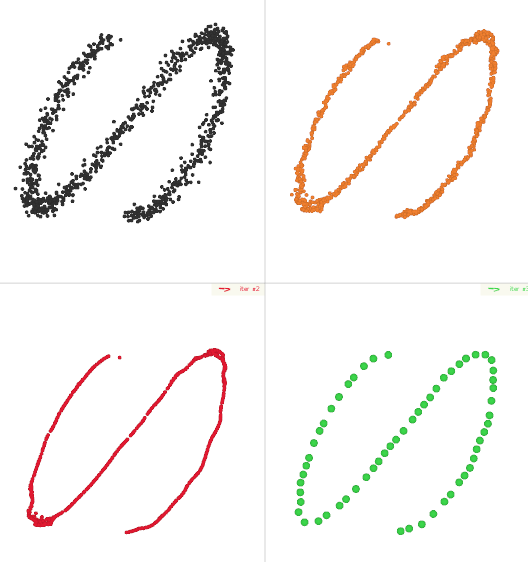
            ![](https://vedo.embl.es/images/advanced/moving_least_squares1D.png)
        """
        coords = self.coordinates
        ncoords = len(coords)

        if n:
            Ncp = n
        elif radius:
            Ncp = 1
        else:
            Ncp = int(ncoords * f / 10)
            if Ncp < 5:
                vedo.logger.warning(f"Please choose a fraction higher than {f}")
                Ncp = 5

        variances, newline = [], []
        for p in coords:
            points = self.closest_point(p, n=Ncp, radius=radius)
            if len(points) < 4:
                variances.append(0.0)
                newline.append(p)
                continue

            try:
                points = np.asarray(points)
                pointsmean = points.mean(axis=0)  # plane center
                _, dd, vv = np.linalg.svd(points - pointsmean)
                newp = np.dot(p - pointsmean, vv[0]) * vv[0] + pointsmean
                variances.append(dd[1] + dd[2])
                newline.append(newp)
            except np.linalg.LinAlgError:
                variances.append(0.0)
                newline.append(p)

        self.pointdata["Variances"] = np.array(variances).astype(np.float32)
        self.coordinates = newline
        self.pipeline = utils.OperationNode("smooth_mls_1d", parents=[self])
        return self

    def smooth_mls_2d(self, f=0.2, radius=None, n=0) -> Self:
        """
        Smooth mesh or points with a `Moving Least Squares` algorithm variant.

        The `mesh.pointdata['MLSVariance']` array will contain the residue calculated for each point.
        When a radius is specified, points that are isolated will not be moved and will get
        a 0 entry in array `mesh.pointdata['MLSValidPoint']`.

        Args:
            f (float):
                smoothing factor - typical range is [0, 2].
            radius (float | array):
                radius search in absolute units. Can be single value (float) or sequence
                for adaptive smoothing. If set then `f` is ignored.
            n (int):
                number of neighbours to be used for the fit.
                If set then `f` and `radius` are ignored.

        Examples:
            - [moving_least_squares2D.py](https://github.com/marcomusy/vedo/tree/master/examples/advanced/moving_least_squares2D.py)
            - [recosurface.py](https://github.com/marcomusy/vedo/tree/master/examples/advanced/recosurface.py)

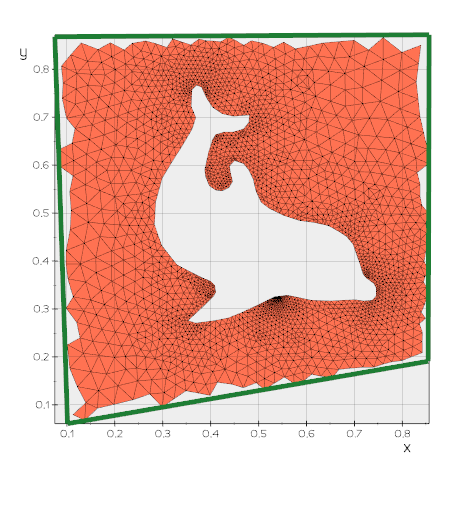
                ![](https://vedo.embl.es/images/advanced/recosurface.png)
        """
        coords = self.coordinates
        ncoords = len(coords)

        if n:
            Ncp = n
            radius = None
        elif radius is not None:
            Ncp = 1
        else:
            Ncp = int(ncoords * f / 100)
            if Ncp < 4:
                vedo.logger.error(f"please choose a f-value higher than {f}")
                Ncp = 4

        variances, newpts, valid = [], [], []
        radius_is_sequence = utils.is_sequence(radius)
        if radius_is_sequence and len(radius) != ncoords:
            raise ValueError("smooth_mls_2d(): radius sequence length must match number of points")

        pb = None
        if ncoords > 10000:
            pb = utils.ProgressBar(0, ncoords, delay=3)

        for i, p in enumerate(coords):
            if pb:
                pb.print("smooth_mls_2d working ...")

            # if a radius was provided for each point
            if radius_is_sequence:
                pts = self.closest_point(p, n=Ncp, radius=radius[i])
            else:
                pts = self.closest_point(p, n=Ncp, radius=radius)

            if len(pts) > 3:
                try:
                    pts = np.asarray(pts)
                    ptsmean = pts.mean(axis=0)  # plane center
                    _, dd, vv = np.linalg.svd(pts - ptsmean)
                    cv = np.cross(vv[0], vv[1])
                    cv2 = np.dot(cv, cv)
                    if cv2 == 0:
                        raise np.linalg.LinAlgError
                    t = (np.dot(cv, ptsmean) - np.dot(cv, p)) / cv2
                    newpts.append(p + cv * t)
                    variances.append(dd[2])
                    if radius is not None:
                        valid.append(1)
                except np.linalg.LinAlgError:
                    newpts.append(p)
                    variances.append(0)
                    if radius is not None:
                        valid.append(0)
            else:
                newpts.append(p)
                variances.append(0)
                if radius is not None:
                    valid.append(0)

        if radius is not None:
            self.pointdata["MLSValidPoint"] = np.array(valid).astype(np.uint8)
        self.pointdata["MLSVariance"] = np.array(variances).astype(np.float32)

        self.coordinates = newpts

        self.pipeline = utils.OperationNode("smooth_mls_2d", parents=[self])
        return self

    def smooth_lloyd_2d(self, iterations=2, bounds=None, options="Qbb Qc Qx") -> Self:
        """
        Lloyd relaxation of a 2D pointcloud.

        Args:
            iterations (int):
                number of iterations.
            bounds (list):
                bounding box of the domain.
            options (str):
                options for the Qhull algorithm.
        """
        # Credits: https://hatarilabs.com/ih-en/
        # tutorial-to-create-a-geospatial-voronoi-sh-mesh-with-python-scipy-and-geopandas
        from scipy.spatial import QhullError
        from scipy.spatial import Voronoi as scipy_voronoi

        def _constrain_points(points):
            # Update any points that have drifted beyond the boundaries of this space
            if bounds is not None:
                for point in points:
                    if point[0] < bounds[0]:
                        point[0] = bounds[0]
                    if point[0] > bounds[1]:
                        point[0] = bounds[1]
                    if point[1] < bounds[2]:
                        point[1] = bounds[2]
                    if point[1] > bounds[3]:
                        point[1] = bounds[3]
            return points

        def _find_centroid(vertices):
            # The equation for the method used here to find the centroid of a
            # 2D polygon is given here: https://en.wikipedia.org/wiki/Centroid#Of_a_polygon
            area = 0
            centroid_x = 0
            centroid_y = 0
            for i in range(len(vertices) - 1):
                step = (vertices[i, 0] * vertices[i + 1, 1]) - (
                    vertices[i + 1, 0] * vertices[i, 1]
                )
                centroid_x += (vertices[i, 0] + vertices[i + 1, 0]) * step
                centroid_y += (vertices[i, 1] + vertices[i + 1, 1]) * step
                area += step
            if area:
                centroid_x = (1.0 / (3.0 * area)) * centroid_x
                centroid_y = (1.0 / (3.0 * area)) * centroid_y
            else:
                centroid_x, centroid_y = np.mean(vertices[:-1], axis=0)
            # prevent centroids from escaping bounding box
            return _constrain_points([[centroid_x, centroid_y]])[0]

        def _relax(voron):
            # Moves each point to the centroid of its cell in the voronoi
            # map to "relax" the points (i.e. jitter the points so as
            # to spread them out within the space).
            centroids = []
            for i, idx in enumerate(voron.point_region):
                # the region is a series of indices into voronoi.vertices
                # remove point at infinity, designated by index -1
                region = [i for i in voron.regions[idx] if i != -1]
                if len(region) < 3:
                    centroids.append(voron.points[i])
                    continue
                # enclose the polygon
                region = region + [region[0]]
                verts = voron.vertices[region]
                # find the centroid of those vertices
                centroids.append(_find_centroid(verts))
            return _constrain_points(centroids)

        if bounds is None:
            bounds = self.bounds()

        pts = self.vertices[:, (0, 1)]
        for i in range(iterations):
            try:
                vor = scipy_voronoi(pts, qhull_options=options)
            except QhullError:
                vedo.logger.warning("smooth_lloyd_2d(): Voronoi construction failed")
                break
            _constrain_points(vor.vertices)
            pts = _relax(vor)
        out = vedo.Points(pts)
        out.name = "MeshSmoothLloyd2D"
        out.pipeline = utils.OperationNode("smooth_lloyd", parents=[self])
        return out

    def compute_clustering(self, radius: float) -> Self:
        """
        Cluster points in space. The `radius` is the radius of local search.

        An array named "ClusterId" is added to `pointdata`.

        Examples:
            - [clustering.py](https://github.com/marcomusy/vedo/blob/master/examples/basic/clustering.py)

                ![](https://vedo.embl.es/images/basic/clustering.png)
        """
        cluster = vtki.new("EuclideanClusterExtraction")
        cluster.SetInputData(self.dataset)
        cluster.SetExtractionModeToAllClusters()
        cluster.SetRadius(radius)
        cluster.ColorClustersOn()
        cluster.Update()
        idsarr = cluster.GetOutput().GetPointData().GetArray("ClusterId")
        self.dataset.GetPointData().AddArray(idsarr)
        self.pipeline = utils.OperationNode(
            "compute_clustering", parents=[self], comment=f"radius = {radius}"
        )
        return self

    def compute_connections(
        self, radius, mode=0, regions=(), vrange=(0, 1), seeds=(), angle=0.0
    ) -> Self:
        """
        Extracts and/or segments points from a point cloud based on geometric distance measures
        (e.g., proximity, normal alignments, etc.) and optional measures such as scalar range.
        The default operation is to segment the points into "connected" regions where the connection
        is determined by an appropriate distance measure. Each region is given a region id.

        Optionally, the filter can output the largest connected region of points; a particular region
        (via id specification); those regions that are seeded using a list of input point ids;
        or the region of points closest to a specified position.

        The key parameter of this filter is the radius defining a sphere around each point which defines
        a local neighborhood: any other points in the local neighborhood are assumed connected to the point.
        Note that the radius is defined in absolute terms.

        Other parameters are used to further qualify what it means to be a neighboring point.
        For example, scalar range and/or point normals can be used to further constrain the neighborhood.
        Also the extraction mode defines how the filter operates.
        By default, all regions are extracted but it is possible to extract particular regions;
        the region closest to a seed point; seeded regions; or the largest region found while processing.
        By default, all regions are extracted.

        On output, all points are labeled with a region number.
        However note that the number of input and output points may not be the same:
        if not extracting all regions then the output size may be less than the input size.

        Args:
            radius (float):
                variable specifying a local sphere used to define local point neighborhood
            mode (int):
                - 0,  Extract all regions
                - 1,  Extract point seeded regions
                - 2,  Extract largest region
                - 3,  Test specified regions
                - 4,  Extract all regions with scalar connectivity
                - 5,  Extract point seeded regions
            regions (list):
                a list of non-negative regions id to extract
            vrange (list):
                scalar range to use to extract points based on scalar connectivity
            seeds (list):
                a list of non-negative point seed ids
            angle (list):
                points are connected if the angle between their normals is
                within this angle threshold (expressed in degrees).
        """
        # https://vtk.org/doc/nightly/html/classvtkConnectedPointsFilter.html
        cpf = vtki.new("ConnectedPointsFilter")
        cpf.SetInputData(self.dataset)
        cpf.SetRadius(radius)
        if mode == 0:  # Extract all regions
            cpf.SetExtractionModeToAllRegions()

        elif mode == 1:  # Extract point seeded regions
            cpf.SetExtractionModeToPointSeededRegions()
            for s in seeds:
                cpf.AddSeed(s)

        elif mode == 2:  # Test largest region
            cpf.SetExtractionModeToLargestRegion()

        elif mode == 3:  # Test specified regions
            cpf.SetExtractionModeToSpecifiedRegions()
            for r in regions:
                cpf.AddSpecifiedRegion(r)

        elif mode == 4:  # Extract all regions with scalar connectivity
            cpf.SetExtractionModeToAllRegions()
            cpf.ScalarConnectivityOn()
            cpf.SetScalarRange(vrange[0], vrange[1])

        elif mode == 5:  # Extract point seeded regions
            cpf.SetExtractionModeToPointSeededRegions()
            for s in seeds:
                cpf.AddSeed(s)
            cpf.ScalarConnectivityOn()
            cpf.SetScalarRange(vrange[0], vrange[1])
            cpf.AlignedNormalsOn()
            cpf.SetNormalAngle(angle)

        else:
            raise ValueError(f"compute_connections(): unknown mode {mode}")

        cpf.Update()
        self._update(cpf.GetOutput(), reset_locators=False)
        return self

    def compute_camera_distance(self) -> np.ndarray:
        """
        Calculate the distance from points to the camera.

        A pointdata array is created with name 'DistanceToCamera' and returned.
        """
        plt = vedo.current_plotter()
        if plt and plt.renderer:
            poly = self.dataset
            dc = vtki.new("DistanceToCamera")
            dc.SetInputData(poly)
            dc.SetRenderer(plt.renderer)
            dc.Update()
            self._update(dc.GetOutput(), reset_locators=False)
            return self.pointdata["DistanceToCamera"]
        return np.array([])

    def densify(
        self, target_distance=0.1, nclosest=6, radius=None, niter=1, nmax=None
    ) -> vedo.Points:
        """
        Return a copy of the cloud with new added points.
        The new points are created in such a way that all points in any local neighborhood are
        within a target distance of one another.

        For each input point, the distance to all points in its neighborhood is computed.
        If any of its neighbors is further than the target distance,
        the edge connecting the point and its neighbor is bisected and
        a new point is inserted at the bisection point.
        A single pass is completed once all the input points are visited.
        Then the process repeats to the number of iterations.

        Examples:
            - [densifycloud.py](https://github.com/marcomusy/vedo/blob/master/examples/volumetric/densifycloud.py)

                ![](https://vedo.embl.es/images/volumetric/densifycloud.png)

        .. note::
            Points will be created in an iterative fashion until all points in their
            local neighborhood are the target distance apart or less.
            Note that the process may terminate early due to the
            number of iterations. By default the target distance is set to 0.5.
            Note that the target_distance should be less than the radius
            or nothing will change on output.

        .. warning::
            This class can generate a lot of points very quickly.
            The maximum number of iterations is by default set to =1.0 for this reason.
            Increase the number of iterations very carefully.
            Also, `nmax` can be set to limit the explosion of points.
            It is also recommended that a N closest neighborhood is used.

        """
        src = vtki.new("ProgrammableSource")
        opts = self.coordinates
        # zeros = np.zeros(3)

        def _read_points():
            output = src.GetPolyDataOutput()
            points = vtki.vtkPoints()
            for p in opts:
                # print(p)
                # if not np.array_equal(p, zeros):
                points.InsertNextPoint(p)
            output.SetPoints(points)

        src.SetExecuteMethod(_read_points)

        dens = vtki.new("DensifyPointCloudFilter")
        dens.SetInputConnection(src.GetOutputPort())
        # dens.SetInputData(self.dataset) # this does not work
        dens.InterpolateAttributeDataOn()
        dens.SetTargetDistance(target_distance)
        dens.SetMaximumNumberOfIterations(niter)
        if nmax:
            dens.SetMaximumNumberOfPoints(nmax)

        if radius:
            dens.SetNeighborhoodTypeToRadius()
            dens.SetRadius(radius)
        elif nclosest:
            dens.SetNeighborhoodTypeToNClosest()
            dens.SetNumberOfClosestPoints(nclosest)
        else:
            vedo.logger.error("set either radius or nclosest")
            raise RuntimeError()
        dens.Update()

        cld = vedo.Points(dens.GetOutput())
        cld.copy_properties_from(self)
        cld.interpolate_data_from(self, n=nclosest, radius=radius)
        cld.name = "DensifiedCloud"
        cld.pipeline = utils.OperationNode(
            "densify",
            parents=[self],
            c="#e9c46a:",
            comment=f"#pts {cld.dataset.GetNumberOfPoints()}",
        )
        return cld

    def density(
        self,
        dims=(40, 40, 40),
        bounds=None,
        radius=None,
        compute_gradient=False,
        locator=None,
    ) -> vedo.Volume:
        """
        Generate a density field from a point cloud. Input can also be a set of 3D coordinates.
        Output is a `Volume`.

        The local neighborhood is specified as the `radius` around each sample position (each voxel).
        If left to None, the radius is automatically computed as the diagonal of the bounding box
        and can be accessed via `vol.metadata["radius"]`.
        The density is expressed as the number of counts in the radius search.

        Args:
            dims (int, list):
                number of voxels in x, y and z of the output Volume.
            compute_gradient (bool):
                Turn on/off the generation of the gradient vector,
                gradient magnitude scalar, and function classification scalar.
                By default this is off. Note that this will increase execution time
                and the size of the output. (The names of these point data arrays are:
                "Gradient", "Gradient Magnitude", and "Classification")
            locator (vtkPointLocator):
                can be assigned from a previous call for speed (access it via `object.point_locator`).

        Examples:
            - [plot_density3d.py](https://github.com/marcomusy/vedo/blob/master/examples/pyplot/plot_density3d.py)

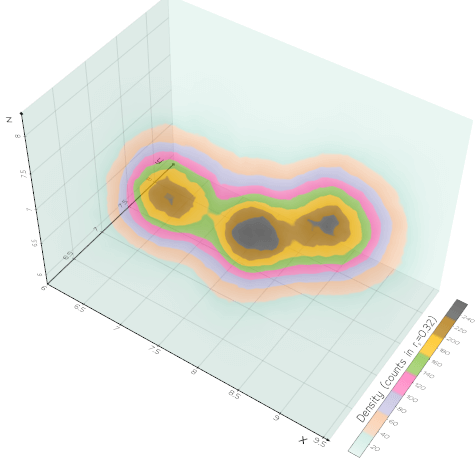
                ![](https://vedo.embl.es/images/pyplot/plot_density3d.png)
        """
        pdf = vtki.new("PointDensityFilter")
        pdf.SetInputData(self.dataset)

        if not utils.is_sequence(dims):
            dims = [dims, dims, dims]
        elif len(dims) not in (2, 3):
            raise ValueError("density(): dims must have length 2 or 3")

        if bounds is None:
            bounds = list(self.bounds())
        elif len(bounds) == 4:
            bounds = [*bounds, 0, 0]
        elif len(bounds) != 6:
            raise ValueError("density(): bounds must have length 4 or 6")

        if bounds[5] - bounds[4] == 0 or len(dims) == 2:  # its 2D
            dims = list(dims)
            dims = [dims[0], dims[1], 2]
            diag = self.diagonal_size()
            bounds[5] = bounds[4] + diag / 1000
        pdf.SetModelBounds(bounds)

        pdf.SetSampleDimensions(dims)

        if locator:
            pdf.SetLocator(locator)

        pdf.SetDensityEstimateToFixedRadius()
        if radius is None:
            radius = self.diagonal_size() / 20
        pdf.SetRadius(radius)
        pdf.SetComputeGradient(compute_gradient)
        pdf.Update()

        vol = vedo.Volume(pdf.GetOutput()).mode(1)
        vol.name = "PointDensity"
        vol.metadata["radius"] = radius
        vol.locator = pdf.GetLocator()
        vol.pipeline = utils.OperationNode(
            "density", parents=[self], comment=f"dims={tuple(vol.dimensions())}"
        )
        return vol

    def visible_points(self, area=(), tol=None, invert=False) -> vedo.Points | None:
        """
        Extract points based on whether they are visible or not.
        Visibility is determined by accessing the z-buffer of a rendering window.
        The position of each input point is converted into display coordinates,
        and then the z-value at that point is obtained.
        If within the user-specified tolerance, the point is considered visible.
        Associated data attributes are passed to the output as well.

        This filter also allows you to specify a rectangular window in display (pixel)
        coordinates in which the visible points must lie.

        Args:
            area (list):
                specify a rectangular region as (xmin,xmax,ymin,ymax)
            tol (float):
                a tolerance in normalized display coordinate system
            invert (bool):
                select invisible points instead.

        Examples:
            ```python
            from vedo import Ellipsoid, show
            s = Ellipsoid().rotate_y(30)

            # Camera options: pos, focal_point, viewup, distance
            camopts = dict(pos=(0,0,25), focal_point=(0,0,0))
            show(s, camera=camopts, offscreen=True)

            m = s.visible_points()
            # print('visible pts:', m.vertices)  # numpy array
            show(m, new=True, axes=1).close() # optionally draw result in a new window
            ```
            ![](https://vedo.embl.es/images/feats/visible_points.png)
        """
        svp = vtki.new("SelectVisiblePoints")
        svp.SetInputData(self.dataset)

        ren = None
        plt = vedo.current_plotter()
        if plt and plt.renderer:
            ren = plt.renderer
            svp.SetRenderer(ren)
        if not ren:
            vedo.logger.warning(
                "visible_points() can only be used after a rendering step"
            )
            return None

        if len(area) == 2:
            area = utils.flatten(area)
        if len(area) == 4:
            # specify a rectangular region
            svp.SetSelection(area[0], area[1], area[2], area[3])
        if tol is not None:
            svp.SetTolerance(tol)
        if invert:
            svp.SelectInvisibleOn()
        svp.Update()

        m = vedo.Points(svp.GetOutput())
        m.name = "VisiblePoints"
        return m

point_normals property

Retrieve vertex normals as a numpy array. Same as vertex_normals. Check out also compute_normals() and compute_normals_with_pca().

vertex_normals property

Retrieve vertex normals as a numpy array. Same as point_normals. If needed, normals are computed via compute_normals_with_pca(). Check out also compute_normals() and compute_normals_with_pca().

auto_distance()

Calculate the distance to the closest point in the same cloud of points. The output is stored in a new pointdata array called "AutoDistance", and it is also returned by the function.

Source code in vedo/pointcloud/analyze.py
449
450
451
452
453
454
455
456
457
458
459
460
461
462
463
464
465
466
467
468
469
470
471
472
473
474
475
476
def auto_distance(self) -> np.ndarray:
    """
    Calculate the distance to the closest point in the same cloud of points.
    The output is stored in a new pointdata array called "AutoDistance",
    and it is also returned by the function.
    """
    points = self.coordinates
    if len(points) < 2:
        dists = np.zeros(len(points), dtype=np.float32)
        self.pointdata["AutoDistance"] = dists
        return dists

    if not self.point_locator:
        self.point_locator = vtki.new("StaticPointLocator")
        self.point_locator.SetDataSet(self.dataset)
        self.point_locator.BuildLocator()
    qs = []
    vtklist = vtki.vtkIdList()
    vtkpoints = self.dataset.GetPoints()
    for p in points:
        self.point_locator.FindClosestNPoints(2, p, vtklist)
        q = [0, 0, 0]
        pid = vtklist.GetId(1)
        vtkpoints.GetPoint(pid, q)
        qs.append(q)
    dists = np.linalg.norm(points - np.array(qs), axis=1)
    self.pointdata["AutoDistance"] = dists
    return dists

chamfer_distance(pcloud)

Compute the Chamfer distance to the input point set.

Examples:

from vedo import *
cloud1 = np.random.randn(1000, 3)
cloud2 = np.random.randn(1000, 3) + [1, 2, 3]
c1 = Points(cloud1, r=5, c="red")
c2 = Points(cloud2, r=5, c="green")
d = c1.chamfer_distance(c2)
show(f"Chamfer distance = {d}", c1, c2, axes=1).close()
Source code in vedo/pointcloud/analyze.py
509
510
511
512
513
514
515
516
517
518
519
520
521
522
523
524
525
526
527
528
529
530
531
532
533
534
535
536
537
538
539
540
541
542
543
544
545
546
547
548
549
550
551
552
553
def chamfer_distance(self, pcloud) -> float:
    """
    Compute the Chamfer distance to the input point set.

    Examples:
        ```python
        from vedo import *
        cloud1 = np.random.randn(1000, 3)
        cloud2 = np.random.randn(1000, 3) + [1, 2, 3]
        c1 = Points(cloud1, r=5, c="red")
        c2 = Points(cloud2, r=5, c="green")
        d = c1.chamfer_distance(c2)
        show(f"Chamfer distance = {d}", c1, c2, axes=1).close()
        ```
    """
    # Definition of Chamfer distance may vary, here we use the average
    if not pcloud.point_locator:
        pcloud.point_locator = vtki.new("PointLocator")
        pcloud.point_locator.SetDataSet(pcloud.dataset)
        pcloud.point_locator.BuildLocator()
    if not self.point_locator:
        self.point_locator = vtki.new("PointLocator")
        self.point_locator.SetDataSet(self.dataset)
        self.point_locator.BuildLocator()

    ps1 = self.coordinates
    ps2 = pcloud.coordinates
    if len(ps1) == 0 or len(ps2) == 0:
        vedo.logger.warning("chamfer_distance(): one of the inputs has no points")
        return np.nan

    ids12 = []
    for p in ps1:
        pid12 = pcloud.point_locator.FindClosestPoint(p)
        ids12.append(pid12)
    deltav = ps2[ids12] - ps1
    da = np.mean(np.linalg.norm(deltav, axis=1))

    ids21 = []
    for p in ps2:
        pid21 = self.point_locator.FindClosestPoint(p)
        ids21.append(pid21)
    deltav = ps1[ids21] - ps2
    db = np.mean(np.linalg.norm(deltav, axis=1))
    return (da + db) / 2

clean()

Clean pointcloud or mesh by removing coincident points.

Source code in vedo/pointcloud/analyze.py
184
185
186
187
188
189
190
191
192
193
194
195
196
197
def clean(self) -> Self:
    """Clean pointcloud or mesh by removing coincident points."""
    cpd = vtki.new("CleanPolyData")
    cpd.PointMergingOn()
    cpd.ConvertLinesToPointsOff()
    cpd.ConvertPolysToLinesOff()
    cpd.ConvertStripsToPolysOff()
    cpd.SetInputData(self.dataset)
    cpd.Update()
    self._update(cpd.GetOutput())
    self.pipeline = utils.OperationNode(
        "clean", parents=[self], comment=f"#pts {self.dataset.GetNumberOfPoints()}"
    )
    return self

closest_point(pt, n=1, radius=None, return_point_id=False, return_cell_id=False)

Find the closest point(s) on a mesh given from the input point pt.

Parameters:

Name Type Description Default
n int

if greater than 1, return a list of n ordered closest points

1
radius float

if given, get all points within that radius. Then n is ignored.

None
return_point_id bool

return point ID instead of coordinates

False
return_cell_id bool

return cell ID in which the closest point sits

False

Examples:

.. note:: The appropriate tree search locator is built on the fly and cached for speed.

If you want to reset it use `mymesh.point_locator=None`
and / or `mymesh.cell_locator=None`.
Source code in vedo/pointcloud/analyze.py
346
347
348
349
350
351
352
353
354
355
356
357
358
359
360
361
362
363
364
365
366
367
368
369
370
371
372
373
374
375
376
377
378
379
380
381
382
383
384
385
386
387
388
389
390
391
392
393
394
395
396
397
398
399
400
401
402
403
404
405
406
407
408
409
410
411
412
413
414
415
416
417
418
419
420
421
422
423
424
425
426
427
428
429
430
431
432
433
434
435
436
437
438
439
440
441
442
443
444
445
446
447
def closest_point(
    self, pt, n=1, radius=None, return_point_id=False, return_cell_id=False
) -> list[int] | int | np.ndarray:
    """
    Find the closest point(s) on a mesh given from the input point `pt`.

    Args:
        n (int):
            if greater than 1, return a list of n ordered closest points
        radius (float):
            if given, get all points within that radius. Then n is ignored.
        return_point_id (bool):
            return point ID instead of coordinates
        return_cell_id (bool):
            return cell ID in which the closest point sits

    Examples:
        - [align1.py](https://github.com/marcomusy/vedo/tree/master/examples/basic/align1.py)
        - [fitplanes.py](https://github.com/marcomusy/vedo/tree/master/examples/basic/fitplanes.py)
        - [quadratic_morphing.py](https://github.com/marcomusy/vedo/tree/master/examples/advanced/quadratic_morphing.py)

    .. note::
        The appropriate tree search locator is built on the fly and cached for speed.

        If you want to reset it use `mymesh.point_locator=None`
        and / or `mymesh.cell_locator=None`.
    """
    if len(pt) != 3:
        pt = [pt[0], pt[1], 0]

    # NB: every time the mesh moves or is warped the locators are set to None
    if ((n > 1 or radius) or (n == 1 and return_point_id)) and not return_cell_id:
        poly = None
        if not self.point_locator:
            poly = self.dataset
            self.point_locator = vtki.new("StaticPointLocator")
            self.point_locator.SetDataSet(poly)
            self.point_locator.BuildLocator()

        ##########
        if radius:
            vtklist = vtki.vtkIdList()
            self.point_locator.FindPointsWithinRadius(radius, pt, vtklist)
        elif n > 1:
            vtklist = vtki.vtkIdList()
            self.point_locator.FindClosestNPoints(n, pt, vtklist)
        else:  # n==1 hence return_point_id==True
            ########
            return self.point_locator.FindClosestPoint(pt)
            ########

        if return_point_id:
            ########
            return utils.vtk2numpy(vtklist)
            ########

        if not poly:
            poly = self.dataset
        trgp = []
        for i in range(vtklist.GetNumberOfIds()):
            trgp_ = [0, 0, 0]
            vi = vtklist.GetId(i)
            poly.GetPoints().GetPoint(vi, trgp_)
            trgp.append(trgp_)
        ########
        return np.array(trgp)
        ########

    else:
        if not self.cell_locator:
            poly = self.dataset

            # As per Miquel example with limbs the vtkStaticCellLocator doesnt work !!
            # https://discourse.vtk.org/t/vtkstaticcelllocator-problem-vtk9-0-3/7854/4
            if vedo.vtk_version[0] >= 9 and vedo.vtk_version[1] > 0:
                self.cell_locator = vtki.new("StaticCellLocator")
            else:
                self.cell_locator = vtki.new("CellLocator")

            self.cell_locator.SetDataSet(poly)
            self.cell_locator.BuildLocator()

        if radius is not None:
            vedo.logger.warning(
                "closest_point() with radius is not implemented for cells."
            )

        if n != 1:
            vedo.logger.warning(
                "closest_point() with n>1 is not implemented for cells."
            )

        trgp = [0, 0, 0]
        cid = vtki.mutable(0)
        dist2 = vtki.mutable(0)
        subid = vtki.mutable(0)
        self.cell_locator.FindClosestPoint(pt, trgp, cid, subid, dist2)

        if return_cell_id:
            return int(cid)

        return np.array(trgp)

compute_acoplanarity(n=25, radius=None, on='points')

Compute acoplanarity which is a measure of how much a local region of the mesh differs from a plane.

The information is stored in a pointdata or celldata array with name 'Acoplanarity'.

Either n (number of neighbour points) or radius (radius of local search) can be specified. If a radius value is given and not enough points fall inside it, then a -1 is stored.

Examples:

from vedo import *
msh = ParametricShape('RandomHills')
msh.compute_acoplanarity(radius=0.1, on='cells')
msh.cmap("coolwarm", on='cells').add_scalarbar()
msh.show(axes=1).close()
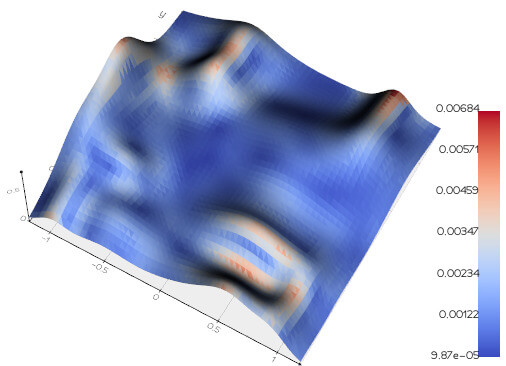
Source code in vedo/pointcloud/analyze.py
 61
 62
 63
 64
 65
 66
 67
 68
 69
 70
 71
 72
 73
 74
 75
 76
 77
 78
 79
 80
 81
 82
 83
 84
 85
 86
 87
 88
 89
 90
 91
 92
 93
 94
 95
 96
 97
 98
 99
100
101
102
103
104
105
106
107
108
109
110
111
112
113
114
115
116
def compute_acoplanarity(self, n=25, radius=None, on="points") -> Self:
    """
    Compute acoplanarity which is a measure of how much a local region of the mesh
    differs from a plane.

    The information is stored in a `pointdata` or `celldata` array with name 'Acoplanarity'.

    Either `n` (number of neighbour points) or `radius` (radius of local search) can be specified.
    If a radius value is given and not enough points fall inside it, then a -1 is stored.

    Examples:
        ```python
        from vedo import *
        msh = ParametricShape('RandomHills')
        msh.compute_acoplanarity(radius=0.1, on='cells')
        msh.cmap("coolwarm", on='cells').add_scalarbar()
        msh.show(axes=1).close()
        ```
        ![](https://vedo.embl.es/images/feats/acoplanarity.jpg)
    """
    if not n and radius is None:
        raise ValueError("compute_acoplanarity(): set either n or radius")

    acoplanarities = []
    if "point" in on:
        pts = self.coordinates
        search_obj = self
    elif "cell" in on:
        pts = self.cell_centers().coordinates
        search_obj = vedo.Points(pts)
    else:
        raise ValueError(
            f"In compute_acoplanarity() set on to either 'cells' or 'points', not {on}"
        )

    for p in utils.progressbar(pts, delay=5, width=15, title=f"{on} acoplanarity"):
        if n:
            data = search_obj.closest_point(p, n=n)
            npts = len(data)
        elif radius is not None:
            data = search_obj.closest_point(p, radius=radius)
            npts = len(data)

        try:
            data = np.asarray(data)
            center = data.mean(axis=0)
            res = np.linalg.svd(data - center)
            acoplanarities.append(res[1][2] / npts)
        except (np.linalg.LinAlgError, ValueError, TypeError, IndexError):
            acoplanarities.append(-1.0)

    if "point" in on:
        self.pointdata["Acoplanarity"] = np.array(acoplanarities, dtype=float)
    else:
        self.celldata["Acoplanarity"] = np.array(acoplanarities, dtype=float)
    return self

compute_camera_distance()

Calculate the distance from points to the camera.

A pointdata array is created with name 'DistanceToCamera' and returned.

Source code in vedo/pointcloud/analyze.py
1040
1041
1042
1043
1044
1045
1046
1047
1048
1049
1050
1051
1052
1053
1054
1055
def compute_camera_distance(self) -> np.ndarray:
    """
    Calculate the distance from points to the camera.

    A pointdata array is created with name 'DistanceToCamera' and returned.
    """
    plt = vedo.current_plotter()
    if plt and plt.renderer:
        poly = self.dataset
        dc = vtki.new("DistanceToCamera")
        dc.SetInputData(poly)
        dc.SetRenderer(plt.renderer)
        dc.Update()
        self._update(dc.GetOutput(), reset_locators=False)
        return self.pointdata["DistanceToCamera"]
    return np.array([])

compute_clustering(radius)

Cluster points in space. The radius is the radius of local search.

An array named "ClusterId" is added to pointdata.

Examples:
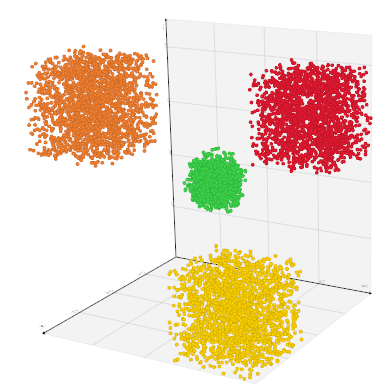
Source code in vedo/pointcloud/analyze.py
927
928
929
930
931
932
933
934
935
936
937
938
939
940
941
942
943
944
945
946
947
948
949
def compute_clustering(self, radius: float) -> Self:
    """
    Cluster points in space. The `radius` is the radius of local search.

    An array named "ClusterId" is added to `pointdata`.

    Examples:
        - [clustering.py](https://github.com/marcomusy/vedo/blob/master/examples/basic/clustering.py)

            ![](https://vedo.embl.es/images/basic/clustering.png)
    """
    cluster = vtki.new("EuclideanClusterExtraction")
    cluster.SetInputData(self.dataset)
    cluster.SetExtractionModeToAllClusters()
    cluster.SetRadius(radius)
    cluster.ColorClustersOn()
    cluster.Update()
    idsarr = cluster.GetOutput().GetPointData().GetArray("ClusterId")
    self.dataset.GetPointData().AddArray(idsarr)
    self.pipeline = utils.OperationNode(
        "compute_clustering", parents=[self], comment=f"radius = {radius}"
    )
    return self

compute_connections(radius, mode=0, regions=(), vrange=(0, 1), seeds=(), angle=0.0)

Extracts and/or segments points from a point cloud based on geometric distance measures (e.g., proximity, normal alignments, etc.) and optional measures such as scalar range. The default operation is to segment the points into "connected" regions where the connection is determined by an appropriate distance measure. Each region is given a region id.

Optionally, the filter can output the largest connected region of points; a particular region (via id specification); those regions that are seeded using a list of input point ids; or the region of points closest to a specified position.

The key parameter of this filter is the radius defining a sphere around each point which defines a local neighborhood: any other points in the local neighborhood are assumed connected to the point. Note that the radius is defined in absolute terms.

Other parameters are used to further qualify what it means to be a neighboring point. For example, scalar range and/or point normals can be used to further constrain the neighborhood. Also the extraction mode defines how the filter operates. By default, all regions are extracted but it is possible to extract particular regions; the region closest to a seed point; seeded regions; or the largest region found while processing. By default, all regions are extracted.

On output, all points are labeled with a region number. However note that the number of input and output points may not be the same: if not extracting all regions then the output size may be less than the input size.

Parameters:

Name Type Description Default
radius float

variable specifying a local sphere used to define local point neighborhood

required
mode int
  • 0, Extract all regions
  • 1, Extract point seeded regions
  • 2, Extract largest region
  • 3, Test specified regions
  • 4, Extract all regions with scalar connectivity
  • 5, Extract point seeded regions
0
regions list

a list of non-negative regions id to extract

()
vrange list

scalar range to use to extract points based on scalar connectivity

(0, 1)
seeds list

a list of non-negative point seed ids

()
angle list

points are connected if the angle between their normals is within this angle threshold (expressed in degrees).

0.0
Source code in vedo/pointcloud/analyze.py
 951
 952
 953
 954
 955
 956
 957
 958
 959
 960
 961
 962
 963
 964
 965
 966
 967
 968
 969
 970
 971
 972
 973
 974
 975
 976
 977
 978
 979
 980
 981
 982
 983
 984
 985
 986
 987
 988
 989
 990
 991
 992
 993
 994
 995
 996
 997
 998
 999
1000
1001
1002
1003
1004
1005
1006
1007
1008
1009
1010
1011
1012
1013
1014
1015
1016
1017
1018
1019
1020
1021
1022
1023
1024
1025
1026
1027
1028
1029
1030
1031
1032
1033
1034
1035
1036
1037
1038
def compute_connections(
    self, radius, mode=0, regions=(), vrange=(0, 1), seeds=(), angle=0.0
) -> Self:
    """
    Extracts and/or segments points from a point cloud based on geometric distance measures
    (e.g., proximity, normal alignments, etc.) and optional measures such as scalar range.
    The default operation is to segment the points into "connected" regions where the connection
    is determined by an appropriate distance measure. Each region is given a region id.

    Optionally, the filter can output the largest connected region of points; a particular region
    (via id specification); those regions that are seeded using a list of input point ids;
    or the region of points closest to a specified position.

    The key parameter of this filter is the radius defining a sphere around each point which defines
    a local neighborhood: any other points in the local neighborhood are assumed connected to the point.
    Note that the radius is defined in absolute terms.

    Other parameters are used to further qualify what it means to be a neighboring point.
    For example, scalar range and/or point normals can be used to further constrain the neighborhood.
    Also the extraction mode defines how the filter operates.
    By default, all regions are extracted but it is possible to extract particular regions;
    the region closest to a seed point; seeded regions; or the largest region found while processing.
    By default, all regions are extracted.

    On output, all points are labeled with a region number.
    However note that the number of input and output points may not be the same:
    if not extracting all regions then the output size may be less than the input size.

    Args:
        radius (float):
            variable specifying a local sphere used to define local point neighborhood
        mode (int):
            - 0,  Extract all regions
            - 1,  Extract point seeded regions
            - 2,  Extract largest region
            - 3,  Test specified regions
            - 4,  Extract all regions with scalar connectivity
            - 5,  Extract point seeded regions
        regions (list):
            a list of non-negative regions id to extract
        vrange (list):
            scalar range to use to extract points based on scalar connectivity
        seeds (list):
            a list of non-negative point seed ids
        angle (list):
            points are connected if the angle between their normals is
            within this angle threshold (expressed in degrees).
    """
    # https://vtk.org/doc/nightly/html/classvtkConnectedPointsFilter.html
    cpf = vtki.new("ConnectedPointsFilter")
    cpf.SetInputData(self.dataset)
    cpf.SetRadius(radius)
    if mode == 0:  # Extract all regions
        cpf.SetExtractionModeToAllRegions()

    elif mode == 1:  # Extract point seeded regions
        cpf.SetExtractionModeToPointSeededRegions()
        for s in seeds:
            cpf.AddSeed(s)

    elif mode == 2:  # Test largest region
        cpf.SetExtractionModeToLargestRegion()

    elif mode == 3:  # Test specified regions
        cpf.SetExtractionModeToSpecifiedRegions()
        for r in regions:
            cpf.AddSpecifiedRegion(r)

    elif mode == 4:  # Extract all regions with scalar connectivity
        cpf.SetExtractionModeToAllRegions()
        cpf.ScalarConnectivityOn()
        cpf.SetScalarRange(vrange[0], vrange[1])

    elif mode == 5:  # Extract point seeded regions
        cpf.SetExtractionModeToPointSeededRegions()
        for s in seeds:
            cpf.AddSeed(s)
        cpf.ScalarConnectivityOn()
        cpf.SetScalarRange(vrange[0], vrange[1])
        cpf.AlignedNormalsOn()
        cpf.SetNormalAngle(angle)

    else:
        raise ValueError(f"compute_connections(): unknown mode {mode}")

    cpf.Update()
    self._update(cpf.GetOutput(), reset_locators=False)
    return self

compute_normals_with_pca(n=20, orientation_point=None, invert=False)

Generate point normals using PCA (principal component analysis). This algorithm estimates a local tangent plane around each sample point p by considering a small neighborhood of points around p, and fitting a plane to the neighborhood (via PCA).

Parameters:

Name Type Description Default
n int

neighborhood size to calculate the normal

20
orientation_point list

adjust the +/- sign of the normals so that the normals all point towards a specified point. If None, perform a traversal of the point cloud and flip neighboring normals so that they are mutually consistent.

None
invert bool

flip all normals

False
Source code in vedo/pointcloud/analyze.py
18
19
20
21
22
23
24
25
26
27
28
29
30
31
32
33
34
35
36
37
38
39
40
41
42
43
44
45
46
47
48
49
50
51
52
53
54
55
56
57
58
59
def compute_normals_with_pca(
    self, n=20, orientation_point=None, invert=False
) -> Self:
    """
    Generate point normals using PCA (principal component analysis).
    This algorithm estimates a local tangent plane around each sample point p
    by considering a small neighborhood of points around p, and fitting a plane
    to the neighborhood (via PCA).

    Args:
        n (int):
            neighborhood size to calculate the normal
        orientation_point (list):
            adjust the +/- sign of the normals so that
            the normals all point towards a specified point. If None, perform a traversal
            of the point cloud and flip neighboring normals so that they are mutually consistent.
        invert (bool):
            flip all normals
    """
    if n < 1:
        raise ValueError("compute_normals_with_pca(): n must be >= 1")

    poly = self.dataset
    pcan = vtki.new("PCANormalEstimation")
    pcan.SetInputData(poly)
    pcan.SetSampleSize(n)

    if orientation_point is not None:
        pcan.SetNormalOrientationToPoint()
        pcan.SetOrientationPoint(orientation_point)
    else:
        pcan.SetNormalOrientationToGraphTraversal()

    if invert:
        pcan.FlipNormalsOn()
    pcan.Update()

    varr = pcan.GetOutput().GetPointData().GetNormals()
    varr.SetName("Normals")
    self.dataset.GetPointData().SetNormals(varr)
    self.dataset.GetPointData().Modified()
    return self

densify(target_distance=0.1, nclosest=6, radius=None, niter=1, nmax=None)

Return a copy of the cloud with new added points. The new points are created in such a way that all points in any local neighborhood are within a target distance of one another.

For each input point, the distance to all points in its neighborhood is computed. If any of its neighbors is further than the target distance, the edge connecting the point and its neighbor is bisected and a new point is inserted at the bisection point. A single pass is completed once all the input points are visited. Then the process repeats to the number of iterations.

Examples:
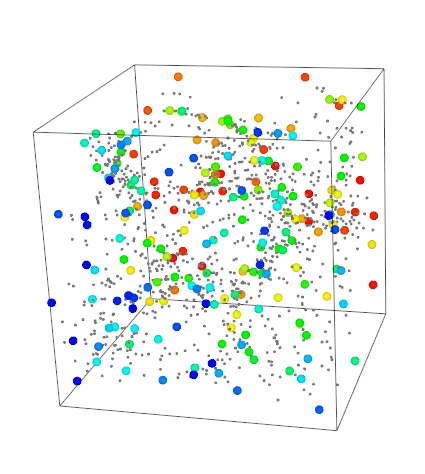
.. note:: Points will be created in an iterative fashion until all points in their local neighborhood are the target distance apart or less. Note that the process may terminate early due to the number of iterations. By default the target distance is set to 0.5. Note that the target_distance should be less than the radius or nothing will change on output.

.. warning:: This class can generate a lot of points very quickly. The maximum number of iterations is by default set to =1.0 for this reason. Increase the number of iterations very carefully. Also, nmax can be set to limit the explosion of points. It is also recommended that a N closest neighborhood is used.

Source code in vedo/pointcloud/analyze.py
1057
1058
1059
1060
1061
1062
1063
1064
1065
1066
1067
1068
1069
1070
1071
1072
1073
1074
1075
1076
1077
1078
1079
1080
1081
1082
1083
1084
1085
1086
1087
1088
1089
1090
1091
1092
1093
1094
1095
1096
1097
1098
1099
1100
1101
1102
1103
1104
1105
1106
1107
1108
1109
1110
1111
1112
1113
1114
1115
1116
1117
1118
1119
1120
1121
1122
1123
1124
1125
1126
1127
1128
1129
1130
1131
1132
1133
1134
1135
1136
1137
1138
def densify(
    self, target_distance=0.1, nclosest=6, radius=None, niter=1, nmax=None
) -> vedo.Points:
    """
    Return a copy of the cloud with new added points.
    The new points are created in such a way that all points in any local neighborhood are
    within a target distance of one another.

    For each input point, the distance to all points in its neighborhood is computed.
    If any of its neighbors is further than the target distance,
    the edge connecting the point and its neighbor is bisected and
    a new point is inserted at the bisection point.
    A single pass is completed once all the input points are visited.
    Then the process repeats to the number of iterations.

    Examples:
        - [densifycloud.py](https://github.com/marcomusy/vedo/blob/master/examples/volumetric/densifycloud.py)

            ![](https://vedo.embl.es/images/volumetric/densifycloud.png)

    .. note::
        Points will be created in an iterative fashion until all points in their
        local neighborhood are the target distance apart or less.
        Note that the process may terminate early due to the
        number of iterations. By default the target distance is set to 0.5.
        Note that the target_distance should be less than the radius
        or nothing will change on output.

    .. warning::
        This class can generate a lot of points very quickly.
        The maximum number of iterations is by default set to =1.0 for this reason.
        Increase the number of iterations very carefully.
        Also, `nmax` can be set to limit the explosion of points.
        It is also recommended that a N closest neighborhood is used.

    """
    src = vtki.new("ProgrammableSource")
    opts = self.coordinates
    # zeros = np.zeros(3)

    def _read_points():
        output = src.GetPolyDataOutput()
        points = vtki.vtkPoints()
        for p in opts:
            # print(p)
            # if not np.array_equal(p, zeros):
            points.InsertNextPoint(p)
        output.SetPoints(points)

    src.SetExecuteMethod(_read_points)

    dens = vtki.new("DensifyPointCloudFilter")
    dens.SetInputConnection(src.GetOutputPort())
    # dens.SetInputData(self.dataset) # this does not work
    dens.InterpolateAttributeDataOn()
    dens.SetTargetDistance(target_distance)
    dens.SetMaximumNumberOfIterations(niter)
    if nmax:
        dens.SetMaximumNumberOfPoints(nmax)

    if radius:
        dens.SetNeighborhoodTypeToRadius()
        dens.SetRadius(radius)
    elif nclosest:
        dens.SetNeighborhoodTypeToNClosest()
        dens.SetNumberOfClosestPoints(nclosest)
    else:
        vedo.logger.error("set either radius or nclosest")
        raise RuntimeError()
    dens.Update()

    cld = vedo.Points(dens.GetOutput())
    cld.copy_properties_from(self)
    cld.interpolate_data_from(self, n=nclosest, radius=radius)
    cld.name = "DensifiedCloud"
    cld.pipeline = utils.OperationNode(
        "densify",
        parents=[self],
        c="#e9c46a:",
        comment=f"#pts {cld.dataset.GetNumberOfPoints()}",
    )
    return cld

density(dims=(40, 40, 40), bounds=None, radius=None, compute_gradient=False, locator=None)

Generate a density field from a point cloud. Input can also be a set of 3D coordinates. Output is a Volume.

The local neighborhood is specified as the radius around each sample position (each voxel). If left to None, the radius is automatically computed as the diagonal of the bounding box and can be accessed via vol.metadata["radius"]. The density is expressed as the number of counts in the radius search.

Parameters:

Name Type Description Default
dims (int, list)

number of voxels in x, y and z of the output Volume.

(40, 40, 40)
compute_gradient bool

Turn on/off the generation of the gradient vector, gradient magnitude scalar, and function classification scalar. By default this is off. Note that this will increase execution time and the size of the output. (The names of these point data arrays are: "Gradient", "Gradient Magnitude", and "Classification")

False
locator vtkPointLocator

can be assigned from a previous call for speed (access it via object.point_locator).

None

Examples:

Source code in vedo/pointcloud/analyze.py
1140
1141
1142
1143
1144
1145
1146
1147
1148
1149
1150
1151
1152
1153
1154
1155
1156
1157
1158
1159
1160
1161
1162
1163
1164
1165
1166
1167
1168
1169
1170
1171
1172
1173
1174
1175
1176
1177
1178
1179
1180
1181
1182
1183
1184
1185
1186
1187
1188
1189
1190
1191
1192
1193
1194
1195
1196
1197
1198
1199
1200
1201
1202
1203
1204
1205
1206
1207
1208
1209
1210
1211
1212
1213
1214
1215
def density(
    self,
    dims=(40, 40, 40),
    bounds=None,
    radius=None,
    compute_gradient=False,
    locator=None,
) -> vedo.Volume:
    """
    Generate a density field from a point cloud. Input can also be a set of 3D coordinates.
    Output is a `Volume`.

    The local neighborhood is specified as the `radius` around each sample position (each voxel).
    If left to None, the radius is automatically computed as the diagonal of the bounding box
    and can be accessed via `vol.metadata["radius"]`.
    The density is expressed as the number of counts in the radius search.

    Args:
        dims (int, list):
            number of voxels in x, y and z of the output Volume.
        compute_gradient (bool):
            Turn on/off the generation of the gradient vector,
            gradient magnitude scalar, and function classification scalar.
            By default this is off. Note that this will increase execution time
            and the size of the output. (The names of these point data arrays are:
            "Gradient", "Gradient Magnitude", and "Classification")
        locator (vtkPointLocator):
            can be assigned from a previous call for speed (access it via `object.point_locator`).

    Examples:
        - [plot_density3d.py](https://github.com/marcomusy/vedo/blob/master/examples/pyplot/plot_density3d.py)

            ![](https://vedo.embl.es/images/pyplot/plot_density3d.png)
    """
    pdf = vtki.new("PointDensityFilter")
    pdf.SetInputData(self.dataset)

    if not utils.is_sequence(dims):
        dims = [dims, dims, dims]
    elif len(dims) not in (2, 3):
        raise ValueError("density(): dims must have length 2 or 3")

    if bounds is None:
        bounds = list(self.bounds())
    elif len(bounds) == 4:
        bounds = [*bounds, 0, 0]
    elif len(bounds) != 6:
        raise ValueError("density(): bounds must have length 4 or 6")

    if bounds[5] - bounds[4] == 0 or len(dims) == 2:  # its 2D
        dims = list(dims)
        dims = [dims[0], dims[1], 2]
        diag = self.diagonal_size()
        bounds[5] = bounds[4] + diag / 1000
    pdf.SetModelBounds(bounds)

    pdf.SetSampleDimensions(dims)

    if locator:
        pdf.SetLocator(locator)

    pdf.SetDensityEstimateToFixedRadius()
    if radius is None:
        radius = self.diagonal_size() / 20
    pdf.SetRadius(radius)
    pdf.SetComputeGradient(compute_gradient)
    pdf.Update()

    vol = vedo.Volume(pdf.GetOutput()).mode(1)
    vol.name = "PointDensity"
    vol.metadata["radius"] = radius
    vol.locator = pdf.GetLocator()
    vol.pipeline = utils.OperationNode(
        "density", parents=[self], comment=f"dims={tuple(vol.dimensions())}"
    )
    return vol

distance_to(pcloud, signed=False, invert=False, name='Distance')

Computes the distance from one point cloud or mesh to another point cloud or mesh. This new pointdata array is saved with default name "Distance".

Keywords signed and invert are used to compute signed distance, but the mesh in that case must have polygonal faces (not a simple point cloud), and normals must also be computed.

Examples:
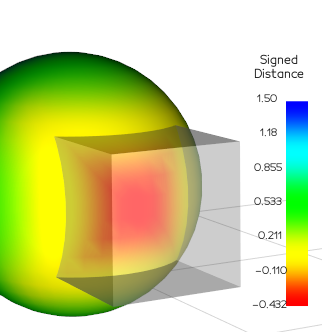
Source code in vedo/pointcloud/analyze.py
118
119
120
121
122
123
124
125
126
127
128
129
130
131
132
133
134
135
136
137
138
139
140
141
142
143
144
145
146
147
148
149
150
151
152
153
154
155
156
157
158
159
160
161
162
163
164
165
166
167
168
169
170
171
172
173
174
175
176
177
178
179
180
181
182
def distance_to(
    self, pcloud, signed=False, invert=False, name="Distance"
) -> np.ndarray:
    """
    Computes the distance from one point cloud or mesh to another point cloud or mesh.
    This new `pointdata` array is saved with default name "Distance".

    Keywords `signed` and `invert` are used to compute signed distance,
    but the mesh in that case must have polygonal faces (not a simple point cloud),
    and normals must also be computed.

    Examples:
        - [distance2mesh.py](https://github.com/marcomusy/vedo/tree/master/examples/basic/distance2mesh.py)

            ![](https://vedo.embl.es/images/basic/distance2mesh.png)
    """
    if pcloud.dataset.GetNumberOfPolys():
        poly1 = self.dataset
        poly2 = pcloud.dataset
        df = vtki.new("DistancePolyDataFilter")
        df.ComputeSecondDistanceOff()
        df.SetInputData(0, poly1)
        df.SetInputData(1, poly2)
        df.SetSignedDistance(signed)
        df.SetNegateDistance(invert)
        df.Update()
        scals = df.GetOutput().GetPointData().GetScalars()
        dists = utils.vtk2numpy(scals)

    else:  # has no polygons
        if signed:
            vedo.logger.warning(
                "distance_to() called with signed=True but input object has no polygons"
            )

        if not pcloud.point_locator:
            pcloud.point_locator = vtki.new("PointLocator")
            pcloud.point_locator.SetDataSet(pcloud.dataset)
            pcloud.point_locator.BuildLocator()

        ids = []
        ps1 = self.coordinates
        ps2 = pcloud.coordinates
        for p in ps1:
            pid = pcloud.point_locator.FindClosestPoint(p)
            ids.append(pid)

        deltas = ps2[ids] - ps1
        dists = np.linalg.norm(deltas, axis=1).astype(np.float32)
        scals = utils.numpy2vtk(dists)

    scals.SetName(name)
    self.dataset.GetPointData().AddArray(scals)
    self.dataset.GetPointData().SetActiveScalars(scals.GetName())
    rng = scals.GetRange()
    self.mapper.SetScalarRange(rng[0], rng[1])
    self.mapper.ScalarVisibilityOn()

    self.pipeline = utils.OperationNode(
        "distance_to",
        parents=[self, pcloud],
        shape="cylinder",
        comment=f"#pts {self.dataset.GetNumberOfPoints()}",
    )
    return dists

hausdorff_distance(points)

Compute the Hausdorff distance to the input point set. Returns a single float.

Examples:

from vedo import *
t = np.linspace(0, 2*np.pi, 100)
x = 4/3 * sin(t)**3
y = cos(t) - cos(2*t)/3 - cos(3*t)/6 - cos(4*t)/12
pol1 = Line(np.c_[x,y], closed=True).triangulate()
pol2 = Polygon(nsides=5).pos(2,2)
d12 = pol1.distance_to(pol2)
d21 = pol2.distance_to(pol1)
pol1.lw(0).cmap("viridis")
pol2.lw(0).cmap("viridis")
print("distance d12, d21 :", min(d12), min(d21))
print("hausdorff distance:", pol1.hausdorff_distance(pol2))
print("chamfer distance  :", pol1.chamfer_distance(pol2))
show(pol1, pol2, axes=1)
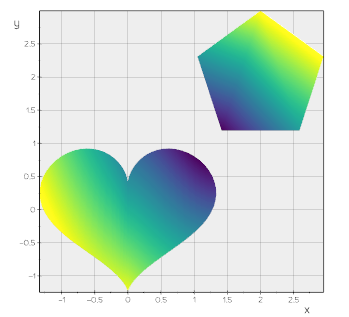
Source code in vedo/pointcloud/analyze.py
478
479
480
481
482
483
484
485
486
487
488
489
490
491
492
493
494
495
496
497
498
499
500
501
502
503
504
505
506
507
def hausdorff_distance(self, points) -> float:
    """
    Compute the Hausdorff distance to the input point set.
    Returns a single `float`.

    Examples:
        ```python
        from vedo import *
        t = np.linspace(0, 2*np.pi, 100)
        x = 4/3 * sin(t)**3
        y = cos(t) - cos(2*t)/3 - cos(3*t)/6 - cos(4*t)/12
        pol1 = Line(np.c_[x,y], closed=True).triangulate()
        pol2 = Polygon(nsides=5).pos(2,2)
        d12 = pol1.distance_to(pol2)
        d21 = pol2.distance_to(pol1)
        pol1.lw(0).cmap("viridis")
        pol2.lw(0).cmap("viridis")
        print("distance d12, d21 :", min(d12), min(d21))
        print("hausdorff distance:", pol1.hausdorff_distance(pol2))
        print("chamfer distance  :", pol1.chamfer_distance(pol2))
        show(pol1, pol2, axes=1)
        ```
        ![](https://vedo.embl.es/images/feats/heart.png)
    """
    hp = vtki.new("HausdorffDistancePointSetFilter")
    hp.SetInputData(0, self.dataset)
    hp.SetInputData(1, points.dataset)
    hp.SetTargetDistanceMethodToPointToCell()
    hp.Update()
    return hp.GetHausdorffDistance()

quantize(value)

The user should input a value and all {x,y,z} coordinates will be quantized to that absolute grain size.

Source code in vedo/pointcloud/analyze.py
309
310
311
312
313
314
315
316
317
318
319
320
321
322
323
def quantize(self, value: float) -> Self:
    """
    The user should input a value and all {x,y,z} coordinates
    will be quantized to that absolute grain size.
    """
    if value <= 0:
        raise ValueError("quantize(): value must be > 0")

    qp = vtki.new("QuantizePolyDataPoints")
    qp.SetInputData(self.dataset)
    qp.SetQFactor(value)
    qp.Update()
    self._update(qp.GetOutput())
    self.pipeline = utils.OperationNode("quantize", parents=[self])
    return self

relax_point_positions(n=10, iters=10, sub_iters=10, packing_factor=1, max_step=0, constraints=None)

Smooth mesh or points with a Laplacian algorithm variant. This modifies the coordinates of the input points by adjusting their positions to create a smooth distribution (and thereby form a pleasing packing of the points). Smoothing is performed by considering the effects of neighboring points on one another it uses a cubic cutoff function to produce repulsive forces between close points and attractive forces that are a little further away.

In general, the larger the neighborhood size, the greater the reduction in high frequency information. The memory and computational requirements of the algorithm may also significantly increase.

The algorithm incrementally adjusts the point positions through an iterative process. Basically points are moved due to the influence of neighboring points.

As points move, both the local connectivity and data attributes associated with each point must be updated. Rather than performing these expensive operations after every iteration, a number of sub-iterations can be specified. If so, then the neighborhood and attribute value updates occur only every sub iteration, which can improve performance significantly.

Parameters:

Name Type Description Default
n int

neighborhood size to calculate the Laplacian.

10
iters int

number of iterations.

10
sub_iters int

number of sub-iterations, i.e. the number of times the neighborhood and attribute value updates occur during each iteration.

10
packing_factor float

adjust convergence speed.

1
max_step float

Specify the maximum smoothing step size for each smoothing iteration. This limits the the distance over which a point can move in each iteration. As in all iterative methods, the stability of the process is sensitive to this parameter. In general, small step size and large numbers of iterations are more stable than a larger step size and a smaller numbers of iterations.

0
constraints dict

dictionary of constraints. Point constraints are used to prevent points from moving, or to move only on a plane. This can prevent shrinking or growing point clouds. If enabled, a local topological analysis is performed to determine whether a point should be marked as fixed" i.e., never moves, or the point only moves on a plane, or the point can move freely. If all points in the neighborhood surrounding a point are in the cone defined by fixed_angle, then the point is classified as fixed. If all points in the neighborhood surrounding a point are in the cone defined by boundary_angle, then the point is classified as lying on a plane. Angles are expressed in degrees.

None

Examples:

import numpy as np
from vedo import Points, show
from vedo.pyplot import histogram

vpts1 = Points(np.random.rand(10_000, 3))
dists = vpts1.auto_distance()
h1 = histogram(dists, xlim=(0,0.08)).clone2d()

vpts2 = vpts1.clone().relax_point_positions(n=100, iters=20, sub_iters=10)
dists = vpts2.auto_distance()
h2 = histogram(dists, xlim=(0,0.08)).clone2d()

show([[vpts1, h1], [vpts2, h2]], N=2).close()
Source code in vedo/pointcloud/analyze.py
588
589
590
591
592
593
594
595
596
597
598
599
600
601
602
603
604
605
606
607
608
609
610
611
612
613
614
615
616
617
618
619
620
621
622
623
624
625
626
627
628
629
630
631
632
633
634
635
636
637
638
639
640
641
642
643
644
645
646
647
648
649
650
651
652
653
654
655
656
657
658
659
660
661
662
663
664
665
666
667
668
669
670
671
672
673
674
675
676
677
678
679
680
681
682
683
684
685
686
687
688
def relax_point_positions(
    self,
    n=10,
    iters=10,
    sub_iters=10,
    packing_factor=1,
    max_step=0,
    constraints=None,
) -> Self:
    """
    Smooth mesh or points with a
    [Laplacian algorithm](https://vtk.org/doc/nightly/html/classvtkPointSmoothingFilter.html)
    variant. This modifies the coordinates of the input points by adjusting their positions
    to create a smooth distribution (and thereby form a pleasing packing of the points).
    Smoothing is performed by considering the effects of neighboring points on one another
    it uses a cubic cutoff function to produce repulsive forces between close points
    and attractive forces that are a little further away.

    In general, the larger the neighborhood size, the greater the reduction in high frequency
    information. The memory and computational requirements of the algorithm may also
    significantly increase.

    The algorithm incrementally adjusts the point positions through an iterative process.
    Basically points are moved due to the influence of neighboring points.

    As points move, both the local connectivity and data attributes associated with each point
    must be updated. Rather than performing these expensive operations after every iteration,
    a number of sub-iterations can be specified. If so, then the neighborhood and attribute
    value updates occur only every sub iteration, which can improve performance significantly.

    Args:
        n (int):
            neighborhood size to calculate the Laplacian.
        iters (int):
            number of iterations.
        sub_iters (int):
            number of sub-iterations, i.e. the number of times the neighborhood and attribute
            value updates occur during each iteration.
        packing_factor (float):
            adjust convergence speed.
        max_step (float):
            Specify the maximum smoothing step size for each smoothing iteration.
            This limits the the distance over which a point can move in each iteration.
            As in all iterative methods, the stability of the process is sensitive to this parameter.
            In general, small step size and large numbers of iterations are more stable than a larger
            step size and a smaller numbers of iterations.
        constraints (dict):
            dictionary of constraints.
            Point constraints are used to prevent points from moving,
            or to move only on a plane. This can prevent shrinking or growing point clouds.
            If enabled, a local topological analysis is performed to determine whether a point
            should be marked as fixed" i.e., never moves, or the point only moves on a plane,
            or the point can move freely.
            If all points in the neighborhood surrounding a point are in the cone defined by
            `fixed_angle`, then the point is classified as fixed.
            If all points in the neighborhood surrounding a point are in the cone defined by
            `boundary_angle`, then the point is classified as lying on a plane.
            Angles are expressed in degrees.

    Examples:
        ```py
        import numpy as np
        from vedo import Points, show
        from vedo.pyplot import histogram

        vpts1 = Points(np.random.rand(10_000, 3))
        dists = vpts1.auto_distance()
        h1 = histogram(dists, xlim=(0,0.08)).clone2d()

        vpts2 = vpts1.clone().relax_point_positions(n=100, iters=20, sub_iters=10)
        dists = vpts2.auto_distance()
        h2 = histogram(dists, xlim=(0,0.08)).clone2d()

        show([[vpts1, h1], [vpts2, h2]], N=2).close()
        ```
    """
    smooth = vtki.new("PointSmoothingFilter")
    smooth.SetInputData(self.dataset)
    smooth.SetSmoothingModeToUniform()
    smooth.SetNumberOfIterations(iters)
    smooth.SetNumberOfSubIterations(sub_iters)
    smooth.SetPackingFactor(packing_factor)
    if self.point_locator:
        smooth.SetLocator(self.point_locator)
    if not max_step:
        max_step = self.diagonal_size() / 100
    smooth.SetMaximumStepSize(max_step)
    smooth.SetNeighborhoodSize(n)
    if constraints:
        fixed_angle = constraints.get("fixed_angle", 45)
        boundary_angle = constraints.get("boundary_angle", 110)
        smooth.EnableConstraintsOn()
        smooth.SetFixedAngle(fixed_angle)
        smooth.SetBoundaryAngle(boundary_angle)
        smooth.GenerateConstraintScalarsOn()
        smooth.GenerateConstraintNormalsOn()
    smooth.Update()
    self._update(smooth.GetOutput())
    self.metadata["PackingRadius"] = smooth.GetPackingRadius()
    self.pipeline = utils.OperationNode("relax_point_positions", parents=[self])
    return self

remove_outliers(radius, neighbors=5)

Remove outliers from a cloud of points within the specified radius search.

Parameters:

Name Type Description Default
radius float

Specify the local search radius.

required
neighbors int

Specify the number of neighbors that a point must have, within the specified radius, for the point to not be considered isolated.

5

Examples:

Source code in vedo/pointcloud/analyze.py
555
556
557
558
559
560
561
562
563
564
565
566
567
568
569
570
571
572
573
574
575
576
577
578
579
580
581
582
583
584
585
586
def remove_outliers(self, radius: float, neighbors=5) -> Self:
    """
    Remove outliers from a cloud of points within the specified `radius` search.

    Args:
        radius (float):
            Specify the local search radius.
        neighbors (int):
            Specify the number of neighbors that a point must have,
            within the specified radius, for the point to not be considered isolated.

    Examples:
        - [clustering.py](https://github.com/marcomusy/vedo/tree/master/examples/basic/clustering.py)

            ![](https://vedo.embl.es/images/basic/clustering.png)
    """
    removal = vtki.new("RadiusOutlierRemoval")
    removal.SetInputData(self.dataset)
    removal.SetRadius(radius)
    removal.SetNumberOfNeighbors(neighbors)
    removal.GenerateOutliersOff()
    removal.Update()
    inputobj = removal.GetOutput()
    if inputobj.GetNumberOfCells() == 0:
        carr = vtki.vtkCellArray()
        for i in range(inputobj.GetNumberOfPoints()):
            carr.InsertNextCell(1)
            carr.InsertCellPoint(i)
        inputobj.SetVerts(carr)
    self._update(removal.GetOutput())
    self.pipeline = utils.OperationNode("remove_outliers", parents=[self])
    return self

smooth_lloyd_2d(iterations=2, bounds=None, options='Qbb Qc Qx')

Lloyd relaxation of a 2D pointcloud.

Parameters:

Name Type Description Default
iterations int

number of iterations.

2
bounds list

bounding box of the domain.

None
options str

options for the Qhull algorithm.

'Qbb Qc Qx'
Source code in vedo/pointcloud/analyze.py
839
840
841
842
843
844
845
846
847
848
849
850
851
852
853
854
855
856
857
858
859
860
861
862
863
864
865
866
867
868
869
870
871
872
873
874
875
876
877
878
879
880
881
882
883
884
885
886
887
888
889
890
891
892
893
894
895
896
897
898
899
900
901
902
903
904
905
906
907
908
909
910
911
912
913
914
915
916
917
918
919
920
921
922
923
924
925
def smooth_lloyd_2d(self, iterations=2, bounds=None, options="Qbb Qc Qx") -> Self:
    """
    Lloyd relaxation of a 2D pointcloud.

    Args:
        iterations (int):
            number of iterations.
        bounds (list):
            bounding box of the domain.
        options (str):
            options for the Qhull algorithm.
    """
    # Credits: https://hatarilabs.com/ih-en/
    # tutorial-to-create-a-geospatial-voronoi-sh-mesh-with-python-scipy-and-geopandas
    from scipy.spatial import QhullError
    from scipy.spatial import Voronoi as scipy_voronoi

    def _constrain_points(points):
        # Update any points that have drifted beyond the boundaries of this space
        if bounds is not None:
            for point in points:
                if point[0] < bounds[0]:
                    point[0] = bounds[0]
                if point[0] > bounds[1]:
                    point[0] = bounds[1]
                if point[1] < bounds[2]:
                    point[1] = bounds[2]
                if point[1] > bounds[3]:
                    point[1] = bounds[3]
        return points

    def _find_centroid(vertices):
        # The equation for the method used here to find the centroid of a
        # 2D polygon is given here: https://en.wikipedia.org/wiki/Centroid#Of_a_polygon
        area = 0
        centroid_x = 0
        centroid_y = 0
        for i in range(len(vertices) - 1):
            step = (vertices[i, 0] * vertices[i + 1, 1]) - (
                vertices[i + 1, 0] * vertices[i, 1]
            )
            centroid_x += (vertices[i, 0] + vertices[i + 1, 0]) * step
            centroid_y += (vertices[i, 1] + vertices[i + 1, 1]) * step
            area += step
        if area:
            centroid_x = (1.0 / (3.0 * area)) * centroid_x
            centroid_y = (1.0 / (3.0 * area)) * centroid_y
        else:
            centroid_x, centroid_y = np.mean(vertices[:-1], axis=0)
        # prevent centroids from escaping bounding box
        return _constrain_points([[centroid_x, centroid_y]])[0]

    def _relax(voron):
        # Moves each point to the centroid of its cell in the voronoi
        # map to "relax" the points (i.e. jitter the points so as
        # to spread them out within the space).
        centroids = []
        for i, idx in enumerate(voron.point_region):
            # the region is a series of indices into voronoi.vertices
            # remove point at infinity, designated by index -1
            region = [i for i in voron.regions[idx] if i != -1]
            if len(region) < 3:
                centroids.append(voron.points[i])
                continue
            # enclose the polygon
            region = region + [region[0]]
            verts = voron.vertices[region]
            # find the centroid of those vertices
            centroids.append(_find_centroid(verts))
        return _constrain_points(centroids)

    if bounds is None:
        bounds = self.bounds()

    pts = self.vertices[:, (0, 1)]
    for i in range(iterations):
        try:
            vor = scipy_voronoi(pts, qhull_options=options)
        except QhullError:
            vedo.logger.warning("smooth_lloyd_2d(): Voronoi construction failed")
            break
        _constrain_points(vor.vertices)
        pts = _relax(vor)
    out = vedo.Points(pts)
    out.name = "MeshSmoothLloyd2D"
    out.pipeline = utils.OperationNode("smooth_lloyd", parents=[self])
    return out

smooth_mls_1d(f=0.2, radius=None, n=0)

Smooth mesh or points with a Moving Least Squares variant. The point data array "Variances" will contain the residue calculated for each point.

Parameters:

Name Type Description Default
f float

smoothing factor - typical range is [0,2].

0.2
radius float

radius search in absolute units. If set then f is ignored.

None
n int

number of neighbours to be used for the fit. If set then f and radius are ignored.

0

Examples:

Source code in vedo/pointcloud/analyze.py
690
691
692
693
694
695
696
697
698
699
700
701
702
703
704
705
706
707
708
709
710
711
712
713
714
715
716
717
718
719
720
721
722
723
724
725
726
727
728
729
730
731
732
733
734
735
736
737
738
739
740
741
742
743
744
745
746
def smooth_mls_1d(self, f=0.2, radius=None, n=0) -> Self:
    """
    Smooth mesh or points with a `Moving Least Squares` variant.
    The point data array "Variances" will contain the residue calculated for each point.

    Args:
        f (float):
            smoothing factor - typical range is [0,2].
        radius (float):
            radius search in absolute units.
            If set then `f` is ignored.
        n (int):
            number of neighbours to be used for the fit.
            If set then `f` and `radius` are ignored.

    Examples:
        - [moving_least_squares1D.py](https://github.com/marcomusy/vedo/tree/master/examples/advanced/moving_least_squares1D.py)
        - [skeletonize.py](https://github.com/marcomusy/vedo/tree/master/examples/advanced/skeletonize.py)

        ![](https://vedo.embl.es/images/advanced/moving_least_squares1D.png)
    """
    coords = self.coordinates
    ncoords = len(coords)

    if n:
        Ncp = n
    elif radius:
        Ncp = 1
    else:
        Ncp = int(ncoords * f / 10)
        if Ncp < 5:
            vedo.logger.warning(f"Please choose a fraction higher than {f}")
            Ncp = 5

    variances, newline = [], []
    for p in coords:
        points = self.closest_point(p, n=Ncp, radius=radius)
        if len(points) < 4:
            variances.append(0.0)
            newline.append(p)
            continue

        try:
            points = np.asarray(points)
            pointsmean = points.mean(axis=0)  # plane center
            _, dd, vv = np.linalg.svd(points - pointsmean)
            newp = np.dot(p - pointsmean, vv[0]) * vv[0] + pointsmean
            variances.append(dd[1] + dd[2])
            newline.append(newp)
        except np.linalg.LinAlgError:
            variances.append(0.0)
            newline.append(p)

    self.pointdata["Variances"] = np.array(variances).astype(np.float32)
    self.coordinates = newline
    self.pipeline = utils.OperationNode("smooth_mls_1d", parents=[self])
    return self

smooth_mls_2d(f=0.2, radius=None, n=0)

Smooth mesh or points with a Moving Least Squares algorithm variant.

The mesh.pointdata['MLSVariance'] array will contain the residue calculated for each point. When a radius is specified, points that are isolated will not be moved and will get a 0 entry in array mesh.pointdata['MLSValidPoint'].

Parameters:

Name Type Description Default
f float

smoothing factor - typical range is [0, 2].

0.2
radius float | array

radius search in absolute units. Can be single value (float) or sequence for adaptive smoothing. If set then f is ignored.

None
n int

number of neighbours to be used for the fit. If set then f and radius are ignored.

0

Examples:

Source code in vedo/pointcloud/analyze.py
748
749
750
751
752
753
754
755
756
757
758
759
760
761
762
763
764
765
766
767
768
769
770
771
772
773
774
775
776
777
778
779
780
781
782
783
784
785
786
787
788
789
790
791
792
793
794
795
796
797
798
799
800
801
802
803
804
805
806
807
808
809
810
811
812
813
814
815
816
817
818
819
820
821
822
823
824
825
826
827
828
829
830
831
832
833
834
835
836
837
def smooth_mls_2d(self, f=0.2, radius=None, n=0) -> Self:
    """
    Smooth mesh or points with a `Moving Least Squares` algorithm variant.

    The `mesh.pointdata['MLSVariance']` array will contain the residue calculated for each point.
    When a radius is specified, points that are isolated will not be moved and will get
    a 0 entry in array `mesh.pointdata['MLSValidPoint']`.

    Args:
        f (float):
            smoothing factor - typical range is [0, 2].
        radius (float | array):
            radius search in absolute units. Can be single value (float) or sequence
            for adaptive smoothing. If set then `f` is ignored.
        n (int):
            number of neighbours to be used for the fit.
            If set then `f` and `radius` are ignored.

    Examples:
        - [moving_least_squares2D.py](https://github.com/marcomusy/vedo/tree/master/examples/advanced/moving_least_squares2D.py)
        - [recosurface.py](https://github.com/marcomusy/vedo/tree/master/examples/advanced/recosurface.py)

            ![](https://vedo.embl.es/images/advanced/recosurface.png)
    """
    coords = self.coordinates
    ncoords = len(coords)

    if n:
        Ncp = n
        radius = None
    elif radius is not None:
        Ncp = 1
    else:
        Ncp = int(ncoords * f / 100)
        if Ncp < 4:
            vedo.logger.error(f"please choose a f-value higher than {f}")
            Ncp = 4

    variances, newpts, valid = [], [], []
    radius_is_sequence = utils.is_sequence(radius)
    if radius_is_sequence and len(radius) != ncoords:
        raise ValueError("smooth_mls_2d(): radius sequence length must match number of points")

    pb = None
    if ncoords > 10000:
        pb = utils.ProgressBar(0, ncoords, delay=3)

    for i, p in enumerate(coords):
        if pb:
            pb.print("smooth_mls_2d working ...")

        # if a radius was provided for each point
        if radius_is_sequence:
            pts = self.closest_point(p, n=Ncp, radius=radius[i])
        else:
            pts = self.closest_point(p, n=Ncp, radius=radius)

        if len(pts) > 3:
            try:
                pts = np.asarray(pts)
                ptsmean = pts.mean(axis=0)  # plane center
                _, dd, vv = np.linalg.svd(pts - ptsmean)
                cv = np.cross(vv[0], vv[1])
                cv2 = np.dot(cv, cv)
                if cv2 == 0:
                    raise np.linalg.LinAlgError
                t = (np.dot(cv, ptsmean) - np.dot(cv, p)) / cv2
                newpts.append(p + cv * t)
                variances.append(dd[2])
                if radius is not None:
                    valid.append(1)
            except np.linalg.LinAlgError:
                newpts.append(p)
                variances.append(0)
                if radius is not None:
                    valid.append(0)
        else:
            newpts.append(p)
            variances.append(0)
            if radius is not None:
                valid.append(0)

    if radius is not None:
        self.pointdata["MLSValidPoint"] = np.array(valid).astype(np.uint8)
    self.pointdata["MLSVariance"] = np.array(variances).astype(np.float32)

    self.coordinates = newpts

    self.pipeline = utils.OperationNode("smooth_mls_2d", parents=[self])
    return self

subsample(fraction, absolute=False)

Subsample a point cloud by requiring that the points or vertices are far apart at least by the specified fraction of the object size. If a Mesh is passed the polygonal faces are not removed but holes can appear as their vertices are removed.

Examples:

Source code in vedo/pointcloud/analyze.py
199
200
201
202
203
204
205
206
207
208
209
210
211
212
213
214
215
216
217
218
219
220
221
222
223
224
225
226
227
228
229
230
231
232
233
234
235
236
237
238
239
240
241
242
243
244
245
246
247
248
def subsample(self, fraction: float, absolute=False) -> Self:
    """
    Subsample a point cloud by requiring that the points
    or vertices are far apart at least by the specified fraction of the object size.
    If a Mesh is passed the polygonal faces are not removed
    but holes can appear as their vertices are removed.

    Examples:
        - [moving_least_squares1D.py](https://github.com/marcomusy/vedo/tree/master/examples/advanced/moving_least_squares1D.py)

            ![](https://vedo.embl.es/images/advanced/moving_least_squares1D.png)

        - [recosurface.py](https://github.com/marcomusy/vedo/tree/master/examples/advanced/recosurface.py)

            ![](https://vedo.embl.es/images/advanced/recosurface.png)
    """
    if not absolute:
        if fraction > 1:
            vedo.logger.warning(
                f"subsample(fraction=...), fraction must be < 1, but is {fraction}"
            )
        if fraction <= 0:
            return self

    cpd = vtki.new("CleanPolyData")
    cpd.PointMergingOn()
    cpd.ConvertLinesToPointsOn()
    cpd.ConvertPolysToLinesOn()
    cpd.ConvertStripsToPolysOn()
    cpd.SetInputData(self.dataset)
    if absolute:
        cpd.SetTolerance(fraction / self.diagonal_size())
        # cpd.SetToleranceIsAbsolute(absolute)
    else:
        cpd.SetTolerance(fraction)
    cpd.Update()

    ps = 2
    if self.properties.GetRepresentation() == 0:
        ps = self.properties.GetPointSize()

    self._update(cpd.GetOutput())
    self.ps(ps)

    self.pipeline = utils.OperationNode(
        "subsample",
        parents=[self],
        comment=f"#pts {self.dataset.GetNumberOfPoints()}",
    )
    return self

threshold(scalars, above=None, below=None, on='points')

Extracts cells where scalar value satisfies threshold criterion.

Parameters:

Name Type Description Default
scalars str

name of the scalars array.

required
above float

minimum value of the scalar

None
below float

maximum value of the scalar

None
on str

if 'cells' assume array of scalars refers to cell data.

'points'

Examples:

Source code in vedo/pointcloud/analyze.py
250
251
252
253
254
255
256
257
258
259
260
261
262
263
264
265
266
267
268
269
270
271
272
273
274
275
276
277
278
279
280
281
282
283
284
285
286
287
288
289
290
291
292
293
294
295
296
297
298
299
300
301
302
303
304
305
306
307
def threshold(self, scalars: str, above=None, below=None, on="points") -> Self:
    """
    Extracts cells where scalar value satisfies threshold criterion.

    Args:
        scalars (str):
            name of the scalars array.
        above (float):
            minimum value of the scalar
        below (float):
            maximum value of the scalar
        on (str):
            if 'cells' assume array of scalars refers to cell data.

    Examples:
        - [mesh_threshold.py](https://github.com/marcomusy/vedo/tree/master/examples/basic/mesh_threshold.py)
    """
    if above is None and below is None:
        raise ValueError("threshold(): specify at least one of above or below")
    if above is not None and below is not None and above > below:
        raise ValueError("threshold(): above cannot be greater than below")

    thres = vtki.new("Threshold")
    thres.SetInputData(self.dataset)

    if on.startswith("c"):
        asso = vtki.vtkDataObject.FIELD_ASSOCIATION_CELLS
    else:
        asso = vtki.vtkDataObject.FIELD_ASSOCIATION_POINTS

    thres.SetInputArrayToProcess(0, 0, 0, asso, scalars)

    if above is None and below is not None:
        try:  # vtk 9.2
            thres.ThresholdByLower(below)
        except AttributeError:  # vtk 9.3
            thres.SetUpperThreshold(below)

    elif below is None and above is not None:
        try:
            thres.ThresholdByUpper(above)
        except AttributeError:
            thres.SetLowerThreshold(above)
    else:
        try:
            thres.ThresholdBetween(above, below)
        except AttributeError:
            thres.SetUpperThreshold(below)
            thres.SetLowerThreshold(above)

    thres.Update()

    gf = vtki.new("GeometryFilter")
    gf.SetInputData(thres.GetOutput())
    gf.Update()
    self._update(gf.GetOutput())
    self.pipeline = utils.OperationNode("threshold", parents=[self])
    return self

visible_points(area=(), tol=None, invert=False)

Extract points based on whether they are visible or not. Visibility is determined by accessing the z-buffer of a rendering window. The position of each input point is converted into display coordinates, and then the z-value at that point is obtained. If within the user-specified tolerance, the point is considered visible. Associated data attributes are passed to the output as well.

This filter also allows you to specify a rectangular window in display (pixel) coordinates in which the visible points must lie.

Parameters:

Name Type Description Default
area list

specify a rectangular region as (xmin,xmax,ymin,ymax)

()
tol float

a tolerance in normalized display coordinate system

None
invert bool

select invisible points instead.

False

Examples:

from vedo import Ellipsoid, show
s = Ellipsoid().rotate_y(30)

# Camera options: pos, focal_point, viewup, distance
camopts = dict(pos=(0,0,25), focal_point=(0,0,0))
show(s, camera=camopts, offscreen=True)

m = s.visible_points()
# print('visible pts:', m.vertices)  # numpy array
show(m, new=True, axes=1).close() # optionally draw result in a new window
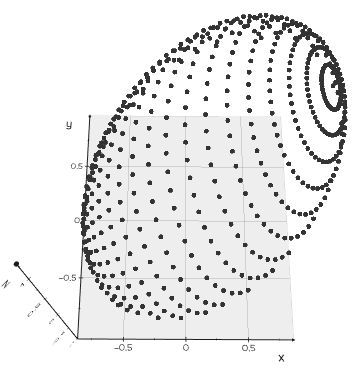
Source code in vedo/pointcloud/analyze.py
1217
1218
1219
1220
1221
1222
1223
1224
1225
1226
1227
1228
1229
1230
1231
1232
1233
1234
1235
1236
1237
1238
1239
1240
1241
1242
1243
1244
1245
1246
1247
1248
1249
1250
1251
1252
1253
1254
1255
1256
1257
1258
1259
1260
1261
1262
1263
1264
1265
1266
1267
1268
1269
1270
1271
1272
1273
1274
1275
1276
1277
1278
1279
def visible_points(self, area=(), tol=None, invert=False) -> vedo.Points | None:
    """
    Extract points based on whether they are visible or not.
    Visibility is determined by accessing the z-buffer of a rendering window.
    The position of each input point is converted into display coordinates,
    and then the z-value at that point is obtained.
    If within the user-specified tolerance, the point is considered visible.
    Associated data attributes are passed to the output as well.

    This filter also allows you to specify a rectangular window in display (pixel)
    coordinates in which the visible points must lie.

    Args:
        area (list):
            specify a rectangular region as (xmin,xmax,ymin,ymax)
        tol (float):
            a tolerance in normalized display coordinate system
        invert (bool):
            select invisible points instead.

    Examples:
        ```python
        from vedo import Ellipsoid, show
        s = Ellipsoid().rotate_y(30)

        # Camera options: pos, focal_point, viewup, distance
        camopts = dict(pos=(0,0,25), focal_point=(0,0,0))
        show(s, camera=camopts, offscreen=True)

        m = s.visible_points()
        # print('visible pts:', m.vertices)  # numpy array
        show(m, new=True, axes=1).close() # optionally draw result in a new window
        ```
        ![](https://vedo.embl.es/images/feats/visible_points.png)
    """
    svp = vtki.new("SelectVisiblePoints")
    svp.SetInputData(self.dataset)

    ren = None
    plt = vedo.current_plotter()
    if plt and plt.renderer:
        ren = plt.renderer
        svp.SetRenderer(ren)
    if not ren:
        vedo.logger.warning(
            "visible_points() can only be used after a rendering step"
        )
        return None

    if len(area) == 2:
        area = utils.flatten(area)
    if len(area) == 4:
        # specify a rectangular region
        svp.SetSelection(area[0], area[1], area[2], area[3])
    if tol is not None:
        svp.SetTolerance(tol)
    if invert:
        svp.SelectInvisibleOn()
    svp.Update()

    m = vedo.Points(svp.GetOutput())
    m.name = "VisiblePoints"
    return m

cut

PointCutMixin

Source code in vedo/pointcloud/cut.py
 19
 20
 21
 22
 23
 24
 25
 26
 27
 28
 29
 30
 31
 32
 33
 34
 35
 36
 37
 38
 39
 40
 41
 42
 43
 44
 45
 46
 47
 48
 49
 50
 51
 52
 53
 54
 55
 56
 57
 58
 59
 60
 61
 62
 63
 64
 65
 66
 67
 68
 69
 70
 71
 72
 73
 74
 75
 76
 77
 78
 79
 80
 81
 82
 83
 84
 85
 86
 87
 88
 89
 90
 91
 92
 93
 94
 95
 96
 97
 98
 99
100
101
102
103
104
105
106
107
108
109
110
111
112
113
114
115
116
117
118
119
120
121
122
123
124
125
126
127
128
129
130
131
132
133
134
135
136
137
138
139
140
141
142
143
144
145
146
147
148
149
150
151
152
153
154
155
156
157
158
159
160
161
162
163
164
165
166
167
168
169
170
171
172
173
174
175
176
177
178
179
180
181
182
183
184
185
186
187
188
189
190
191
192
193
194
195
196
197
198
199
200
201
202
203
204
205
206
207
208
209
210
211
212
213
214
215
216
217
218
219
220
221
222
223
224
225
226
227
228
229
230
231
232
233
234
235
236
237
238
239
240
241
242
243
244
245
246
247
248
249
250
251
252
253
254
255
256
257
258
259
260
261
262
263
264
265
266
267
268
269
270
271
272
273
274
275
276
277
278
279
280
281
282
283
284
285
286
287
288
289
290
291
292
293
294
295
296
297
298
299
300
301
302
303
304
305
306
307
308
309
310
311
312
313
314
315
316
317
318
319
320
321
322
323
324
325
326
327
328
329
330
331
332
333
334
335
336
337
338
339
340
341
342
343
344
345
346
347
348
349
350
351
352
353
354
355
356
357
358
359
360
361
362
363
364
365
366
367
368
369
370
371
372
373
374
375
376
377
378
379
380
381
382
383
384
385
386
387
388
389
390
391
392
393
394
395
396
397
398
399
400
401
402
403
404
405
406
407
408
409
410
411
412
413
414
415
416
417
418
419
420
421
422
423
424
425
426
427
428
429
430
431
432
433
434
435
436
437
438
439
440
441
442
443
444
445
446
447
448
449
450
451
452
453
454
455
456
457
458
459
460
461
462
463
464
465
466
467
468
469
470
471
472
473
474
475
476
477
478
479
480
481
482
483
484
485
486
487
488
489
490
491
492
493
494
495
496
497
498
499
500
501
502
503
504
505
506
507
508
509
510
511
512
513
514
515
516
517
518
519
520
521
522
523
524
525
526
527
528
529
530
531
532
533
534
535
536
537
538
539
540
541
542
543
544
545
546
547
548
549
550
551
552
553
554
555
556
557
558
559
560
561
562
563
564
565
566
567
568
569
570
571
572
573
574
575
576
577
578
579
580
581
582
583
584
585
586
587
588
589
590
591
592
593
594
595
596
597
598
599
600
601
602
603
604
605
606
607
608
609
610
611
612
613
614
615
616
617
618
619
620
621
622
623
624
625
626
627
628
629
630
631
632
633
634
635
636
637
638
639
640
641
642
643
644
645
646
647
648
649
650
651
652
653
654
655
656
657
class PointCutMixin:
    def cut_with_plane(
        self,
        origin=(0, 0, 0),
        normal=(1, 0, 0),
        invert=False,
        # generate_ids=False,
    ) -> Self:
        """
        Cut the mesh with the plane defined by a point and a normal.

        Args:
            origin (array):
                the cutting plane goes through this point
            normal (array):
                normal of the cutting plane
            invert (bool):
                select which side of the plane to keep

        Examples:
            ```python
            from vedo import Cube
            cube = Cube().cut_with_plane(normal=(1,1,1))
            cube.back_color('pink').show().close()
            ```
            ![](https://vedo.embl.es/images/feats/cut_with_plane_cube.png)

        Examples:
            - [trail.py](https://github.com/marcomusy/vedo/blob/master/examples/animation/trail.py)

                ![](https://vedo.embl.es/images/animation/trail.gif)

        Check out also:
            `cut_with_box()`, `cut_with_cylinder()`, `cut_with_sphere()`.
        """
        s = str(normal)
        if "x" in s:
            normal = (1, 0, 0)
            if "-" in s:
                normal = -np.array(normal)
        elif "y" in s:
            normal = (0, 1, 0)
            if "-" in s:
                normal = -np.array(normal)
        elif "z" in s:
            normal = (0, 0, 1)
            if "-" in s:
                normal = -np.array(normal)
        plane = vtki.vtkPlane()
        plane.SetOrigin(origin)
        plane.SetNormal(normal)

        clipper = vtki.new("ClipPolyData")
        clipper.SetInputData(self.dataset)
        clipper.SetClipFunction(plane)
        clipper.GenerateClippedOutputOff()
        clipper.SetGenerateClipScalars(0)
        clipper.SetInsideOut(invert)
        clipper.SetValue(0)
        clipper.Update()

        # if generate_ids:
        #     saved_scalars = None # otherwise the scalars are lost
        #     if self.dataset.GetPointData().GetScalars():
        #         saved_scalars = self.dataset.GetPointData().GetScalars()
        #     varr = clipper.GetOutput().GetPointData().GetScalars()
        #     if varr.GetName() is None:
        #         varr.SetName("DistanceToCut")
        #     arr = utils.vtk2numpy(varr)
        #     # array of original ids
        #     ids = np.arange(arr.shape[0]).astype(int)
        #     ids[arr == 0] = -1
        #     ids_arr = utils.numpy2vtk(ids, dtype=int)
        #     ids_arr.SetName("OriginalIds")
        #     clipper.GetOutput().GetPointData().AddArray(ids_arr)
        #     if saved_scalars:
        #         clipper.GetOutput().GetPointData().AddArray(saved_scalars)

        self._update(clipper.GetOutput())
        self.pipeline = utils.OperationNode("cut_with_plane", parents=[self])
        return self

    def cut_with_planes(self, origins, normals, invert=False) -> Self:
        """
        Cut the mesh with a convex set of planes defined by points and normals.

        Args:
            origins (array):
                each cutting plane goes through this point
            normals (array):
                normal of each of the cutting planes
            invert (bool):
                if True, cut outside instead of inside

        Check out also:
            `cut_with_box()`, `cut_with_cylinder()`, `cut_with_sphere()`
        """

        vpoints = vtki.vtkPoints()
        for p in utils.make3d(origins):
            vpoints.InsertNextPoint(p)
        normals = utils.make3d(normals)

        planes = vtki.vtkPlanes()
        planes.SetPoints(vpoints)
        planes.SetNormals(utils.numpy2vtk(normals, dtype=float))

        clipper = vtki.new("ClipPolyData")
        clipper.SetInputData(self.dataset)
        clipper.SetInsideOut(invert)
        clipper.SetClipFunction(planes)
        clipper.GenerateClippedOutputOff()
        clipper.GenerateClipScalarsOff()
        clipper.SetValue(0)
        clipper.Update()

        self._update(clipper.GetOutput())

        self.pipeline = utils.OperationNode("cut_with_planes", parents=[self])
        return self

    def cut_with_box(self, bounds, invert=False) -> Self:
        """
        Cut the current mesh with a box or a set of boxes.
        This is much faster than `cut_with_mesh()`.

        Input `bounds` can be either:
        - a Mesh or Points object
        - a list of 6 number representing a bounding box `[xmin,xmax, ymin,ymax, zmin,zmax]`
        - a list of bounding boxes like the above: `[[xmin1,...], [xmin2,...], ...]`

        Examples:
            ```python
            from vedo import Sphere, Cube, show
            mesh = Sphere(r=1, res=50)
            box  = Cube(side=1.5).wireframe()
            mesh.cut_with_box(box)
            show(mesh, box, axes=1).close()
            ```
            ![](https://vedo.embl.es/images/feats/cut_with_box_cube.png)

        Check out also:
            `cut_with_line()`, `cut_with_plane()`, `cut_with_cylinder()`
        """
        if isinstance(bounds, vedo.pointcloud.Points):
            bounds = bounds.bounds()

        box = vtki.new("Box")
        if utils.is_sequence(bounds[0]):
            for bs in bounds:
                box.AddBounds(bs)
        else:
            box.SetBounds(bounds)

        clipper = vtki.new("ClipPolyData")
        clipper.SetInputData(self.dataset)
        clipper.SetClipFunction(box)
        clipper.SetInsideOut(not invert)
        clipper.GenerateClippedOutputOff()
        clipper.GenerateClipScalarsOff()
        clipper.SetValue(0)
        clipper.Update()
        self._update(clipper.GetOutput())

        self.pipeline = utils.OperationNode("cut_with_box", parents=[self])
        return self

    def cut_with_line(self, points, invert=False, closed=True) -> Self:
        """
        Cut the current mesh with a line vertically in the z-axis direction like a cookie cutter.
        The polyline is defined by a set of points (z-coordinates are ignored).
        This is much faster than `cut_with_mesh()`.

        Check out also:
            `cut_with_box()`, `cut_with_plane()`, `cut_with_sphere()`
        """
        pplane = vtki.new("PolyPlane")
        if isinstance(points, vedo.pointcloud.Points):
            points = points.coordinates.tolist()

        if closed:
            if isinstance(points, np.ndarray):
                points = points.tolist()
            points.append(points[0])

        vpoints = vtki.vtkPoints()
        for p in points:
            if len(p) == 2:
                p = [p[0], p[1], 0.0]
            vpoints.InsertNextPoint(p)

        n = len(points)
        polyline = vtki.new("PolyLine")
        polyline.Initialize(n, vpoints)
        polyline.GetPointIds().SetNumberOfIds(n)
        for i in range(n):
            polyline.GetPointIds().SetId(i, i)
        pplane.SetPolyLine(polyline)

        clipper = vtki.new("ClipPolyData")
        clipper.SetInputData(self.dataset)
        clipper.SetClipFunction(pplane)
        clipper.SetInsideOut(invert)
        clipper.GenerateClippedOutputOff()
        clipper.GenerateClipScalarsOff()
        clipper.SetValue(0)
        clipper.Update()
        self._update(clipper.GetOutput())

        self.pipeline = utils.OperationNode("cut_with_line", parents=[self])
        return self

    def cut_with_cookiecutter(self, lines) -> Self:
        """
        Cut the current mesh with a single line or a set of lines.

        Input `lines` can be either:
        - a `Mesh` or `Points` object
        - a list of 3D points: `[(x1,y1,z1), (x2,y2,z2), ...]`
        - a list of 2D points: `[(x1,y1), (x2,y2), ...]`

        Examples:
            ```python
            from vedo import *
            grid = Mesh(dataurl + "dolfin_fine.vtk")
            grid.compute_quality().cmap("Greens")
            pols = merge(
                Polygon(nsides=10, r=0.3).pos(0.7, 0.3),
                Polygon(nsides=10, r=0.2).pos(0.3, 0.7),
            )
            lines = pols.boundaries()
            cgrid = grid.clone().cut_with_cookiecutter(lines)
            grid.alpha(0.1).wireframe()
            show(grid, cgrid, lines, axes=8, bg='blackboard').close()
            ```
            ![](https://vedo.embl.es/images/feats/cookiecutter.png)

        Check out also:
            `cut_with_line()` and `cut_with_point_loop()`

        Note:
            In case of a warning message like:
                "Mesh and trim loop point data attributes are different"
            consider interpolating the mesh point data to the loop points,
            Eg. (in the above example):
            ```python
            lines = pols.boundaries().interpolate_data_from(grid, n=2)
            ```

        Note:
            trying to invert the selection by reversing the loop order
            will have no effect in this method, hence it does not have
            the `invert` option.
        """
        if utils.is_sequence(lines):
            lines = utils.make3d(lines)
            iline = list(range(len(lines))) + [0]
            poly = utils.buildPolyData(lines, lines=[iline])
        else:
            poly = lines.dataset

        # if invert: # not working
        #     rev = vtki.new("ReverseSense")
        #     rev.ReverseCellsOn()
        #     rev.SetInputData(poly)
        #     rev.Update()
        #     poly = rev.GetOutput()

        # Build loops from the polyline
        build_loops = vtki.new("ContourLoopExtraction")
        build_loops.SetGlobalWarningDisplay(0)
        build_loops.SetInputData(poly)
        build_loops.Update()
        boundary_poly = build_loops.GetOutput()

        ccut = vtki.new("CookieCutter")
        ccut.SetInputData(self.dataset)
        ccut.SetLoopsData(boundary_poly)
        ccut.SetPointInterpolationToMeshEdges()
        # ccut.SetPointInterpolationToLoopEdges()
        ccut.PassCellDataOn()
        ccut.PassPointDataOn()
        ccut.Update()
        self._update(ccut.GetOutput())

        self.pipeline = utils.OperationNode("cut_with_cookiecutter", parents=[self])
        return self

    def cut_with_cylinder(
        self, center=(0, 0, 0), axis=(0, 0, 1), r=1, invert=False
    ) -> Self:
        """
        Cut the current mesh with an infinite cylinder.
        This is much faster than `cut_with_mesh()`.

        Args:
            center (array):
                the center of the cylinder
            normal (array):
                direction of the cylinder axis
            r (float):
                radius of the cylinder

        Examples:
            ```python
            from vedo import Disc, show
            disc = Disc(r1=1, r2=1.2)
            mesh = disc.extrude(3, res=50).linewidth(1)
            mesh.cut_with_cylinder([0,0,2], r=0.4, axis='y', invert=True)
            show(mesh, axes=1).close()
            ```
            ![](https://vedo.embl.es/images/feats/cut_with_cylinder.png)

        Examples:
            - [optics_main1.py](https://github.com/marcomusy/vedo/blob/master/examples/animation/optics_main1.py)

        Check out also:
            `cut_with_box()`, `cut_with_plane()`, `cut_with_sphere()`
        """
        s = str(axis)
        if "x" in s:
            axis = (1, 0, 0)
        elif "y" in s:
            axis = (0, 1, 0)
        elif "z" in s:
            axis = (0, 0, 1)
        cyl = vtki.new("Cylinder")
        cyl.SetCenter(center)
        cyl.SetAxis(axis[0], axis[1], axis[2])
        cyl.SetRadius(r)

        clipper = vtki.new("ClipPolyData")
        clipper.SetInputData(self.dataset)
        clipper.SetClipFunction(cyl)
        clipper.SetInsideOut(not invert)
        clipper.GenerateClippedOutputOff()
        clipper.GenerateClipScalarsOff()
        clipper.SetValue(0)
        clipper.Update()
        self._update(clipper.GetOutput())

        self.pipeline = utils.OperationNode("cut_with_cylinder", parents=[self])
        return self

    def cut_with_sphere(self, center=(0, 0, 0), r=1.0, invert=False) -> Self:
        """
        Cut the current mesh with an sphere.
        This is much faster than `cut_with_mesh()`.

        Args:
            center (array):
                the center of the sphere
            r (float):
                radius of the sphere

        Examples:
            ```python
            from vedo import Disc, show
            disc = Disc(r1=1, r2=1.2)
            mesh = disc.extrude(3, res=50).linewidth(1)
            mesh.cut_with_sphere([1,-0.7,2], r=1.5, invert=True)
            show(mesh, axes=1).close()
            ```
            ![](https://vedo.embl.es/images/feats/cut_with_sphere.png)

        Check out also:
            `cut_with_box()`, `cut_with_plane()`, `cut_with_cylinder()`
        """
        sph = vtki.new("Sphere")
        sph.SetCenter(center)
        sph.SetRadius(r)

        clipper = vtki.new("ClipPolyData")
        clipper.SetInputData(self.dataset)
        clipper.SetClipFunction(sph)
        clipper.SetInsideOut(not invert)
        clipper.GenerateClippedOutputOff()
        clipper.GenerateClipScalarsOff()
        clipper.SetValue(0)
        clipper.Update()
        self._update(clipper.GetOutput())
        self.pipeline = utils.OperationNode("cut_with_sphere", parents=[self])
        return self

    def cut_with_mesh(self, mesh, invert=False, keep=False) -> Self | vedo.Assembly:
        """
         Cut an `Mesh` mesh with another `Mesh`.

         Use `invert` to invert the selection.

         Use `keep` to keep the cutoff part, in this case an `Assembly` is returned:
         the "cut" object and the "discarded" part of the original object.
         You can access both via `assembly.unpack()` method.

         Examples:
         ```python
         from vedo import *
         arr = np.random.randn(100000, 3)/2
         pts = Points(arr).c('red3').pos(5,0,0)
         cube = Cube().pos(4,0.5,0)
         assem = pts.cut_with_mesh(cube, keep=True)
         show(assem.unpack(), axes=1).close()
         ```
         ![](https://vedo.embl.es/images/feats/cut_with_mesh.png)

        Check out also:
             `cut_with_box()`, `cut_with_plane()`, `cut_with_cylinder()`
        """
        polymesh = mesh.dataset
        poly = self.dataset

        # Create an array to hold distance information
        signed_distances = vtki.vtkFloatArray()
        signed_distances.SetNumberOfComponents(1)
        signed_distances.SetName("SignedDistances")

        # implicit function that will be used to slice the mesh
        ippd = vtki.new("ImplicitPolyDataDistance")
        ippd.SetInput(polymesh)

        # Evaluate the signed distance function at all of the grid points
        for pointId in range(poly.GetNumberOfPoints()):
            p = poly.GetPoint(pointId)
            signed_distance = ippd.EvaluateFunction(p)
            signed_distances.InsertNextValue(signed_distance)

        currentscals = poly.GetPointData().GetScalars()
        if currentscals:
            currentscals = currentscals.GetName()

        poly.GetPointData().AddArray(signed_distances)
        poly.GetPointData().SetActiveScalars("SignedDistances")

        clipper = vtki.new("ClipPolyData")
        clipper.SetInputData(poly)
        clipper.SetInsideOut(not invert)
        clipper.SetGenerateClippedOutput(keep)
        clipper.SetValue(0.0)
        clipper.Update()
        cpoly = clipper.GetOutput()

        if keep:
            kpoly = clipper.GetOutput(1)

        vis = False
        if currentscals:
            cpoly.GetPointData().SetActiveScalars(currentscals)
            vis = self.mapper.GetScalarVisibility()

        self._update(cpoly)

        self.pointdata.remove("SignedDistances")
        self.mapper.SetScalarVisibility(vis)
        if keep:
            if isinstance(self, vedo.Mesh):
                cutoff = vedo.Mesh(kpoly)
            else:
                cutoff = vedo.Points(kpoly)
            # cutoff = self.__class__(kpoly) # this does not work properly
            cutoff.properties = vtki.vtkProperty()
            cutoff.properties.DeepCopy(self.properties)
            cutoff.actor.SetProperty(cutoff.properties)
            cutoff.c("k5").alpha(0.2)
            return vedo.Assembly([self, cutoff])

        self.pipeline = utils.OperationNode("cut_with_mesh", parents=[self, mesh])
        return self

    def cut_with_point_loop(
        self, points, invert=False, on="points", include_boundary=False
    ) -> Self:
        """
        Cut an `Mesh` object with a set of points forming a closed loop.

        Args:
            invert (bool):
                invert selection (inside-out)
            on (str):
                if 'cells' will extract the whole cells lying inside (or outside) the point loop
            include_boundary (bool):
                include cells lying exactly on the boundary line. Only relevant on 'cells' mode

        Examples:
            - [cut_with_points1.py](https://github.com/marcomusy/vedo/blob/master/examples/advanced/cut_with_points1.py)

                ![](https://vedo.embl.es/images/advanced/cutWithPoints1.png)

            - [cut_with_points2.py](https://github.com/marcomusy/vedo/blob/master/examples/advanced/cut_with_points2.py)

                ![](https://vedo.embl.es/images/advanced/cutWithPoints2.png)
        """
        if isinstance(points, vedo.pointcloud.Points):
            parents = [points]
            vpts = points.dataset.GetPoints()
            points = points.coordinates
        else:
            parents = [self]
            vpts = vtki.vtkPoints()
            points = utils.make3d(points)
            for p in points:
                vpts.InsertNextPoint(p)

        if "cell" in on:
            ippd = vtki.new("ImplicitSelectionLoop")
            ippd.SetLoop(vpts)
            ippd.AutomaticNormalGenerationOn()
            clipper = vtki.new("ExtractPolyDataGeometry")
            clipper.SetInputData(self.dataset)
            clipper.SetImplicitFunction(ippd)
            clipper.SetExtractInside(not invert)
            clipper.SetExtractBoundaryCells(include_boundary)
        else:
            spol = vtki.new("SelectPolyData")
            spol.SetLoop(vpts)
            spol.GenerateSelectionScalarsOn()
            spol.GenerateUnselectedOutputOff()
            spol.SetInputData(self.dataset)
            spol.Update()
            clipper = vtki.new("ClipPolyData")
            clipper.SetInputData(spol.GetOutput())
            clipper.SetInsideOut(not invert)
            clipper.SetValue(0.0)
        clipper.Update()
        self._update(clipper.GetOutput())

        self.pipeline = utils.OperationNode("cut_with_pointloop", parents=parents)
        return self

    def cut_with_scalar(self, value: float, name="", invert=False) -> Self:
        """
        Cut a mesh or point cloud with some input scalar point-data.

        Args:
            value (float):
                cutting value
            name (str):
                array name of the scalars to be used
            invert (bool):
                flip selection

        Examples:
            ```python
            from vedo import *
            s = Sphere().lw(1)
            pts = s.points
            scalars = np.sin(3*pts[:,2]) + pts[:,0]
            s.pointdata["somevalues"] = scalars
            s.cut_with_scalar(0.3)
            s.cmap("Spectral", "somevalues").add_scalarbar()
            s.show(axes=1).close()
            ```
            ![](https://vedo.embl.es/images/feats/cut_with_scalars.png)
        """
        if name:
            self.pointdata.select(name)
        clipper = vtki.new("ClipPolyData")
        clipper.SetInputData(self.dataset)
        clipper.SetValue(value)
        clipper.GenerateClippedOutputOff()
        clipper.SetInsideOut(not invert)
        clipper.Update()
        self._update(clipper.GetOutput())
        self.pipeline = utils.OperationNode("cut_with_scalar", parents=[self])
        return self

    def crop(
        self,
        top=None,
        bottom=None,
        right=None,
        left=None,
        front=None,
        back=None,
        bounds=(),
    ) -> Self:
        """
        Crop an `Mesh` object.

        Args:
            top (float):
                fraction to crop from the top plane (positive z)
            bottom (float):
                fraction to crop from the bottom plane (negative z)
            front (float):
                fraction to crop from the front plane (positive y)
            back (float):
                fraction to crop from the back plane (negative y)
            right (float):
                fraction to crop from the right plane (positive x)
            left (float):
                fraction to crop from the left plane (negative x)
            bounds (list):
                bounding box of the crop region as `[x0,x1, y0,y1, z0,z1]`

        Examples:
            ```python
            from vedo import Sphere
            Sphere().crop(right=0.3, left=0.1).show()
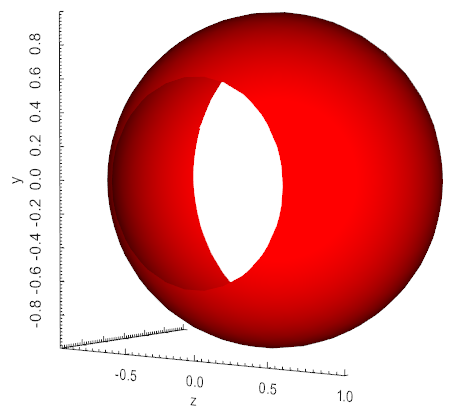
            ```
            ![](https://user-images.githubusercontent.com/32848391/57081955-0ef1e800-6cf6-11e9-99de-b45220939bc9.png)
        """
        if len(bounds) == 0:
            pos = np.array(self.pos())
            x0, x1, y0, y1, z0, z1 = self.bounds()
            x0, y0, z0 = [x0, y0, z0] - pos
            x1, y1, z1 = [x1, y1, z1] - pos

            dx, dy, dz = x1 - x0, y1 - y0, z1 - z0
            if top:
                z1 = z1 - top * dz
            if bottom:
                z0 = z0 + bottom * dz
            if front:
                y1 = y1 - front * dy
            if back:
                y0 = y0 + back * dy
            if right:
                x1 = x1 - right * dx
            if left:
                x0 = x0 + left * dx
            bounds = (x0, x1, y0, y1, z0, z1)

        cu = vtki.new("Box")
        cu.SetBounds(bounds)

        clipper = vtki.new("ClipPolyData")
        clipper.SetInputData(self.dataset)
        clipper.SetClipFunction(cu)
        clipper.InsideOutOn()
        clipper.GenerateClippedOutputOff()
        clipper.GenerateClipScalarsOff()
        clipper.SetValue(0)
        clipper.Update()
        self._update(clipper.GetOutput())

        self.pipeline = utils.OperationNode(
            "crop", parents=[self], comment=f"#pts {self.dataset.GetNumberOfPoints()}"
        )
        return self

crop(top=None, bottom=None, right=None, left=None, front=None, back=None, bounds=())

Crop an Mesh object.

Parameters:

Name Type Description Default
top float

fraction to crop from the top plane (positive z)

None
bottom float

fraction to crop from the bottom plane (negative z)

None
front float

fraction to crop from the front plane (positive y)

None
back float

fraction to crop from the back plane (negative y)

None
right float

fraction to crop from the right plane (positive x)

None
left float

fraction to crop from the left plane (negative x)

None
bounds list

bounding box of the crop region as [x0,x1, y0,y1, z0,z1]

()

Examples:

from vedo import Sphere
Sphere().crop(right=0.3, left=0.1).show()

Source code in vedo/pointcloud/cut.py
584
585
586
587
588
589
590
591
592
593
594
595
596
597
598
599
600
601
602
603
604
605
606
607
608
609
610
611
612
613
614
615
616
617
618
619
620
621
622
623
624
625
626
627
628
629
630
631
632
633
634
635
636
637
638
639
640
641
642
643
644
645
646
647
648
649
650
651
652
653
654
655
656
657
def crop(
    self,
    top=None,
    bottom=None,
    right=None,
    left=None,
    front=None,
    back=None,
    bounds=(),
) -> Self:
    """
    Crop an `Mesh` object.

    Args:
        top (float):
            fraction to crop from the top plane (positive z)
        bottom (float):
            fraction to crop from the bottom plane (negative z)
        front (float):
            fraction to crop from the front plane (positive y)
        back (float):
            fraction to crop from the back plane (negative y)
        right (float):
            fraction to crop from the right plane (positive x)
        left (float):
            fraction to crop from the left plane (negative x)
        bounds (list):
            bounding box of the crop region as `[x0,x1, y0,y1, z0,z1]`

    Examples:
        ```python
        from vedo import Sphere
        Sphere().crop(right=0.3, left=0.1).show()
        ```
        ![](https://user-images.githubusercontent.com/32848391/57081955-0ef1e800-6cf6-11e9-99de-b45220939bc9.png)
    """
    if len(bounds) == 0:
        pos = np.array(self.pos())
        x0, x1, y0, y1, z0, z1 = self.bounds()
        x0, y0, z0 = [x0, y0, z0] - pos
        x1, y1, z1 = [x1, y1, z1] - pos

        dx, dy, dz = x1 - x0, y1 - y0, z1 - z0
        if top:
            z1 = z1 - top * dz
        if bottom:
            z0 = z0 + bottom * dz
        if front:
            y1 = y1 - front * dy
        if back:
            y0 = y0 + back * dy
        if right:
            x1 = x1 - right * dx
        if left:
            x0 = x0 + left * dx
        bounds = (x0, x1, y0, y1, z0, z1)

    cu = vtki.new("Box")
    cu.SetBounds(bounds)

    clipper = vtki.new("ClipPolyData")
    clipper.SetInputData(self.dataset)
    clipper.SetClipFunction(cu)
    clipper.InsideOutOn()
    clipper.GenerateClippedOutputOff()
    clipper.GenerateClipScalarsOff()
    clipper.SetValue(0)
    clipper.Update()
    self._update(clipper.GetOutput())

    self.pipeline = utils.OperationNode(
        "crop", parents=[self], comment=f"#pts {self.dataset.GetNumberOfPoints()}"
    )
    return self

cut_with_box(bounds, invert=False)

Cut the current mesh with a box or a set of boxes. This is much faster than cut_with_mesh().

Input bounds can be either: - a Mesh or Points object - a list of 6 number representing a bounding box [xmin,xmax, ymin,ymax, zmin,zmax] - a list of bounding boxes like the above: [[xmin1,...], [xmin2,...], ...]

Examples:

from vedo import Sphere, Cube, show
mesh = Sphere(r=1, res=50)
box  = Cube(side=1.5).wireframe()
mesh.cut_with_box(box)
show(mesh, box, axes=1).close()
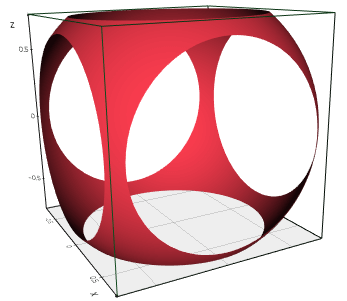
Check out also

cut_with_line(), cut_with_plane(), cut_with_cylinder()

Source code in vedo/pointcloud/cut.py
140
141
142
143
144
145
146
147
148
149
150
151
152
153
154
155
156
157
158
159
160
161
162
163
164
165
166
167
168
169
170
171
172
173
174
175
176
177
178
179
180
181
182
183
184
def cut_with_box(self, bounds, invert=False) -> Self:
    """
    Cut the current mesh with a box or a set of boxes.
    This is much faster than `cut_with_mesh()`.

    Input `bounds` can be either:
    - a Mesh or Points object
    - a list of 6 number representing a bounding box `[xmin,xmax, ymin,ymax, zmin,zmax]`
    - a list of bounding boxes like the above: `[[xmin1,...], [xmin2,...], ...]`

    Examples:
        ```python
        from vedo import Sphere, Cube, show
        mesh = Sphere(r=1, res=50)
        box  = Cube(side=1.5).wireframe()
        mesh.cut_with_box(box)
        show(mesh, box, axes=1).close()
        ```
        ![](https://vedo.embl.es/images/feats/cut_with_box_cube.png)

    Check out also:
        `cut_with_line()`, `cut_with_plane()`, `cut_with_cylinder()`
    """
    if isinstance(bounds, vedo.pointcloud.Points):
        bounds = bounds.bounds()

    box = vtki.new("Box")
    if utils.is_sequence(bounds[0]):
        for bs in bounds:
            box.AddBounds(bs)
    else:
        box.SetBounds(bounds)

    clipper = vtki.new("ClipPolyData")
    clipper.SetInputData(self.dataset)
    clipper.SetClipFunction(box)
    clipper.SetInsideOut(not invert)
    clipper.GenerateClippedOutputOff()
    clipper.GenerateClipScalarsOff()
    clipper.SetValue(0)
    clipper.Update()
    self._update(clipper.GetOutput())

    self.pipeline = utils.OperationNode("cut_with_box", parents=[self])
    return self

cut_with_cookiecutter(lines)

Cut the current mesh with a single line or a set of lines.

Input lines can be either: - a Mesh or Points object - a list of 3D points: [(x1,y1,z1), (x2,y2,z2), ...] - a list of 2D points: [(x1,y1), (x2,y2), ...]

Examples:

from vedo import *
grid = Mesh(dataurl + "dolfin_fine.vtk")
grid.compute_quality().cmap("Greens")
pols = merge(
    Polygon(nsides=10, r=0.3).pos(0.7, 0.3),
    Polygon(nsides=10, r=0.2).pos(0.3, 0.7),
)
lines = pols.boundaries()
cgrid = grid.clone().cut_with_cookiecutter(lines)
grid.alpha(0.1).wireframe()
show(grid, cgrid, lines, axes=8, bg='blackboard').close()
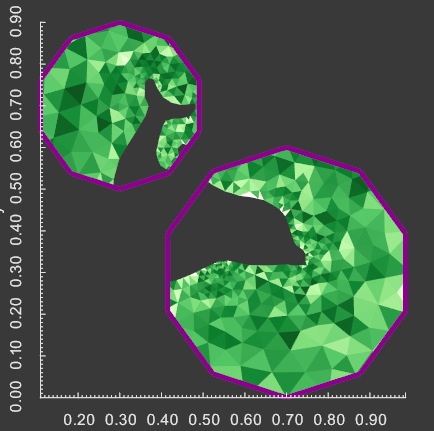
Check out also

cut_with_line() and cut_with_point_loop()

Note

In case of a warning message like: "Mesh and trim loop point data attributes are different" consider interpolating the mesh point data to the loop points, Eg. (in the above example):

lines = pols.boundaries().interpolate_data_from(grid, n=2)

Note

trying to invert the selection by reversing the loop order will have no effect in this method, hence it does not have the invert option.

Source code in vedo/pointcloud/cut.py
231
232
233
234
235
236
237
238
239
240
241
242
243
244
245
246
247
248
249
250
251
252
253
254
255
256
257
258
259
260
261
262
263
264
265
266
267
268
269
270
271
272
273
274
275
276
277
278
279
280
281
282
283
284
285
286
287
288
289
290
291
292
293
294
295
296
297
298
299
300
301
302
303
304
305
def cut_with_cookiecutter(self, lines) -> Self:
    """
    Cut the current mesh with a single line or a set of lines.

    Input `lines` can be either:
    - a `Mesh` or `Points` object
    - a list of 3D points: `[(x1,y1,z1), (x2,y2,z2), ...]`
    - a list of 2D points: `[(x1,y1), (x2,y2), ...]`

    Examples:
        ```python
        from vedo import *
        grid = Mesh(dataurl + "dolfin_fine.vtk")
        grid.compute_quality().cmap("Greens")
        pols = merge(
            Polygon(nsides=10, r=0.3).pos(0.7, 0.3),
            Polygon(nsides=10, r=0.2).pos(0.3, 0.7),
        )
        lines = pols.boundaries()
        cgrid = grid.clone().cut_with_cookiecutter(lines)
        grid.alpha(0.1).wireframe()
        show(grid, cgrid, lines, axes=8, bg='blackboard').close()
        ```
        ![](https://vedo.embl.es/images/feats/cookiecutter.png)

    Check out also:
        `cut_with_line()` and `cut_with_point_loop()`

    Note:
        In case of a warning message like:
            "Mesh and trim loop point data attributes are different"
        consider interpolating the mesh point data to the loop points,
        Eg. (in the above example):
        ```python
        lines = pols.boundaries().interpolate_data_from(grid, n=2)
        ```

    Note:
        trying to invert the selection by reversing the loop order
        will have no effect in this method, hence it does not have
        the `invert` option.
    """
    if utils.is_sequence(lines):
        lines = utils.make3d(lines)
        iline = list(range(len(lines))) + [0]
        poly = utils.buildPolyData(lines, lines=[iline])
    else:
        poly = lines.dataset

    # if invert: # not working
    #     rev = vtki.new("ReverseSense")
    #     rev.ReverseCellsOn()
    #     rev.SetInputData(poly)
    #     rev.Update()
    #     poly = rev.GetOutput()

    # Build loops from the polyline
    build_loops = vtki.new("ContourLoopExtraction")
    build_loops.SetGlobalWarningDisplay(0)
    build_loops.SetInputData(poly)
    build_loops.Update()
    boundary_poly = build_loops.GetOutput()

    ccut = vtki.new("CookieCutter")
    ccut.SetInputData(self.dataset)
    ccut.SetLoopsData(boundary_poly)
    ccut.SetPointInterpolationToMeshEdges()
    # ccut.SetPointInterpolationToLoopEdges()
    ccut.PassCellDataOn()
    ccut.PassPointDataOn()
    ccut.Update()
    self._update(ccut.GetOutput())

    self.pipeline = utils.OperationNode("cut_with_cookiecutter", parents=[self])
    return self

cut_with_cylinder(center=(0, 0, 0), axis=(0, 0, 1), r=1, invert=False)

Cut the current mesh with an infinite cylinder. This is much faster than cut_with_mesh().

Parameters:

Name Type Description Default
center array

the center of the cylinder

(0, 0, 0)
normal array

direction of the cylinder axis

required
r float

radius of the cylinder

1

Examples:

from vedo import Disc, show
disc = Disc(r1=1, r2=1.2)
mesh = disc.extrude(3, res=50).linewidth(1)
mesh.cut_with_cylinder([0,0,2], r=0.4, axis='y', invert=True)
show(mesh, axes=1).close()
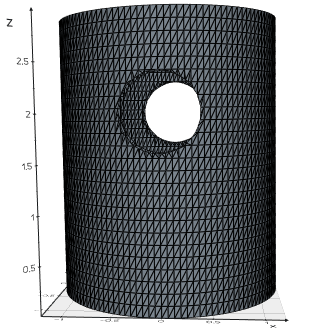
Examples:

Check out also

cut_with_box(), cut_with_plane(), cut_with_sphere()

Source code in vedo/pointcloud/cut.py
307
308
309
310
311
312
313
314
315
316
317
318
319
320
321
322
323
324
325
326
327
328
329
330
331
332
333
334
335
336
337
338
339
340
341
342
343
344
345
346
347
348
349
350
351
352
353
354
355
356
357
358
359
360
361
def cut_with_cylinder(
    self, center=(0, 0, 0), axis=(0, 0, 1), r=1, invert=False
) -> Self:
    """
    Cut the current mesh with an infinite cylinder.
    This is much faster than `cut_with_mesh()`.

    Args:
        center (array):
            the center of the cylinder
        normal (array):
            direction of the cylinder axis
        r (float):
            radius of the cylinder

    Examples:
        ```python
        from vedo import Disc, show
        disc = Disc(r1=1, r2=1.2)
        mesh = disc.extrude(3, res=50).linewidth(1)
        mesh.cut_with_cylinder([0,0,2], r=0.4, axis='y', invert=True)
        show(mesh, axes=1).close()
        ```
        ![](https://vedo.embl.es/images/feats/cut_with_cylinder.png)

    Examples:
        - [optics_main1.py](https://github.com/marcomusy/vedo/blob/master/examples/animation/optics_main1.py)

    Check out also:
        `cut_with_box()`, `cut_with_plane()`, `cut_with_sphere()`
    """
    s = str(axis)
    if "x" in s:
        axis = (1, 0, 0)
    elif "y" in s:
        axis = (0, 1, 0)
    elif "z" in s:
        axis = (0, 0, 1)
    cyl = vtki.new("Cylinder")
    cyl.SetCenter(center)
    cyl.SetAxis(axis[0], axis[1], axis[2])
    cyl.SetRadius(r)

    clipper = vtki.new("ClipPolyData")
    clipper.SetInputData(self.dataset)
    clipper.SetClipFunction(cyl)
    clipper.SetInsideOut(not invert)
    clipper.GenerateClippedOutputOff()
    clipper.GenerateClipScalarsOff()
    clipper.SetValue(0)
    clipper.Update()
    self._update(clipper.GetOutput())

    self.pipeline = utils.OperationNode("cut_with_cylinder", parents=[self])
    return self

cut_with_line(points, invert=False, closed=True)

Cut the current mesh with a line vertically in the z-axis direction like a cookie cutter. The polyline is defined by a set of points (z-coordinates are ignored). This is much faster than cut_with_mesh().

Check out also

cut_with_box(), cut_with_plane(), cut_with_sphere()

Source code in vedo/pointcloud/cut.py
186
187
188
189
190
191
192
193
194
195
196
197
198
199
200
201
202
203
204
205
206
207
208
209
210
211
212
213
214
215
216
217
218
219
220
221
222
223
224
225
226
227
228
229
def cut_with_line(self, points, invert=False, closed=True) -> Self:
    """
    Cut the current mesh with a line vertically in the z-axis direction like a cookie cutter.
    The polyline is defined by a set of points (z-coordinates are ignored).
    This is much faster than `cut_with_mesh()`.

    Check out also:
        `cut_with_box()`, `cut_with_plane()`, `cut_with_sphere()`
    """
    pplane = vtki.new("PolyPlane")
    if isinstance(points, vedo.pointcloud.Points):
        points = points.coordinates.tolist()

    if closed:
        if isinstance(points, np.ndarray):
            points = points.tolist()
        points.append(points[0])

    vpoints = vtki.vtkPoints()
    for p in points:
        if len(p) == 2:
            p = [p[0], p[1], 0.0]
        vpoints.InsertNextPoint(p)

    n = len(points)
    polyline = vtki.new("PolyLine")
    polyline.Initialize(n, vpoints)
    polyline.GetPointIds().SetNumberOfIds(n)
    for i in range(n):
        polyline.GetPointIds().SetId(i, i)
    pplane.SetPolyLine(polyline)

    clipper = vtki.new("ClipPolyData")
    clipper.SetInputData(self.dataset)
    clipper.SetClipFunction(pplane)
    clipper.SetInsideOut(invert)
    clipper.GenerateClippedOutputOff()
    clipper.GenerateClipScalarsOff()
    clipper.SetValue(0)
    clipper.Update()
    self._update(clipper.GetOutput())

    self.pipeline = utils.OperationNode("cut_with_line", parents=[self])
    return self

cut_with_mesh(mesh, invert=False, keep=False)

Cut an Mesh mesh with another Mesh.

Use invert to invert the selection.

Use keep to keep the cutoff part, in this case an Assembly is returned: the "cut" object and the "discarded" part of the original object. You can access both via assembly.unpack() method.

Examples:

from vedo import *
arr = np.random.randn(100000, 3)/2
pts = Points(arr).c('red3').pos(5,0,0)
cube = Cube().pos(4,0.5,0)
assem = pts.cut_with_mesh(cube, keep=True)
show(assem.unpack(), axes=1).close()
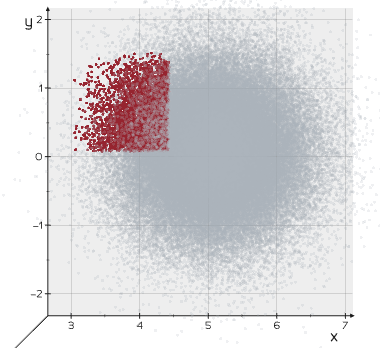
Check out also

cut_with_box(), cut_with_plane(), cut_with_cylinder()

Source code in vedo/pointcloud/cut.py
403
404
405
406
407
408
409
410
411
412
413
414
415
416
417
418
419
420
421
422
423
424
425
426
427
428
429
430
431
432
433
434
435
436
437
438
439
440
441
442
443
444
445
446
447
448
449
450
451
452
453
454
455
456
457
458
459
460
461
462
463
464
465
466
467
468
469
470
471
472
473
474
475
476
477
478
479
480
481
482
483
484
485
def cut_with_mesh(self, mesh, invert=False, keep=False) -> Self | vedo.Assembly:
    """
     Cut an `Mesh` mesh with another `Mesh`.

     Use `invert` to invert the selection.

     Use `keep` to keep the cutoff part, in this case an `Assembly` is returned:
     the "cut" object and the "discarded" part of the original object.
     You can access both via `assembly.unpack()` method.

     Examples:
     ```python
     from vedo import *
     arr = np.random.randn(100000, 3)/2
     pts = Points(arr).c('red3').pos(5,0,0)
     cube = Cube().pos(4,0.5,0)
     assem = pts.cut_with_mesh(cube, keep=True)
     show(assem.unpack(), axes=1).close()
     ```
     ![](https://vedo.embl.es/images/feats/cut_with_mesh.png)

    Check out also:
         `cut_with_box()`, `cut_with_plane()`, `cut_with_cylinder()`
    """
    polymesh = mesh.dataset
    poly = self.dataset

    # Create an array to hold distance information
    signed_distances = vtki.vtkFloatArray()
    signed_distances.SetNumberOfComponents(1)
    signed_distances.SetName("SignedDistances")

    # implicit function that will be used to slice the mesh
    ippd = vtki.new("ImplicitPolyDataDistance")
    ippd.SetInput(polymesh)

    # Evaluate the signed distance function at all of the grid points
    for pointId in range(poly.GetNumberOfPoints()):
        p = poly.GetPoint(pointId)
        signed_distance = ippd.EvaluateFunction(p)
        signed_distances.InsertNextValue(signed_distance)

    currentscals = poly.GetPointData().GetScalars()
    if currentscals:
        currentscals = currentscals.GetName()

    poly.GetPointData().AddArray(signed_distances)
    poly.GetPointData().SetActiveScalars("SignedDistances")

    clipper = vtki.new("ClipPolyData")
    clipper.SetInputData(poly)
    clipper.SetInsideOut(not invert)
    clipper.SetGenerateClippedOutput(keep)
    clipper.SetValue(0.0)
    clipper.Update()
    cpoly = clipper.GetOutput()

    if keep:
        kpoly = clipper.GetOutput(1)

    vis = False
    if currentscals:
        cpoly.GetPointData().SetActiveScalars(currentscals)
        vis = self.mapper.GetScalarVisibility()

    self._update(cpoly)

    self.pointdata.remove("SignedDistances")
    self.mapper.SetScalarVisibility(vis)
    if keep:
        if isinstance(self, vedo.Mesh):
            cutoff = vedo.Mesh(kpoly)
        else:
            cutoff = vedo.Points(kpoly)
        # cutoff = self.__class__(kpoly) # this does not work properly
        cutoff.properties = vtki.vtkProperty()
        cutoff.properties.DeepCopy(self.properties)
        cutoff.actor.SetProperty(cutoff.properties)
        cutoff.c("k5").alpha(0.2)
        return vedo.Assembly([self, cutoff])

    self.pipeline = utils.OperationNode("cut_with_mesh", parents=[self, mesh])
    return self

cut_with_plane(origin=(0, 0, 0), normal=(1, 0, 0), invert=False)

Cut the mesh with the plane defined by a point and a normal.

Parameters:

Name Type Description Default
origin array

the cutting plane goes through this point

(0, 0, 0)
normal array

normal of the cutting plane

(1, 0, 0)
invert bool

select which side of the plane to keep

False

Examples:

from vedo import Cube
cube = Cube().cut_with_plane(normal=(1,1,1))
cube.back_color('pink').show().close()
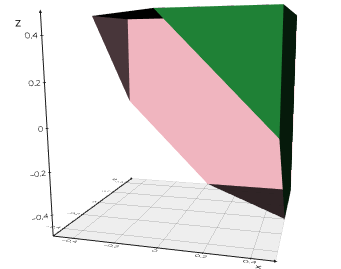
Examples:
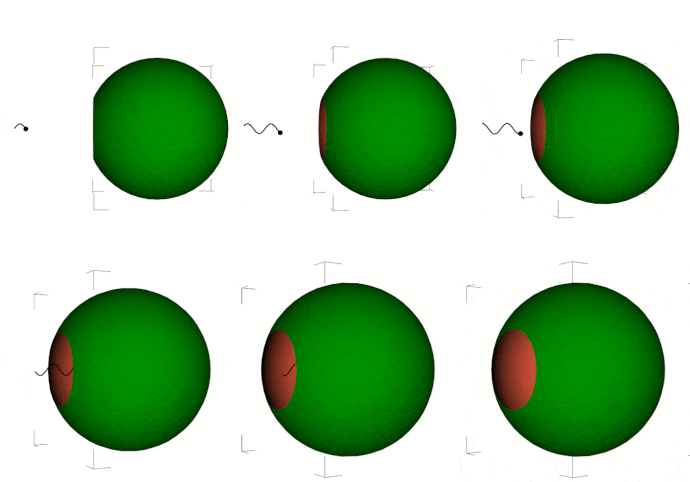
Check out also

cut_with_box(), cut_with_cylinder(), cut_with_sphere().

Source code in vedo/pointcloud/cut.py
20
21
22
23
24
25
26
27
28
29
30
31
32
33
34
35
36
37
38
39
40
41
42
43
44
45
46
47
48
49
50
51
52
53
54
55
56
57
58
59
60
61
62
63
64
65
66
67
68
69
70
71
72
73
74
75
76
77
78
79
80
81
82
83
84
85
86
87
88
89
90
91
92
93
94
95
96
97
98
99
def cut_with_plane(
    self,
    origin=(0, 0, 0),
    normal=(1, 0, 0),
    invert=False,
    # generate_ids=False,
) -> Self:
    """
    Cut the mesh with the plane defined by a point and a normal.

    Args:
        origin (array):
            the cutting plane goes through this point
        normal (array):
            normal of the cutting plane
        invert (bool):
            select which side of the plane to keep

    Examples:
        ```python
        from vedo import Cube
        cube = Cube().cut_with_plane(normal=(1,1,1))
        cube.back_color('pink').show().close()
        ```
        ![](https://vedo.embl.es/images/feats/cut_with_plane_cube.png)

    Examples:
        - [trail.py](https://github.com/marcomusy/vedo/blob/master/examples/animation/trail.py)

            ![](https://vedo.embl.es/images/animation/trail.gif)

    Check out also:
        `cut_with_box()`, `cut_with_cylinder()`, `cut_with_sphere()`.
    """
    s = str(normal)
    if "x" in s:
        normal = (1, 0, 0)
        if "-" in s:
            normal = -np.array(normal)
    elif "y" in s:
        normal = (0, 1, 0)
        if "-" in s:
            normal = -np.array(normal)
    elif "z" in s:
        normal = (0, 0, 1)
        if "-" in s:
            normal = -np.array(normal)
    plane = vtki.vtkPlane()
    plane.SetOrigin(origin)
    plane.SetNormal(normal)

    clipper = vtki.new("ClipPolyData")
    clipper.SetInputData(self.dataset)
    clipper.SetClipFunction(plane)
    clipper.GenerateClippedOutputOff()
    clipper.SetGenerateClipScalars(0)
    clipper.SetInsideOut(invert)
    clipper.SetValue(0)
    clipper.Update()

    # if generate_ids:
    #     saved_scalars = None # otherwise the scalars are lost
    #     if self.dataset.GetPointData().GetScalars():
    #         saved_scalars = self.dataset.GetPointData().GetScalars()
    #     varr = clipper.GetOutput().GetPointData().GetScalars()
    #     if varr.GetName() is None:
    #         varr.SetName("DistanceToCut")
    #     arr = utils.vtk2numpy(varr)
    #     # array of original ids
    #     ids = np.arange(arr.shape[0]).astype(int)
    #     ids[arr == 0] = -1
    #     ids_arr = utils.numpy2vtk(ids, dtype=int)
    #     ids_arr.SetName("OriginalIds")
    #     clipper.GetOutput().GetPointData().AddArray(ids_arr)
    #     if saved_scalars:
    #         clipper.GetOutput().GetPointData().AddArray(saved_scalars)

    self._update(clipper.GetOutput())
    self.pipeline = utils.OperationNode("cut_with_plane", parents=[self])
    return self

cut_with_planes(origins, normals, invert=False)

Cut the mesh with a convex set of planes defined by points and normals.

Parameters:

Name Type Description Default
origins array

each cutting plane goes through this point

required
normals array

normal of each of the cutting planes

required
invert bool

if True, cut outside instead of inside

False
Check out also

cut_with_box(), cut_with_cylinder(), cut_with_sphere()

Source code in vedo/pointcloud/cut.py
101
102
103
104
105
106
107
108
109
110
111
112
113
114
115
116
117
118
119
120
121
122
123
124
125
126
127
128
129
130
131
132
133
134
135
136
137
138
def cut_with_planes(self, origins, normals, invert=False) -> Self:
    """
    Cut the mesh with a convex set of planes defined by points and normals.

    Args:
        origins (array):
            each cutting plane goes through this point
        normals (array):
            normal of each of the cutting planes
        invert (bool):
            if True, cut outside instead of inside

    Check out also:
        `cut_with_box()`, `cut_with_cylinder()`, `cut_with_sphere()`
    """

    vpoints = vtki.vtkPoints()
    for p in utils.make3d(origins):
        vpoints.InsertNextPoint(p)
    normals = utils.make3d(normals)

    planes = vtki.vtkPlanes()
    planes.SetPoints(vpoints)
    planes.SetNormals(utils.numpy2vtk(normals, dtype=float))

    clipper = vtki.new("ClipPolyData")
    clipper.SetInputData(self.dataset)
    clipper.SetInsideOut(invert)
    clipper.SetClipFunction(planes)
    clipper.GenerateClippedOutputOff()
    clipper.GenerateClipScalarsOff()
    clipper.SetValue(0)
    clipper.Update()

    self._update(clipper.GetOutput())

    self.pipeline = utils.OperationNode("cut_with_planes", parents=[self])
    return self

cut_with_point_loop(points, invert=False, on='points', include_boundary=False)

Cut an Mesh object with a set of points forming a closed loop.

Parameters:

Name Type Description Default
invert bool

invert selection (inside-out)

False
on str

if 'cells' will extract the whole cells lying inside (or outside) the point loop

'points'
include_boundary bool

include cells lying exactly on the boundary line. Only relevant on 'cells' mode

False

Examples:

Source code in vedo/pointcloud/cut.py
487
488
489
490
491
492
493
494
495
496
497
498
499
500
501
502
503
504
505
506
507
508
509
510
511
512
513
514
515
516
517
518
519
520
521
522
523
524
525
526
527
528
529
530
531
532
533
534
535
536
537
538
539
540
541
542
543
544
545
def cut_with_point_loop(
    self, points, invert=False, on="points", include_boundary=False
) -> Self:
    """
    Cut an `Mesh` object with a set of points forming a closed loop.

    Args:
        invert (bool):
            invert selection (inside-out)
        on (str):
            if 'cells' will extract the whole cells lying inside (or outside) the point loop
        include_boundary (bool):
            include cells lying exactly on the boundary line. Only relevant on 'cells' mode

    Examples:
        - [cut_with_points1.py](https://github.com/marcomusy/vedo/blob/master/examples/advanced/cut_with_points1.py)

            ![](https://vedo.embl.es/images/advanced/cutWithPoints1.png)

        - [cut_with_points2.py](https://github.com/marcomusy/vedo/blob/master/examples/advanced/cut_with_points2.py)

            ![](https://vedo.embl.es/images/advanced/cutWithPoints2.png)
    """
    if isinstance(points, vedo.pointcloud.Points):
        parents = [points]
        vpts = points.dataset.GetPoints()
        points = points.coordinates
    else:
        parents = [self]
        vpts = vtki.vtkPoints()
        points = utils.make3d(points)
        for p in points:
            vpts.InsertNextPoint(p)

    if "cell" in on:
        ippd = vtki.new("ImplicitSelectionLoop")
        ippd.SetLoop(vpts)
        ippd.AutomaticNormalGenerationOn()
        clipper = vtki.new("ExtractPolyDataGeometry")
        clipper.SetInputData(self.dataset)
        clipper.SetImplicitFunction(ippd)
        clipper.SetExtractInside(not invert)
        clipper.SetExtractBoundaryCells(include_boundary)
    else:
        spol = vtki.new("SelectPolyData")
        spol.SetLoop(vpts)
        spol.GenerateSelectionScalarsOn()
        spol.GenerateUnselectedOutputOff()
        spol.SetInputData(self.dataset)
        spol.Update()
        clipper = vtki.new("ClipPolyData")
        clipper.SetInputData(spol.GetOutput())
        clipper.SetInsideOut(not invert)
        clipper.SetValue(0.0)
    clipper.Update()
    self._update(clipper.GetOutput())

    self.pipeline = utils.OperationNode("cut_with_pointloop", parents=parents)
    return self

cut_with_scalar(value, name='', invert=False)

Cut a mesh or point cloud with some input scalar point-data.

Parameters:

Name Type Description Default
value float

cutting value

required
name str

array name of the scalars to be used

''
invert bool

flip selection

False

Examples:

from vedo import *
s = Sphere().lw(1)
pts = s.points
scalars = np.sin(3*pts[:,2]) + pts[:,0]
s.pointdata["somevalues"] = scalars
s.cut_with_scalar(0.3)
s.cmap("Spectral", "somevalues").add_scalarbar()
s.show(axes=1).close()
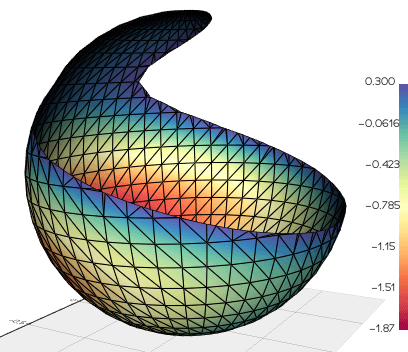
Source code in vedo/pointcloud/cut.py
547
548
549
550
551
552
553
554
555
556
557
558
559
560
561
562
563
564
565
566
567
568
569
570
571
572
573
574
575
576
577
578
579
580
581
582
def cut_with_scalar(self, value: float, name="", invert=False) -> Self:
    """
    Cut a mesh or point cloud with some input scalar point-data.

    Args:
        value (float):
            cutting value
        name (str):
            array name of the scalars to be used
        invert (bool):
            flip selection

    Examples:
        ```python
        from vedo import *
        s = Sphere().lw(1)
        pts = s.points
        scalars = np.sin(3*pts[:,2]) + pts[:,0]
        s.pointdata["somevalues"] = scalars
        s.cut_with_scalar(0.3)
        s.cmap("Spectral", "somevalues").add_scalarbar()
        s.show(axes=1).close()
        ```
        ![](https://vedo.embl.es/images/feats/cut_with_scalars.png)
    """
    if name:
        self.pointdata.select(name)
    clipper = vtki.new("ClipPolyData")
    clipper.SetInputData(self.dataset)
    clipper.SetValue(value)
    clipper.GenerateClippedOutputOff()
    clipper.SetInsideOut(not invert)
    clipper.Update()
    self._update(clipper.GetOutput())
    self.pipeline = utils.OperationNode("cut_with_scalar", parents=[self])
    return self

cut_with_sphere(center=(0, 0, 0), r=1.0, invert=False)

Cut the current mesh with an sphere. This is much faster than cut_with_mesh().

Parameters:

Name Type Description Default
center array

the center of the sphere

(0, 0, 0)
r float

radius of the sphere

1.0

Examples:

from vedo import Disc, show
disc = Disc(r1=1, r2=1.2)
mesh = disc.extrude(3, res=50).linewidth(1)
mesh.cut_with_sphere([1,-0.7,2], r=1.5, invert=True)
show(mesh, axes=1).close()
Check out also

cut_with_box(), cut_with_plane(), cut_with_cylinder()

Source code in vedo/pointcloud/cut.py
363
364
365
366
367
368
369
370
371
372
373
374
375
376
377
378
379
380
381
382
383
384
385
386
387
388
389
390
391
392
393
394
395
396
397
398
399
400
401
def cut_with_sphere(self, center=(0, 0, 0), r=1.0, invert=False) -> Self:
    """
    Cut the current mesh with an sphere.
    This is much faster than `cut_with_mesh()`.

    Args:
        center (array):
            the center of the sphere
        r (float):
            radius of the sphere

    Examples:
        ```python
        from vedo import Disc, show
        disc = Disc(r1=1, r2=1.2)
        mesh = disc.extrude(3, res=50).linewidth(1)
        mesh.cut_with_sphere([1,-0.7,2], r=1.5, invert=True)
        show(mesh, axes=1).close()
        ```
        ![](https://vedo.embl.es/images/feats/cut_with_sphere.png)

    Check out also:
        `cut_with_box()`, `cut_with_plane()`, `cut_with_cylinder()`
    """
    sph = vtki.new("Sphere")
    sph.SetCenter(center)
    sph.SetRadius(r)

    clipper = vtki.new("ClipPolyData")
    clipper.SetInputData(self.dataset)
    clipper.SetClipFunction(sph)
    clipper.SetInsideOut(not invert)
    clipper.GenerateClippedOutputOff()
    clipper.GenerateClipScalarsOff()
    clipper.SetValue(0)
    clipper.Update()
    self._update(clipper.GetOutput())
    self.pipeline = utils.OperationNode("cut_with_sphere", parents=[self])
    return self

fits

Point(pos=(0, 0, 0), r=12, c='red', alpha=1.0)

Build a point at position of radius size r, color c and transparency alpha.

Source code in vedo/pointcloud/core.py
35
36
37
def Point(pos=(0, 0, 0), r=12, c="red", alpha=1.0) -> Points:
    """Build a point at position of radius size `r`, color `c` and transparency `alpha`."""
    return Points([[0, 0, 0]], r=r, c=c, alpha=alpha).pos(pos)

fit_circle(points)

Fits a circle through a set of 3D points, with a very fast non-iterative method.

Returns the tuple (center, radius, normal_to_circle).

.. warning:: trying to fit s-shaped points will inevitably lead to instabilities and circles of small radius.

References

J.F. Crawford, Nucl. Instr. Meth. 211, 1983, 223-225.

Source code in vedo/pointcloud/fits.py
161
162
163
164
165
166
167
168
169
170
171
172
173
174
175
176
177
178
179
180
181
182
183
184
185
186
187
188
189
190
191
192
193
194
195
196
197
198
199
200
201
202
203
204
205
206
207
208
209
210
211
212
213
214
215
216
217
218
219
220
def fit_circle(points: np.ndarray | vedo.Points) -> tuple:
    """
    Fits a circle through a set of 3D points, with a very fast non-iterative method.

    Returns the tuple `(center, radius, normal_to_circle)`.

    .. warning::
        trying to fit s-shaped points will inevitably lead to instabilities and
        circles of small radius.

    References:
        *J.F. Crawford, Nucl. Instr. Meth. 211, 1983, 223-225.*
    """
    if isinstance(points, Points):
        points = points.coordinates
    data = np.asarray(points)

    offs = data.mean(axis=0)
    data, n0 = _rotate_points(data - offs)

    xi = data[:, 0]
    yi = data[:, 1]

    x = sum(xi)
    xi2 = xi * xi
    xx = sum(xi2)
    xxx = sum(xi2 * xi)

    y = sum(yi)
    yi2 = yi * yi
    yy = sum(yi2)
    yyy = sum(yi2 * yi)

    xiyi = xi * yi
    xy = sum(xiyi)
    xyy = sum(xiyi * yi)
    xxy = sum(xi * xiyi)

    N = len(xi)
    k = (xx + yy) / N

    a1 = xx - x * x / N
    b1 = xy - x * y / N
    c1 = 0.5 * (xxx + xyy - x * k)

    a2 = xy - x * y / N
    b2 = yy - y * y / N
    c2 = 0.5 * (xxy + yyy - y * k)

    d = a2 * b1 - a1 * b2
    if not d:
        return offs, 0, n0
    x0 = (b1 * c2 - b2 * c1) / d
    y0 = (c1 - a1 * x0) / b1

    R = np.sqrt(x0 * x0 + y0 * y0 - 1 / N * (2 * x0 * x + 2 * y0 * y - xx - yy))

    c, _ = _rotate_points([x0, y0, 0], (0, 0, 1), n0)

    return c[0] + offs, R, n0

fit_line(points)

Fits a line through points.

Extra info is stored in Line.slope, Line.center, Line.variances.

Examples:
Source code in vedo/pointcloud/fits.py
129
130
131
132
133
134
135
136
137
138
139
140
141
142
143
144
145
146
147
148
149
150
151
152
153
154
155
156
157
158
def fit_line(points: np.ndarray | vedo.Points) -> vedo.shapes.Line:
    """
    Fits a line through points.

    Extra info is stored in `Line.slope`, `Line.center`, `Line.variances`.

    Examples:
        - [fitline.py](https://github.com/marcomusy/vedo/tree/master/examples/advanced/fitline.py)

            ![](https://vedo.embl.es/images/advanced/fitline.png)
    """
    if isinstance(points, Points):
        points = points.coordinates
    data = np.asarray(points)
    datamean = data.mean(axis=0)
    _, dd, vv = np.linalg.svd(data - datamean)
    vv = vv[0] / np.linalg.norm(vv[0])
    # vv contains the first principal component, i.e. the direction
    # vector of the best fit line in the least squares sense.
    xyz_min = data.min(axis=0)
    xyz_max = data.max(axis=0)
    a = np.linalg.norm(xyz_min - datamean)
    b = np.linalg.norm(xyz_max - datamean)
    p1 = datamean - a * vv
    p2 = datamean + b * vv
    line = vedo.shapes.Line(p1, p2, lw=1)
    line.slope = vv
    line.center = datamean
    line.variances = dd
    return line

fit_plane(points, signed=False)

Fits a plane to a set of points.

Extra info is stored in Plane.normal, Plane.center, Plane.variance.

Parameters:

Name Type Description Default
signed bool

if True flip sign of the normal based on the ordering of the points

False

Examples:

Source code in vedo/pointcloud/fits.py
223
224
225
226
227
228
229
230
231
232
233
234
235
236
237
238
239
240
241
242
243
244
245
246
247
248
249
250
251
252
253
254
255
256
257
258
259
260
def fit_plane(points: np.ndarray | vedo.Points, signed=False) -> vedo.shapes.Plane:
    """
    Fits a plane to a set of points.

    Extra info is stored in `Plane.normal`, `Plane.center`, `Plane.variance`.

    Args:
        signed (bool):
            if True flip sign of the normal based on the ordering of the points

    Examples:
        - [fitline.py](https://github.com/marcomusy/vedo/tree/master/examples/advanced/fitline.py)

            ![](https://vedo.embl.es/images/advanced/fitline.png)
    """
    if isinstance(points, Points):
        points = points.coordinates
    data = np.asarray(points)
    datamean = data.mean(axis=0)
    pts = data - datamean
    res = np.linalg.svd(pts)
    dd, vv = res[1], res[2]
    n = np.cross(vv[0], vv[1])
    if signed:
        v = np.zeros_like(pts)
        for i in range(len(pts) - 1):
            vi = np.cross(pts[i], pts[i + 1])
            v[i] = vi / np.linalg.norm(vi)
        ns = np.mean(v, axis=0)  # normal to the points plane
        if np.dot(n, ns) < 0:
            n = -n
    xyz_min = data.min(axis=0)
    xyz_max = data.max(axis=0)
    s = np.linalg.norm(xyz_max - xyz_min)
    pla = vedo.shapes.Plane(datamean, n, s=[s, s])
    pla.variance = dd[2]
    pla.name = "FitPlane"
    return pla

fit_sphere(coords)

Fits a sphere to a set of points.

Extra info is stored in Sphere.radius, Sphere.center, Sphere.residue.

Examples:
Source code in vedo/pointcloud/fits.py
421
422
423
424
425
426
427
428
429
430
431
432
433
434
435
436
437
438
439
440
441
442
443
444
445
446
447
448
449
450
451
452
453
454
455
456
457
458
459
460
461
462
def fit_sphere(coords: np.ndarray | vedo.Points) -> vedo.shapes.Sphere:
    """
    Fits a sphere to a set of points.

    Extra info is stored in `Sphere.radius`, `Sphere.center`, `Sphere.residue`.

    Examples:
        - [fitspheres1.py](https://github.com/marcomusy/vedo/tree/master/examples/basic/fitspheres1.py)

            ![](https://vedo.embl.es/images/advanced/fitspheres1.jpg)
    """
    if isinstance(coords, Points):
        coords = coords.coordinates
    coords = np.array(coords)
    n = len(coords)
    A = np.zeros((n, 4))
    A[:, :-1] = coords * 2
    A[:, 3] = 1
    f = np.zeros((n, 1))
    x = coords[:, 0]
    y = coords[:, 1]
    z = coords[:, 2]
    f[:, 0] = x * x + y * y + z * z
    try:
        C, residue, rank, _ = np.linalg.lstsq(A, f, rcond=-1)  # solve AC=f
    except TypeError:
        C, residue, rank, _ = np.linalg.lstsq(A, f)  # solve AC=f
    if rank < 4:
        return None
    t = (C[0] * C[0]) + (C[1] * C[1]) + (C[2] * C[2]) + C[3]
    radius = np.sqrt(t)[0]
    center = np.array([C[0][0], C[1][0], C[2][0]])
    if len(residue) > 0:
        residue = np.sqrt(residue[0]) / n
    else:
        residue = 0
    sph = vedo.shapes.Sphere(center, radius, c=(1, 0, 0)).wireframe(1)
    sph.radius = radius
    sph.center = center
    sph.residue = residue
    sph.name = "FitSphere"
    return sph

merge(*meshs, flag=False)

Build a new Mesh (or Points) formed by the fusion of the inputs.

Similar to Assembly, but in this case the input objects become a single entity.

To keep track of the original identities of the inputs you can set flag=True. In this case a pointdata array of ids is added to the output with name "OriginalMeshID".

Examples:
Source code in vedo/pointcloud/fits.py
32
33
34
35
36
37
38
39
40
41
42
43
44
45
46
47
48
49
50
51
52
53
54
55
56
57
58
59
60
61
62
63
64
65
66
67
68
69
70
71
72
73
74
75
76
77
78
79
80
81
82
83
84
85
86
def merge(*meshs, flag=False) -> vedo.Mesh | vedo.Points | None:
    """
    Build a new Mesh (or Points) formed by the fusion of the inputs.

    Similar to Assembly, but in this case the input objects become a single entity.

    To keep track of the original identities of the inputs you can set `flag=True`.
    In this case a `pointdata` array of ids is added to the output with name "OriginalMeshID".

    Examples:
        - [warp1.py](https://github.com/marcomusy/vedo/tree/master/examples/advanced/warp1.py)

            ![](https://vedo.embl.es/images/advanced/warp1.png)

        - [value_iteration.py](https://github.com/marcomusy/vedo/tree/master/examples/animation/value_iteration.py)

    """
    objs = [a for a in utils.flatten(meshs) if a]

    if not objs:
        return None

    idarr = []
    polyapp = vtki.new("AppendPolyData")
    for i, ob in enumerate(objs):
        try:
            polyapp.AddInputData(ob.dataset)
        except AttributeError:
            polyapp.AddInputData(ob)
        if flag:
            idarr += [i] * ob.dataset.GetNumberOfPoints()
    polyapp.Update()
    mpoly = polyapp.GetOutput()

    if flag:
        varr = utils.numpy2vtk(idarr, dtype=np.uint16, name="OriginalMeshID")
        mpoly.GetPointData().AddArray(varr)

    has_mesh = False
    for ob in objs:
        if isinstance(ob, vedo.Mesh):
            has_mesh = True
            break

    if has_mesh:
        msh = vedo.Mesh(mpoly)
    else:
        msh = Points(mpoly)  # type: ignore

    msh.copy_properties_from(objs[0])

    msh.pipeline = utils.OperationNode(
        "merge", parents=objs, comment=f"#pts {msh.dataset.GetNumberOfPoints()}"
    )
    return msh

pca_ellipse(points, pvalue=0.673, res=60)

Create the oriented 2D ellipse that contains the fraction pvalue of points. PCA (Principal Component Analysis) is used to compute the ellipse orientation.

Parameter pvalue sets the specified fraction of points inside the ellipse. Normalized directions are stored in ellipse.axis1, ellipse.axis2. Axes sizes are stored in ellipse.va, ellipse.vb

Parameters:

Name Type Description Default
pvalue float

ellipse will include this fraction of points

0.673
res int

resolution of the ellipse

60

Examples:

Source code in vedo/pointcloud/fits.py
465
466
467
468
469
470
471
472
473
474
475
476
477
478
479
480
481
482
483
484
485
486
487
488
489
490
491
492
493
494
495
496
497
498
499
500
501
502
503
504
505
506
507
508
509
510
511
512
513
514
515
516
517
518
519
520
521
522
523
524
525
def pca_ellipse(
    points: np.ndarray | vedo.Points, pvalue=0.673, res=60
) -> vedo.shapes.Circle | None:
    """
    Create the oriented 2D ellipse that contains the fraction `pvalue` of points.
    PCA (Principal Component Analysis) is used to compute the ellipse orientation.

    Parameter `pvalue` sets the specified fraction of points inside the ellipse.
    Normalized directions are stored in `ellipse.axis1`, `ellipse.axis2`.
    Axes sizes are stored in `ellipse.va`, `ellipse.vb`

    Args:
        pvalue (float):
            ellipse will include this fraction of points
        res (int):
            resolution of the ellipse

    Examples:
        - [pca_ellipse.py](https://github.com/marcomusy/vedo/tree/master/examples/basic/pca_ellipse.py)
        - [histo_pca.py](https://github.com/marcomusy/vedo/tree/master/examples/pyplot/histo_pca.py)

            ![](https://vedo.embl.es/images/pyplot/histo_pca.png)
    """
    from scipy.stats import f

    if isinstance(points, Points):
        coords = points.coordinates
    else:
        coords = points
    if len(coords) < 4:
        vedo.logger.warning("in pca_ellipse(), there are not enough points!")
        return None

    P = np.array(coords, dtype=float)[:, (0, 1)]
    cov = np.cov(P, rowvar=0)  # type: ignore
    _, s, R = np.linalg.svd(cov)  # singular value decomposition
    p, n = s.size, P.shape[0]
    fppf = f.ppf(pvalue, p, n - p)  # f % point function
    u = np.sqrt(s * fppf / 2) * 2  # semi-axes (largest first)
    ua, ub = u
    center = utils.make3d(np.mean(P, axis=0))  # centroid of the ellipse

    t = LinearTransform(R.T * u).translate(center)
    elli = vedo.shapes.Circle(alpha=0.75, res=res)
    elli.apply_transform(t)
    elli.properties.LightingOff()

    elli.pvalue = pvalue
    elli.center = np.array([center[0], center[1], 0])
    elli.nr_of_points = n
    elli.va = ua
    elli.vb = ub

    # we subtract center because it's in t
    elli.axis1 = t.move([1, 0, 0]) - center
    elli.axis2 = t.move([0, 1, 0]) - center

    elli.axis1 /= np.linalg.norm(elli.axis1)
    elli.axis2 /= np.linalg.norm(elli.axis2)
    elli.name = "PCAEllipse"
    return elli

pca_ellipsoid(points, pvalue=0.673, res=24)

Create the oriented ellipsoid that contains the fraction pvalue of points. PCA (Principal Component Analysis) is used to compute the ellipsoid orientation.

Axes sizes can be accessed in ellips.va, ellips.vb, ellips.vc, normalized directions are stored in ellips.axis1, ellips.axis2 and ellips.axis3. Center of mass is stored in ellips.center.

Asphericity can be accessed in ellips.asphericity() and ellips.asphericity_error(). A value of 0 means a perfect sphere.

Parameters:

Name Type Description Default
pvalue float

ellipsoid will include this fraction of points

0.673

Examples:

pca_ellipsoid.py

![](https://vedo.embl.es/images/basic/pca.png)
See also

pca_ellipse() for a 2D ellipse.

Source code in vedo/pointcloud/fits.py
528
529
530
531
532
533
534
535
536
537
538
539
540
541
542
543
544
545
546
547
548
549
550
551
552
553
554
555
556
557
558
559
560
561
562
563
564
565
566
567
568
569
570
571
572
573
574
575
576
577
578
579
580
581
582
583
584
585
586
587
588
589
590
591
592
593
594
595
def pca_ellipsoid(
    points: np.ndarray | vedo.Points, pvalue=0.673, res=24
) -> vedo.shapes.Ellipsoid | None:
    """
    Create the oriented ellipsoid that contains the fraction `pvalue` of points.
    PCA (Principal Component Analysis) is used to compute the ellipsoid orientation.

    Axes sizes can be accessed in `ellips.va`, `ellips.vb`, `ellips.vc`,
    normalized directions are stored in `ellips.axis1`, `ellips.axis2` and `ellips.axis3`.
    Center of mass is stored in `ellips.center`.

    Asphericity can be accessed in `ellips.asphericity()` and ellips.asphericity_error().
    A value of 0 means a perfect sphere.

    Args:
        pvalue (float):
            ellipsoid will include this fraction of points

    Examples:
        [pca_ellipsoid.py](https://github.com/marcomusy/vedo/tree/master/examples/basic/pca_ellipsoid.py)

            ![](https://vedo.embl.es/images/basic/pca.png)

    See also:
        `pca_ellipse()` for a 2D ellipse.
    """
    from scipy.stats import f

    if isinstance(points, Points):
        coords = points.coordinates
    else:
        coords = points
    if len(coords) < 4:
        vedo.logger.warning("in pca_ellipsoid(), not enough input points!")
        return None

    P = np.array(coords, ndmin=2, dtype=float)
    cov = np.cov(P, rowvar=0)  # type: ignore
    _, s, R = np.linalg.svd(cov)  # singular value decomposition
    p, n = s.size, P.shape[0]
    fppf = (
        f.ppf(pvalue, p, n - p) * (n - 1) * p * (n + 1) / n / (n - p)
    )  # f % point function
    u = np.sqrt(s * fppf)
    ua, ub, uc = u  # semi-axes (largest first)
    center = np.mean(P, axis=0)  # centroid of the hyperellipsoid

    t = LinearTransform(R.T * u).translate(center)
    elli = vedo.shapes.Ellipsoid((0, 0, 0), (1, 0, 0), (0, 1, 0), (0, 0, 1), res=res)
    elli.apply_transform(t)
    elli.alpha(0.25)
    elli.properties.LightingOff()

    elli.pvalue = pvalue
    elli.nr_of_points = n
    elli.center = center
    elli.va = ua
    elli.vb = ub
    elli.vc = uc
    # we subtract center because it's in t
    elli.axis1 = np.array(t.move([1, 0, 0])) - center
    elli.axis2 = np.array(t.move([0, 1, 0])) - center
    elli.axis3 = np.array(t.move([0, 0, 1])) - center
    elli.axis1 /= np.linalg.norm(elli.axis1)
    elli.axis2 /= np.linalg.norm(elli.axis2)
    elli.axis3 /= np.linalg.norm(elli.axis3)
    elli.name = "PCAEllipsoid"
    return elli

project_point_on_variety(pt, points, degree=3, compute_surface=False, compute_curvature=False)

Project a point in 3D space onto a polynomial surface defined by a set of points around it. The polynomial degree can be adjusted.

Parameters:

Name Type Description Default
pt list or ndarray

The point to smooth (3D coordinates).

required
points ndarray

A set of points (Nx3 array) to fit the polynomial surface.

required
degree int

The degree of the polynomial to fit.

3
compute_surface bool

If True, returns a surface mesh of the fitted polynomial.

False

Returns:

Name Type Description
transformed_pt ndarray

The projected point on the polynomial surface.

surface_data tuple

If compute_surface is True, the first element is a vedo.Grid object representing the surface. If compute_curvature is True, the second element contains curvature information. Contains the fitted polynomial coefficients, rotation matrix, and centroid.

Examples:

import vedo
from vedo.pointcloud import project_point_on_variety

mesh = vedo.Mesh(vedo.dataurl+"bunny.obj").subdivide().scale(100)
mesh.wireframe().alpha(0.1)

pt = mesh.coordinates[30]
points = mesh.closest_point(pt, n=200)

pt_trans, res = project_point_on_variety(pt, points, degree=3, compute_surface=True)
vpoints = vedo.Points(points, r=6, c="yellow2")

plotter = vedo.Plotter(size=(1200, 800))
plotter += mesh, vedo.Point(pt), vpoints, res[0], f"Residue: {pt - pt_trans}"
plotter.show(axes=1).close()

Check out also the fit_plane() function for a simpler case of plane fitting.

Source code in vedo/pointcloud/fits.py
263
264
265
266
267
268
269
270
271
272
273
274
275
276
277
278
279
280
281
282
283
284
285
286
287
288
289
290
291
292
293
294
295
296
297
298
299
300
301
302
303
304
305
306
307
308
309
310
311
312
313
314
315
316
317
318
319
320
321
322
323
324
325
326
327
328
329
330
331
332
333
334
335
336
337
338
339
340
341
342
343
344
345
346
347
348
349
350
351
352
353
354
355
356
357
358
359
360
361
362
363
364
365
366
367
368
369
370
371
372
373
374
375
376
377
378
379
380
381
382
383
384
385
386
387
388
389
390
391
392
393
394
395
396
397
398
399
400
401
402
403
404
405
406
407
408
409
410
411
412
413
414
415
416
417
418
def project_point_on_variety(
    pt, points, degree=3, compute_surface=False, compute_curvature=False
) -> tuple:
    """
    Project a point in 3D space onto a polynomial surface defined by a set of points
    around it. The polynomial degree can be adjusted.

    Args:
        pt (list or np.ndarray):
            The point to smooth (3D coordinates).
        points (np.ndarray):
            A set of points (Nx3 array) to fit the polynomial surface.
        degree (int):
            The degree of the polynomial to fit.
        compute_surface (bool):
            If True, returns a surface mesh of the fitted polynomial.

    Returns:
        transformed_pt (np.ndarray):
            The projected point on the polynomial surface.
        surface_data (tuple):
            If compute_surface is True, the first element is a vedo.Grid object representing the surface.
            If compute_curvature is True, the second element contains curvature information.
            Contains the fitted polynomial coefficients, rotation matrix, and centroid.

    Examples:
        ```python
        import vedo
        from vedo.pointcloud import project_point_on_variety

        mesh = vedo.Mesh(vedo.dataurl+"bunny.obj").subdivide().scale(100)
        mesh.wireframe().alpha(0.1)

        pt = mesh.coordinates[30]
        points = mesh.closest_point(pt, n=200)

        pt_trans, res = project_point_on_variety(pt, points, degree=3, compute_surface=True)
        vpoints = vedo.Points(points, r=6, c="yellow2")

        plotter = vedo.Plotter(size=(1200, 800))
        plotter += mesh, vedo.Point(pt), vpoints, res[0], f"Residue: {pt - pt_trans}"
        plotter.show(axes=1).close()
        ```

    Check out also the `fit_plane()` function for a simpler case of plane fitting.
    """

    def _fit_polynomial_3d(points, degree):
        x, y, z = points.T
        # Create a Vandermonde matrix for polynomial fitting
        terms = []
        for i in range(degree + 1):
            for j in range(degree + 1 - i):
                terms.append(x**i * y**j)
        V = np.vstack(terms).T
        coeffs = np.linalg.lstsq(V, z, rcond=None)[0]
        return coeffs

    def _predict_polynomial_3d(x, y, coeffs, degree):
        idx = 0
        z_pred = 0
        for i in range(degree + 1):
            for j in range(degree + 1 - i):
                z_pred += coeffs[idx] * x**i * y**j
                idx += 1
        return z_pred

    def _compute_curvature(coeffs, terms, degree):
        if not compute_curvature or degree < 2:
            return 0, 0
        terms = [
            f"x^{i}y^{j}" for i in range(degree + 1) for j in range(degree + 1 - i)
        ]
        # Print coefficients
        # for term, coeff in zip(terms, coeffs):
        #     print(f"Coefficient for {term}: {coeff}")
        # Find indices of curvature-related terms
        a_20 = a_02 = a_11 = 0
        for idx, term in enumerate(terms):
            if term == "x^2y^0":
                a_20 = coeffs[idx]
            elif term == "x^0y^2":
                a_02 = coeffs[idx]
            elif term == "x^1y^1":
                a_11 = coeffs[idx]
        # Second derivatives
        f_xx = 2 * a_20
        f_yy = 2 * a_02
        f_xy = a_11
        # Gaussian and mean curvature
        gaussian = f_xx * f_yy - f_xy**2
        mean = (f_xx**2 + f_yy**2) / 2
        return float(gaussian), float(mean)

    # Fit the plane: compute centroid and normal
    points = np.asarray(points)
    centroid = np.mean(points, axis=0)
    centered = points - centroid

    # SVD to find the normal vector
    U, S, Vt = np.linalg.svd(centered)
    normal = Vt[-1, :]
    normal /= np.linalg.norm(normal)

    # Find an orthogonal basis: v1 perpendicular to normal
    axes = np.eye(3)
    crosses = np.cross(normal, axes)
    norms = np.linalg.norm(crosses, axis=1)
    max_idx = np.argmax(norms)
    v1 = crosses[max_idx]
    v1 /= np.linalg.norm(v1)
    v2 = np.cross(normal, v1)
    v2 /= np.linalg.norm(v2)

    # Old basis matrix with columns v1, v2, normal
    old_basis = np.column_stack((v1, v2, normal))

    # Ensure positive determinant for proper rotation
    if np.linalg.det(old_basis) < 0:
        v2 = -v2
        old_basis = np.column_stack((v1, v2, normal))

    # Rotation matrix R such that new_coords = centered @ R.T
    R = old_basis.T

    # Transform points to new coordinate system (plane aligns with XY)
    transformed = np.dot(centered, R.T)

    tpt = (pt - centroid) @ R.T  # Transform point to new coordinate system

    # Fit polynomial of arbitrary degree
    coeffs = _fit_polynomial_3d(transformed, degree)
    gauss_curv, mean_curv = _compute_curvature(coeffs, transformed, degree)

    # Predict z for a new point
    x_new, y_new = tpt[0], tpt[1]
    z_pred = _predict_polynomial_3d(x_new, y_new, coeffs, degree)

    # Transform back to original
    transformed_pt = np.array([x_new, y_new, z_pred])
    back_transformed = np.dot(transformed_pt, R) + centroid
    grid = None
    if compute_surface:
        # Create a surface mesh from the polynomial fit
        x_min, x_max = transformed[:, 0].min(), transformed[:, 0].max()
        y_min, y_max = transformed[:, 1].min(), transformed[:, 1].max()
        grid = vedo.Grid([x_min, x_max, y_min, y_max], res=(20, 20))
        grid.flat().use_bounds(False)
        gpts = grid.points
        for g in gpts:
            zg = _predict_polynomial_3d(g[0], g[1], coeffs, degree)
            tzg = np.array([g[0], g[1], zg])
            g[:] = np.dot(tzg, R)
        grid.shift(centroid).compute_normals()
        grid.lw(0).c("lightblue").alpha(0.5).lighting("glossy")
    return back_transformed, (grid, coeffs, R, centroid, gauss_curv, mean_curv)

reconstruct

PointReconstructMixin

Source code in vedo/pointcloud/reconstruct.py
 19
 20
 21
 22
 23
 24
 25
 26
 27
 28
 29
 30
 31
 32
 33
 34
 35
 36
 37
 38
 39
 40
 41
 42
 43
 44
 45
 46
 47
 48
 49
 50
 51
 52
 53
 54
 55
 56
 57
 58
 59
 60
 61
 62
 63
 64
 65
 66
 67
 68
 69
 70
 71
 72
 73
 74
 75
 76
 77
 78
 79
 80
 81
 82
 83
 84
 85
 86
 87
 88
 89
 90
 91
 92
 93
 94
 95
 96
 97
 98
 99
100
101
102
103
104
105
106
107
108
109
110
111
112
113
114
115
116
117
118
119
120
121
122
123
124
125
126
127
128
129
130
131
132
133
134
135
136
137
138
139
140
141
142
143
144
145
146
147
148
149
150
151
152
153
154
155
156
157
158
159
160
161
162
163
164
165
166
167
168
169
170
171
172
173
174
175
176
177
178
179
180
181
182
183
184
185
186
187
188
189
190
191
192
193
194
195
196
197
198
199
200
201
202
203
204
205
206
207
208
209
210
211
212
213
214
215
216
217
218
219
220
221
222
223
224
225
226
227
228
229
230
231
232
233
234
235
236
237
238
239
240
241
242
243
244
245
246
247
248
249
250
251
252
253
254
255
256
257
258
259
260
261
262
263
264
265
266
267
268
269
270
271
272
273
274
275
276
277
278
279
280
281
282
283
284
285
286
287
288
289
290
291
292
293
294
295
296
297
298
299
300
301
302
303
304
305
306
307
308
309
310
311
312
313
314
315
316
317
318
319
320
321
322
323
324
325
326
327
328
329
330
331
332
333
334
335
336
337
338
339
340
341
342
343
344
345
346
347
348
349
350
351
352
353
354
355
356
357
358
359
360
361
362
363
364
365
366
367
368
369
370
371
372
373
374
375
376
377
378
379
380
381
382
383
384
385
386
387
388
389
390
391
392
393
394
395
396
397
398
399
400
401
402
403
404
405
406
407
408
409
410
411
412
413
414
415
416
417
418
419
420
421
422
423
424
425
426
427
428
429
430
431
432
433
434
435
436
437
438
439
440
441
442
443
444
445
446
447
448
449
450
451
452
453
454
455
456
457
458
459
460
461
462
463
464
465
466
467
468
469
470
471
472
473
474
475
476
477
478
479
480
481
482
483
484
485
486
487
488
489
490
491
492
493
494
495
496
497
498
499
500
501
502
503
504
505
506
507
508
509
510
511
512
513
514
515
516
517
518
519
520
521
522
523
524
525
526
527
528
529
530
531
532
533
534
535
536
537
538
539
540
541
542
543
544
545
546
547
548
549
550
551
552
553
554
555
556
557
558
559
560
561
562
563
564
565
566
567
568
569
570
571
572
573
574
575
576
577
578
579
580
581
582
583
584
585
586
587
588
589
590
591
592
593
594
595
596
597
598
599
600
601
602
603
604
605
606
607
608
609
610
611
612
613
614
615
616
617
618
619
620
621
622
623
624
625
626
627
628
629
630
631
632
633
634
635
636
637
638
639
640
641
642
643
644
645
646
647
648
649
650
651
652
653
654
655
656
657
658
659
660
661
662
663
664
665
666
667
668
669
670
671
672
673
class PointReconstructMixin:
    def generate_surface_halo(
        self,
        distance=0.05,
        res=(50, 50, 50),
        bounds=(),
        maxdist=None,
    ) -> vedo.Mesh:
        """
        Generate the surface halo which sits at the specified distance from the input one.

        Args:
            distance (float):
                distance from the input surface
            res (int):
                resolution of the surface
            bounds (list):
                bounding box of the surface
            maxdist (float):
                maximum distance to generate the surface
        """
        if not bounds:
            bounds = self.bounds()

        if not maxdist:
            maxdist = self.diagonal_size() / 2

        imp = vtki.new("ImplicitModeller")
        imp.SetInputData(self.dataset)
        imp.SetSampleDimensions(res)
        if maxdist:
            imp.SetMaximumDistance(maxdist)
        if len(bounds) == 6:
            imp.SetModelBounds(bounds)
        contour = vtki.new("ContourFilter")
        contour.SetInputConnection(imp.GetOutputPort())
        contour.SetValue(0, distance)
        contour.Update()
        out = vedo.Mesh(contour.GetOutput())
        out.c("lightblue").alpha(0.25).lighting("off")
        out.pipeline = utils.OperationNode("generate_surface_halo", parents=[self])
        return out

    def generate_mesh(
        self,
        line_resolution=None,
        mesh_resolution=None,
        smooth=0.0,
        jitter=0.001,
        grid=None,
        quads=False,
        invert=False,
    ) -> Self:
        """
        Generate a polygonal Mesh from a closed contour line.
        If line is not closed it will be closed with a straight segment.

        Check also `generate_delaunay2d()`.

        Args:
            line_resolution (int):
                resolution of the contour line. The default is None, in this case
                the contour is not resampled.
            mesh_resolution (int):
                resolution of the internal triangles not touching the boundary.
            smooth (float):
                smoothing of the contour before meshing.
            jitter (float):
                add a small noise to the internal points.
            grid (Grid):
                manually pass a Grid object. The default is True.
            quads (bool):
                generate a mesh of quads instead of triangles.
            invert (bool):
                flip the line orientation. The default is False.

        Examples:
            - [line2mesh_tri.py](https://github.com/marcomusy/vedo/blob/master/examples/advanced/line2mesh_tri.py)

                ![](https://vedo.embl.es/images/advanced/line2mesh_tri.jpg)

            - [line2mesh_quads.py](https://github.com/marcomusy/vedo/blob/master/examples/advanced/line2mesh_quads.py)

                ![](https://vedo.embl.es/images/advanced/line2mesh_quads.png)
        """
        if line_resolution is None:
            contour = vedo.shapes.Line(self.coordinates)
        else:
            contour = vedo.shapes.Spline(
                self.coordinates, smooth=smooth, res=line_resolution
            )
        contour.clean()

        length = contour.length()
        density = length / contour.npoints
        # print(f"tomesh():\n\tline length = {length}")
        # print(f"\tdensity = {density} length/pt_separation")

        x0, x1 = contour.xbounds()
        y0, y1 = contour.ybounds()

        if grid is None:
            if mesh_resolution is None:
                resx = int((x1 - x0) / density + 0.5)
                resy = int((y1 - y0) / density + 0.5)
                # print(f"tmesh_resolution = {[resx, resy]}")
            else:
                if utils.is_sequence(mesh_resolution):
                    resx, resy = mesh_resolution
                else:
                    resx, resy = mesh_resolution, mesh_resolution
            grid = vedo.shapes.Grid(
                [(x0 + x1) / 2, (y0 + y1) / 2, 0],
                s=((x1 - x0) * 1.025, (y1 - y0) * 1.025),
                res=(resx, resy),
            )
        else:
            grid = grid.clone()

        cpts = contour.coordinates

        # make sure it's closed
        p0, p1 = cpts[0], cpts[-1]
        nj = max(2, int(utils.mag(p1 - p0) / density + 0.5))
        joinline = vedo.shapes.Line(p1, p0, res=nj)
        contour = vedo.merge(contour, joinline).subsample(0.0001)

        ####################################### quads
        if quads:
            cmesh = grid.clone().cut_with_point_loop(contour, on="cells", invert=invert)
            cmesh.wireframe(False).lw(0.5)
            cmesh.pipeline = utils.OperationNode(
                "generate_mesh",
                parents=[self, contour],
                comment=f"#quads {cmesh.dataset.GetNumberOfCells()}",
            )
            return cmesh
        #############################################

        grid_tmp = grid.coordinates.copy()

        if jitter:
            np.random.seed(0)
            sigma = 1.0 / np.sqrt(grid.npoints) * grid.diagonal_size() * jitter
            # print(f"\tsigma jittering = {sigma}")
            grid_tmp += np.random.rand(grid.npoints, 3) * sigma
            grid_tmp[:, 2] = 0.0

        todel = []
        density /= np.sqrt(3)
        vgrid_tmp = vedo.Points(grid_tmp)

        for p in contour.coordinates:
            out = vgrid_tmp.closest_point(p, radius=density, return_point_id=True)
            todel += out.tolist()

        grid_tmp = grid_tmp.tolist()
        for index in sorted(list(set(todel)), reverse=True):
            del grid_tmp[index]

        points = contour.coordinates.tolist() + grid_tmp
        if invert:
            boundary = list(reversed(range(contour.npoints)))
        else:
            boundary = list(range(contour.npoints))

        dln = vedo.Points(points).generate_delaunay2d(mode="xy", boundaries=[boundary])
        dln.compute_normals(points=False)  # fixes reversd faces
        dln.lw(1)

        dln.pipeline = utils.OperationNode(
            "generate_mesh",
            parents=[self, contour],
            comment=f"#cells {dln.dataset.GetNumberOfCells()}",
        )
        return dln

    def reconstruct_surface(
        self,
        dims=(100, 100, 100),
        radius=None,
        sample_size=None,
        hole_filling=True,
        bounds=(),
        padding=0.05,
    ) -> vedo.Mesh:
        """
        Surface reconstruction from a scattered cloud of points.

        Args:
            dims (int):
                number of voxels in x, y and z to control precision.
            radius (float):
                radius of influence of each point.
                Smaller values generally improve performance markedly.
                Note that after the signed distance function is computed,
                any voxel taking on the value >= radius
                is presumed to be "unseen" or uninitialized.
            sample_size (int):
                if normals are not present
                they will be calculated using this sample size per point.
            hole_filling (bool):
                enables hole filling, this generates
                separating surfaces between the empty and unseen portions of the volume.
            bounds (list):
                region in space in which to perform the sampling
                in format (xmin,xmax, ymin,ymax, zim, zmax)
            padding (float):
                increase by this fraction the bounding box

        Examples:
            - [recosurface.py](https://github.com/marcomusy/vedo/blob/master/examples/advanced/recosurface.py)

                ![](https://vedo.embl.es/images/advanced/recosurface.png)
        """
        if not utils.is_sequence(dims):
            dims = (dims, dims, dims)

        sdf = vtki.new("SignedDistance")

        if len(bounds) == 6:
            sdf.SetBounds(bounds)
        else:
            x0, x1, y0, y1, z0, z1 = self.bounds()
            sdf.SetBounds(
                x0 - (x1 - x0) * padding,
                x1 + (x1 - x0) * padding,
                y0 - (y1 - y0) * padding,
                y1 + (y1 - y0) * padding,
                z0 - (z1 - z0) * padding,
                z1 + (z1 - z0) * padding,
            )

        bb = sdf.GetBounds()
        if bb[0] == bb[1]:
            vedo.logger.warning("reconstruct_surface(): zero x-range")
        if bb[2] == bb[3]:
            vedo.logger.warning("reconstruct_surface(): zero y-range")
        if bb[4] == bb[5]:
            vedo.logger.warning("reconstruct_surface(): zero z-range")

        pd = self.dataset

        if pd.GetPointData().GetNormals():
            sdf.SetInputData(pd)
        else:
            normals = vtki.new("PCANormalEstimation")
            normals.SetInputData(pd)
            if not sample_size:
                sample_size = int(pd.GetNumberOfPoints() / 50)
            normals.SetSampleSize(sample_size)
            normals.SetNormalOrientationToGraphTraversal()
            sdf.SetInputConnection(normals.GetOutputPort())
            # print("Recalculating normals with sample size =", sample_size)

        if radius is None:
            radius = self.diagonal_size() / (sum(dims) / 3) * 5
            # print("Calculating mesh from points with radius =", radius)

        sdf.SetRadius(radius)
        sdf.SetDimensions(dims)
        sdf.Update()

        surface = vtki.new("ExtractSurface")
        surface.SetRadius(radius * 0.99)
        surface.SetHoleFilling(hole_filling)
        surface.ComputeNormalsOff()
        surface.ComputeGradientsOff()
        surface.SetInputConnection(sdf.GetOutputPort())
        surface.Update()
        m = vedo.mesh.Mesh(surface.GetOutput(), c=self.color())

        m.pipeline = utils.OperationNode(
            "reconstruct_surface",
            parents=[self],
            comment=f"#pts {m.dataset.GetNumberOfPoints()}",
        )
        return m

    def tovolume(
        self,
        kernel="shepard",
        radius=None,
        n=None,
        bounds=None,
        null_value=None,
        dims=(25, 25, 25),
    ) -> vedo.Volume:
        """
        Generate a `Volume` by interpolating a scalar
        or vector field which is only known on a scattered set of points or mesh.
        Available interpolation kernels are: shepard, gaussian, or linear.

        Args:
            kernel (str):
                interpolation kernel type [shepard]
            radius (float):
                radius of the local search
            n (int):
                number of point to use for interpolation
            bounds (list):
                bounding box of the output Volume object
            dims (list):
                dimensions of the output Volume object
            null_value (float):
                value to be assigned to invalid points

        Examples:
            - [interpolate_volume.py](https://github.com/marcomusy/vedo/blob/master/examples/volumetric/interpolate_volume.py)

                ![](https://vedo.embl.es/images/volumetric/59095175-1ec5a300-8918-11e9-8bc0-fd35c8981e2b.jpg)
        """
        if radius is None and not n:
            vedo.logger.error("please set either radius or n")
            raise RuntimeError

        poly = self.dataset

        # Create a probe volume
        probe = vtki.vtkImageData()
        probe.SetDimensions(dims)
        if bounds is None:
            bounds = self.bounds()
        probe.SetOrigin(bounds[0], bounds[2], bounds[4])
        probe.SetSpacing(
            (bounds[1] - bounds[0]) / dims[0],
            (bounds[3] - bounds[2]) / dims[1],
            (bounds[5] - bounds[4]) / dims[2],
        )

        if not self.point_locator:
            self.point_locator = vtki.new("PointLocator")
            self.point_locator.SetDataSet(poly)
            self.point_locator.BuildLocator()

        if kernel == "shepard":
            kern = vtki.new("ShepardKernel")
            kern.SetPowerParameter(2)
        elif kernel == "gaussian":
            kern = vtki.new("GaussianKernel")
        elif kernel == "linear":
            kern = vtki.new("LinearKernel")
        else:
            vedo.logger.error("Error in tovolume(), available kernels are:")
            vedo.logger.error(" [shepard, gaussian, linear]")
            raise RuntimeError()

        if radius:
            kern.SetRadius(radius)

        interpolator = vtki.new("PointInterpolator")
        interpolator.SetInputData(probe)
        interpolator.SetSourceData(poly)
        interpolator.SetKernel(kern)
        interpolator.SetLocator(self.point_locator)

        if n:
            kern.SetNumberOfPoints(n)
            kern.SetKernelFootprintToNClosest()
        else:
            kern.SetRadius(radius)

        if null_value is not None:
            interpolator.SetNullValue(null_value)
        else:
            interpolator.SetNullPointsStrategyToClosestPoint()
        interpolator.Update()

        vol = vedo.Volume(interpolator.GetOutput())

        vol.pipeline = utils.OperationNode(
            "signed_distance",
            parents=[self],
            comment=f"dims={tuple(vol.dimensions())}",
            c="#e9c46a:#0096c7",
        )
        return vol

    def generate_segments(self, istart=0, rmax=1e30, niter=3) -> vedo.shapes.Lines:
        """
        Generate a line segments from a set of points.
        The algorithm is based on the closest point search.

        Returns a `Line` object.
        This object contains the a metadata array of used vertex counts in "UsedVertexCount"
        and the sum of the length of the segments in "SegmentsLengthSum".

        Args:
            istart (int):
                index of the starting point
            rmax (float):
                maximum length of a segment
            niter (int):
                number of iterations or passes through the points

        Examples:
            - [moving_least_squares1D.py](https://github.com/marcomusy/vedo/tree/master/examples/advanced/moving_least_squares1D.py)
        """
        points = self.coordinates
        segments = []
        dists = []
        n = len(points)
        used = np.zeros(n, dtype=int)
        for _ in range(niter):
            i = istart
            for _ in range(n):
                p = points[i]
                ids = self.closest_point(p, n=4, return_point_id=True)
                j = ids[1]
                if used[j] > 1 or [j, i] in segments:
                    j = ids[2]
                if used[j] > 1:
                    j = ids[3]
                d = np.linalg.norm(p - points[j])
                if used[j] > 1 or used[i] > 1 or d > rmax:
                    i += 1
                    if i >= n:
                        i = 0
                    continue
                used[i] += 1
                used[j] += 1
                segments.append([i, j])
                dists.append(d)
                i = j
        segments = np.array(segments, dtype=int)

        lines = vedo.shapes.Lines(points[segments], c="k", lw=3)
        lines.metadata["UsedVertexCount"] = used
        lines.metadata["SegmentsLengthSum"] = np.sum(dists)
        lines.pipeline = utils.OperationNode("generate_segments", parents=[self])
        lines.name = "Segments"
        return lines

    def generate_delaunay2d(
        self,
        mode="scipy",
        boundaries=(),
        tol=None,
        alpha=0.0,
        offset=0.0,
        transform=None,
    ) -> vedo.mesh.Mesh:
        """
        Create a mesh from points in the XY plane.
        If `mode='fit'` then the filter computes a best fitting
        plane and projects the points onto it.

        Check also `generate_mesh()`.

        Args:
            tol (float):
                specify a tolerance to control discarding of closely spaced points.
                This tolerance is specified as a fraction of the diagonal length of the bounding box of the points.
            alpha (float):
                for a non-zero alpha value, only edges or triangles contained
                within a sphere centered at mesh vertices will be output.
                Otherwise, only triangles will be output.
            offset (float):
                multiplier to control the size of the initial, bounding Delaunay triangulation.
            transform (LinearTransform, NonLinearTransform):
                a transformation which is applied to points to generate a 2D problem.
                This maps a 3D dataset into a 2D dataset where triangulation can be done on the XY plane.
                The points are transformed and triangulated.
                The topology of triangulated points is used as the output topology.

        Examples:
            - [delaunay2d.py](https://github.com/marcomusy/vedo/tree/master/examples/basic/delaunay2d.py)

                ![](https://vedo.embl.es/images/basic/delaunay2d.png)
        """
        plist = self.coordinates.copy()

        #########################################################
        if mode == "scipy":
            from scipy.spatial import Delaunay as scipy_delaunay

            tri = scipy_delaunay(plist[:, 0:2])
            return vedo.mesh.Mesh([plist, tri.simplices])
        ##########################################################

        pd = vtki.vtkPolyData()
        vpts = vtki.vtkPoints()
        vpts.SetData(utils.numpy2vtk(plist, dtype=np.float32))
        pd.SetPoints(vpts)

        delny = vtki.new("Delaunay2D")
        delny.SetInputData(pd)
        if tol:
            delny.SetTolerance(tol)
        delny.SetAlpha(alpha)
        delny.SetOffset(offset)

        if transform:
            delny.SetTransform(transform.T)
        elif mode == "fit":
            delny.SetProjectionPlaneMode(vtki.get_class("VTK_BEST_FITTING_PLANE"))
        elif mode == "xy" and boundaries:
            boundary = vtki.vtkPolyData()
            boundary.SetPoints(vpts)
            cell_array = vtki.vtkCellArray()
            for b in boundaries:
                cpolygon = vtki.vtkPolygon()
                for idd in b:
                    cpolygon.GetPointIds().InsertNextId(idd)
                cell_array.InsertNextCell(cpolygon)
            boundary.SetPolys(cell_array)
            delny.SetSourceData(boundary)

        delny.Update()

        msh = vedo.mesh.Mesh(delny.GetOutput())
        msh.name = "Delaunay2D"
        msh.clean().lighting("off")
        msh.pipeline = utils.OperationNode(
            "delaunay2d",
            parents=[self],
            comment=f"#cells {msh.dataset.GetNumberOfCells()}",
        )
        return msh

    def generate_voronoi(self, padding=0.0, fit=False, method="vtk") -> vedo.Mesh:
        """
        Generate the 2D Voronoi convex tiling of the input points (z is ignored).
        The points are assumed to lie in a plane. The output is a Mesh. Each output cell is a convex polygon.

        A cell array named "VoronoiID" is added to the output Mesh.

        The 2D Voronoi tessellation is a tiling of space, where each Voronoi tile represents the region nearest
        to one of the input points. Voronoi tessellations are important in computational geometry
        (and many other fields), and are the dual of Delaunay triangulations.

        Thus the triangulation is constructed in the x-y plane, and the z coordinate is ignored
        (although carried through to the output).
        If you desire to triangulate in a different plane, you can use fit=True.

        A brief summary is as follows. Each (generating) input point is associated with
        an initial Voronoi tile, which is simply the bounding box of the point set.
        A locator is then used to identify nearby points: each neighbor in turn generates a
        clipping line positioned halfway between the generating point and the neighboring point,
        and orthogonal to the line connecting them. Clips are readily performed by evaluationg the
        vertices of the convex Voronoi tile as being on either side (inside,outside) of the clip line.
        If two intersections of the Voronoi tile are found, the portion of the tile "outside" the clip
        line is discarded, resulting in a new convex, Voronoi tile. As each clip occurs,
        the Voronoi "Flower" error metric (the union of error spheres) is compared to the extent of the region
        containing the neighboring clip points. The clip region (along with the points contained in it) is grown
        by careful expansion (e.g., outward spiraling iterator over all candidate clip points).
        When the Voronoi Flower is contained within the clip region, the algorithm terminates and the Voronoi
        tile is output. Once complete, it is possible to construct the Delaunay triangulation from the Voronoi
        tessellation. Note that topological and geometric information is used to generate a valid triangulation
        (e.g., merging points and validating topology).

        Args:
            pts (list):
                list of input points.
            padding (float):
                padding distance. The default is 0.
            fit (bool):
                detect automatically the best fitting plane. The default is False.

        Examples:
            - [voronoi1.py](https://github.com/marcomusy/vedo/tree/master/examples/basic/voronoi1.py)

                ![](https://vedo.embl.es/images/basic/voronoi1.png)

            - [voronoi2.py](https://github.com/marcomusy/vedo/tree/master/examples/basic/voronoi2.py)

                ![](https://vedo.embl.es/images/advanced/voronoi2.png)
        """
        pts = self.coordinates

        if method == "scipy":
            from scipy.spatial import Voronoi as scipy_voronoi

            pts = np.asarray(pts)[:, (0, 1)]
            vor = scipy_voronoi(pts)
            regs = []  # filter out invalid indices
            for r in vor.regions:
                flag = True
                for x in r:
                    if x < 0:
                        flag = False
                        break
                if flag and len(r) > 0:
                    regs.append(r)

            m = vedo.Mesh([vor.vertices, regs])
            m.celldata["VoronoiID"] = np.array(list(range(len(regs)))).astype(int)

        elif method == "vtk":
            vor = vtki.new("Voronoi2D")
            if isinstance(pts, vedo.pointcloud.Points):
                vor.SetInputData(pts.dataset)
            else:
                pts = np.asarray(pts)
                if pts.shape[1] == 2:
                    pts = np.c_[pts, np.zeros(len(pts))]
                pd = vtki.vtkPolyData()
                vpts = vtki.vtkPoints()
                vpts.SetData(utils.numpy2vtk(pts, dtype=np.float32))
                pd.SetPoints(vpts)
                vor.SetInputData(pd)
            vor.SetPadding(padding)
            vor.SetGenerateScalarsToPointIds()
            if fit:
                vor.SetProjectionPlaneModeToBestFittingPlane()
            else:
                vor.SetProjectionPlaneModeToXYPlane()
            vor.Update()
            poly = vor.GetOutput()
            arr = poly.GetCellData().GetArray(0)
            if arr:
                arr.SetName("VoronoiID")
            m = vedo.Mesh(poly, c="orange5")

        else:
            vedo.logger.error(f"Unknown method {method} in voronoi()")
            raise RuntimeError

        m.lw(2).lighting("off").wireframe()
        m.name = "Voronoi"
        return m

    def generate_delaunay3d(self, radius=0, tol=None) -> vedo.TetMesh:
        """
        Create 3D Delaunay triangulation of input points.

        Args:
            radius (float):
                specify distance (or "alpha") value to control output.
                For a non-zero values, only tetra contained within the circumsphere
                will be output.
            tol (float):
                Specify a tolerance to control discarding of closely spaced points.
                This tolerance is specified as a fraction of the diagonal length of
                the bounding box of the points.
        """
        deln = vtki.new("Delaunay3D")
        deln.SetInputData(self.dataset)
        deln.SetAlpha(radius)
        deln.AlphaTetsOn()
        deln.AlphaTrisOff()
        deln.AlphaLinesOff()
        deln.AlphaVertsOff()
        deln.BoundingTriangulationOff()
        if tol:
            deln.SetTolerance(tol)
        deln.Update()
        m = vedo.TetMesh(deln.GetOutput())
        m.pipeline = utils.OperationNode(
            "generate_delaunay3d",
            c="#e9c46a:#edabab",
            parents=[self],
        )
        m.name = "Delaunay3D"
        return m

generate_delaunay2d(mode='scipy', boundaries=(), tol=None, alpha=0.0, offset=0.0, transform=None)

Create a mesh from points in the XY plane. If mode='fit' then the filter computes a best fitting plane and projects the points onto it.

Check also generate_mesh().

Parameters:

Name Type Description Default
tol float

specify a tolerance to control discarding of closely spaced points. This tolerance is specified as a fraction of the diagonal length of the bounding box of the points.

None
alpha float

for a non-zero alpha value, only edges or triangles contained within a sphere centered at mesh vertices will be output. Otherwise, only triangles will be output.

0.0
offset float

multiplier to control the size of the initial, bounding Delaunay triangulation.

0.0
transform (LinearTransform, NonLinearTransform)

a transformation which is applied to points to generate a 2D problem. This maps a 3D dataset into a 2D dataset where triangulation can be done on the XY plane. The points are transformed and triangulated. The topology of triangulated points is used as the output topology.

None

Examples:

Source code in vedo/pointcloud/reconstruct.py
452
453
454
455
456
457
458
459
460
461
462
463
464
465
466
467
468
469
470
471
472
473
474
475
476
477
478
479
480
481
482
483
484
485
486
487
488
489
490
491
492
493
494
495
496
497
498
499
500
501
502
503
504
505
506
507
508
509
510
511
512
513
514
515
516
517
518
519
520
521
522
523
524
525
526
527
528
529
530
531
532
533
534
535
536
537
def generate_delaunay2d(
    self,
    mode="scipy",
    boundaries=(),
    tol=None,
    alpha=0.0,
    offset=0.0,
    transform=None,
) -> vedo.mesh.Mesh:
    """
    Create a mesh from points in the XY plane.
    If `mode='fit'` then the filter computes a best fitting
    plane and projects the points onto it.

    Check also `generate_mesh()`.

    Args:
        tol (float):
            specify a tolerance to control discarding of closely spaced points.
            This tolerance is specified as a fraction of the diagonal length of the bounding box of the points.
        alpha (float):
            for a non-zero alpha value, only edges or triangles contained
            within a sphere centered at mesh vertices will be output.
            Otherwise, only triangles will be output.
        offset (float):
            multiplier to control the size of the initial, bounding Delaunay triangulation.
        transform (LinearTransform, NonLinearTransform):
            a transformation which is applied to points to generate a 2D problem.
            This maps a 3D dataset into a 2D dataset where triangulation can be done on the XY plane.
            The points are transformed and triangulated.
            The topology of triangulated points is used as the output topology.

    Examples:
        - [delaunay2d.py](https://github.com/marcomusy/vedo/tree/master/examples/basic/delaunay2d.py)

            ![](https://vedo.embl.es/images/basic/delaunay2d.png)
    """
    plist = self.coordinates.copy()

    #########################################################
    if mode == "scipy":
        from scipy.spatial import Delaunay as scipy_delaunay

        tri = scipy_delaunay(plist[:, 0:2])
        return vedo.mesh.Mesh([plist, tri.simplices])
    ##########################################################

    pd = vtki.vtkPolyData()
    vpts = vtki.vtkPoints()
    vpts.SetData(utils.numpy2vtk(plist, dtype=np.float32))
    pd.SetPoints(vpts)

    delny = vtki.new("Delaunay2D")
    delny.SetInputData(pd)
    if tol:
        delny.SetTolerance(tol)
    delny.SetAlpha(alpha)
    delny.SetOffset(offset)

    if transform:
        delny.SetTransform(transform.T)
    elif mode == "fit":
        delny.SetProjectionPlaneMode(vtki.get_class("VTK_BEST_FITTING_PLANE"))
    elif mode == "xy" and boundaries:
        boundary = vtki.vtkPolyData()
        boundary.SetPoints(vpts)
        cell_array = vtki.vtkCellArray()
        for b in boundaries:
            cpolygon = vtki.vtkPolygon()
            for idd in b:
                cpolygon.GetPointIds().InsertNextId(idd)
            cell_array.InsertNextCell(cpolygon)
        boundary.SetPolys(cell_array)
        delny.SetSourceData(boundary)

    delny.Update()

    msh = vedo.mesh.Mesh(delny.GetOutput())
    msh.name = "Delaunay2D"
    msh.clean().lighting("off")
    msh.pipeline = utils.OperationNode(
        "delaunay2d",
        parents=[self],
        comment=f"#cells {msh.dataset.GetNumberOfCells()}",
    )
    return msh

generate_delaunay3d(radius=0, tol=None)

Create 3D Delaunay triangulation of input points.

Parameters:

Name Type Description Default
radius float

specify distance (or "alpha") value to control output. For a non-zero values, only tetra contained within the circumsphere will be output.

0
tol float

Specify a tolerance to control discarding of closely spaced points. This tolerance is specified as a fraction of the diagonal length of the bounding box of the points.

None
Source code in vedo/pointcloud/reconstruct.py
641
642
643
644
645
646
647
648
649
650
651
652
653
654
655
656
657
658
659
660
661
662
663
664
665
666
667
668
669
670
671
672
673
def generate_delaunay3d(self, radius=0, tol=None) -> vedo.TetMesh:
    """
    Create 3D Delaunay triangulation of input points.

    Args:
        radius (float):
            specify distance (or "alpha") value to control output.
            For a non-zero values, only tetra contained within the circumsphere
            will be output.
        tol (float):
            Specify a tolerance to control discarding of closely spaced points.
            This tolerance is specified as a fraction of the diagonal length of
            the bounding box of the points.
    """
    deln = vtki.new("Delaunay3D")
    deln.SetInputData(self.dataset)
    deln.SetAlpha(radius)
    deln.AlphaTetsOn()
    deln.AlphaTrisOff()
    deln.AlphaLinesOff()
    deln.AlphaVertsOff()
    deln.BoundingTriangulationOff()
    if tol:
        deln.SetTolerance(tol)
    deln.Update()
    m = vedo.TetMesh(deln.GetOutput())
    m.pipeline = utils.OperationNode(
        "generate_delaunay3d",
        c="#e9c46a:#edabab",
        parents=[self],
    )
    m.name = "Delaunay3D"
    return m

generate_mesh(line_resolution=None, mesh_resolution=None, smooth=0.0, jitter=0.001, grid=None, quads=False, invert=False)

Generate a polygonal Mesh from a closed contour line. If line is not closed it will be closed with a straight segment.

Check also generate_delaunay2d().

Parameters:

Name Type Description Default
line_resolution int

resolution of the contour line. The default is None, in this case the contour is not resampled.

None
mesh_resolution int

resolution of the internal triangles not touching the boundary.

None
smooth float

smoothing of the contour before meshing.

0.0
jitter float

add a small noise to the internal points.

0.001
grid Grid

manually pass a Grid object. The default is True.

None
quads bool

generate a mesh of quads instead of triangles.

False
invert bool

flip the line orientation. The default is False.

False

Examples:

Source code in vedo/pointcloud/reconstruct.py
 62
 63
 64
 65
 66
 67
 68
 69
 70
 71
 72
 73
 74
 75
 76
 77
 78
 79
 80
 81
 82
 83
 84
 85
 86
 87
 88
 89
 90
 91
 92
 93
 94
 95
 96
 97
 98
 99
100
101
102
103
104
105
106
107
108
109
110
111
112
113
114
115
116
117
118
119
120
121
122
123
124
125
126
127
128
129
130
131
132
133
134
135
136
137
138
139
140
141
142
143
144
145
146
147
148
149
150
151
152
153
154
155
156
157
158
159
160
161
162
163
164
165
166
167
168
169
170
171
172
173
174
175
176
177
178
179
180
181
182
183
184
185
186
187
188
189
190
191
192
193
194
def generate_mesh(
    self,
    line_resolution=None,
    mesh_resolution=None,
    smooth=0.0,
    jitter=0.001,
    grid=None,
    quads=False,
    invert=False,
) -> Self:
    """
    Generate a polygonal Mesh from a closed contour line.
    If line is not closed it will be closed with a straight segment.

    Check also `generate_delaunay2d()`.

    Args:
        line_resolution (int):
            resolution of the contour line. The default is None, in this case
            the contour is not resampled.
        mesh_resolution (int):
            resolution of the internal triangles not touching the boundary.
        smooth (float):
            smoothing of the contour before meshing.
        jitter (float):
            add a small noise to the internal points.
        grid (Grid):
            manually pass a Grid object. The default is True.
        quads (bool):
            generate a mesh of quads instead of triangles.
        invert (bool):
            flip the line orientation. The default is False.

    Examples:
        - [line2mesh_tri.py](https://github.com/marcomusy/vedo/blob/master/examples/advanced/line2mesh_tri.py)

            ![](https://vedo.embl.es/images/advanced/line2mesh_tri.jpg)

        - [line2mesh_quads.py](https://github.com/marcomusy/vedo/blob/master/examples/advanced/line2mesh_quads.py)

            ![](https://vedo.embl.es/images/advanced/line2mesh_quads.png)
    """
    if line_resolution is None:
        contour = vedo.shapes.Line(self.coordinates)
    else:
        contour = vedo.shapes.Spline(
            self.coordinates, smooth=smooth, res=line_resolution
        )
    contour.clean()

    length = contour.length()
    density = length / contour.npoints
    # print(f"tomesh():\n\tline length = {length}")
    # print(f"\tdensity = {density} length/pt_separation")

    x0, x1 = contour.xbounds()
    y0, y1 = contour.ybounds()

    if grid is None:
        if mesh_resolution is None:
            resx = int((x1 - x0) / density + 0.5)
            resy = int((y1 - y0) / density + 0.5)
            # print(f"tmesh_resolution = {[resx, resy]}")
        else:
            if utils.is_sequence(mesh_resolution):
                resx, resy = mesh_resolution
            else:
                resx, resy = mesh_resolution, mesh_resolution
        grid = vedo.shapes.Grid(
            [(x0 + x1) / 2, (y0 + y1) / 2, 0],
            s=((x1 - x0) * 1.025, (y1 - y0) * 1.025),
            res=(resx, resy),
        )
    else:
        grid = grid.clone()

    cpts = contour.coordinates

    # make sure it's closed
    p0, p1 = cpts[0], cpts[-1]
    nj = max(2, int(utils.mag(p1 - p0) / density + 0.5))
    joinline = vedo.shapes.Line(p1, p0, res=nj)
    contour = vedo.merge(contour, joinline).subsample(0.0001)

    ####################################### quads
    if quads:
        cmesh = grid.clone().cut_with_point_loop(contour, on="cells", invert=invert)
        cmesh.wireframe(False).lw(0.5)
        cmesh.pipeline = utils.OperationNode(
            "generate_mesh",
            parents=[self, contour],
            comment=f"#quads {cmesh.dataset.GetNumberOfCells()}",
        )
        return cmesh
    #############################################

    grid_tmp = grid.coordinates.copy()

    if jitter:
        np.random.seed(0)
        sigma = 1.0 / np.sqrt(grid.npoints) * grid.diagonal_size() * jitter
        # print(f"\tsigma jittering = {sigma}")
        grid_tmp += np.random.rand(grid.npoints, 3) * sigma
        grid_tmp[:, 2] = 0.0

    todel = []
    density /= np.sqrt(3)
    vgrid_tmp = vedo.Points(grid_tmp)

    for p in contour.coordinates:
        out = vgrid_tmp.closest_point(p, radius=density, return_point_id=True)
        todel += out.tolist()

    grid_tmp = grid_tmp.tolist()
    for index in sorted(list(set(todel)), reverse=True):
        del grid_tmp[index]

    points = contour.coordinates.tolist() + grid_tmp
    if invert:
        boundary = list(reversed(range(contour.npoints)))
    else:
        boundary = list(range(contour.npoints))

    dln = vedo.Points(points).generate_delaunay2d(mode="xy", boundaries=[boundary])
    dln.compute_normals(points=False)  # fixes reversd faces
    dln.lw(1)

    dln.pipeline = utils.OperationNode(
        "generate_mesh",
        parents=[self, contour],
        comment=f"#cells {dln.dataset.GetNumberOfCells()}",
    )
    return dln

generate_segments(istart=0, rmax=1e+30, niter=3)

Generate a line segments from a set of points. The algorithm is based on the closest point search.

Returns a Line object. This object contains the a metadata array of used vertex counts in "UsedVertexCount" and the sum of the length of the segments in "SegmentsLengthSum".

Parameters:

Name Type Description Default
istart int

index of the starting point

0
rmax float

maximum length of a segment

1e+30
niter int

number of iterations or passes through the points

3

Examples:

Source code in vedo/pointcloud/reconstruct.py
397
398
399
400
401
402
403
404
405
406
407
408
409
410
411
412
413
414
415
416
417
418
419
420
421
422
423
424
425
426
427
428
429
430
431
432
433
434
435
436
437
438
439
440
441
442
443
444
445
446
447
448
449
450
def generate_segments(self, istart=0, rmax=1e30, niter=3) -> vedo.shapes.Lines:
    """
    Generate a line segments from a set of points.
    The algorithm is based on the closest point search.

    Returns a `Line` object.
    This object contains the a metadata array of used vertex counts in "UsedVertexCount"
    and the sum of the length of the segments in "SegmentsLengthSum".

    Args:
        istart (int):
            index of the starting point
        rmax (float):
            maximum length of a segment
        niter (int):
            number of iterations or passes through the points

    Examples:
        - [moving_least_squares1D.py](https://github.com/marcomusy/vedo/tree/master/examples/advanced/moving_least_squares1D.py)
    """
    points = self.coordinates
    segments = []
    dists = []
    n = len(points)
    used = np.zeros(n, dtype=int)
    for _ in range(niter):
        i = istart
        for _ in range(n):
            p = points[i]
            ids = self.closest_point(p, n=4, return_point_id=True)
            j = ids[1]
            if used[j] > 1 or [j, i] in segments:
                j = ids[2]
            if used[j] > 1:
                j = ids[3]
            d = np.linalg.norm(p - points[j])
            if used[j] > 1 or used[i] > 1 or d > rmax:
                i += 1
                if i >= n:
                    i = 0
                continue
            used[i] += 1
            used[j] += 1
            segments.append([i, j])
            dists.append(d)
            i = j
    segments = np.array(segments, dtype=int)

    lines = vedo.shapes.Lines(points[segments], c="k", lw=3)
    lines.metadata["UsedVertexCount"] = used
    lines.metadata["SegmentsLengthSum"] = np.sum(dists)
    lines.pipeline = utils.OperationNode("generate_segments", parents=[self])
    lines.name = "Segments"
    return lines

generate_surface_halo(distance=0.05, res=(50, 50, 50), bounds=(), maxdist=None)

Generate the surface halo which sits at the specified distance from the input one.

Parameters:

Name Type Description Default
distance float

distance from the input surface

0.05
res int

resolution of the surface

(50, 50, 50)
bounds list

bounding box of the surface

()
maxdist float

maximum distance to generate the surface

None
Source code in vedo/pointcloud/reconstruct.py
20
21
22
23
24
25
26
27
28
29
30
31
32
33
34
35
36
37
38
39
40
41
42
43
44
45
46
47
48
49
50
51
52
53
54
55
56
57
58
59
60
def generate_surface_halo(
    self,
    distance=0.05,
    res=(50, 50, 50),
    bounds=(),
    maxdist=None,
) -> vedo.Mesh:
    """
    Generate the surface halo which sits at the specified distance from the input one.

    Args:
        distance (float):
            distance from the input surface
        res (int):
            resolution of the surface
        bounds (list):
            bounding box of the surface
        maxdist (float):
            maximum distance to generate the surface
    """
    if not bounds:
        bounds = self.bounds()

    if not maxdist:
        maxdist = self.diagonal_size() / 2

    imp = vtki.new("ImplicitModeller")
    imp.SetInputData(self.dataset)
    imp.SetSampleDimensions(res)
    if maxdist:
        imp.SetMaximumDistance(maxdist)
    if len(bounds) == 6:
        imp.SetModelBounds(bounds)
    contour = vtki.new("ContourFilter")
    contour.SetInputConnection(imp.GetOutputPort())
    contour.SetValue(0, distance)
    contour.Update()
    out = vedo.Mesh(contour.GetOutput())
    out.c("lightblue").alpha(0.25).lighting("off")
    out.pipeline = utils.OperationNode("generate_surface_halo", parents=[self])
    return out

generate_voronoi(padding=0.0, fit=False, method='vtk')

Generate the 2D Voronoi convex tiling of the input points (z is ignored). The points are assumed to lie in a plane. The output is a Mesh. Each output cell is a convex polygon.

A cell array named "VoronoiID" is added to the output Mesh.

The 2D Voronoi tessellation is a tiling of space, where each Voronoi tile represents the region nearest to one of the input points. Voronoi tessellations are important in computational geometry (and many other fields), and are the dual of Delaunay triangulations.

Thus the triangulation is constructed in the x-y plane, and the z coordinate is ignored (although carried through to the output). If you desire to triangulate in a different plane, you can use fit=True.

A brief summary is as follows. Each (generating) input point is associated with an initial Voronoi tile, which is simply the bounding box of the point set. A locator is then used to identify nearby points: each neighbor in turn generates a clipping line positioned halfway between the generating point and the neighboring point, and orthogonal to the line connecting them. Clips are readily performed by evaluationg the vertices of the convex Voronoi tile as being on either side (inside,outside) of the clip line. If two intersections of the Voronoi tile are found, the portion of the tile "outside" the clip line is discarded, resulting in a new convex, Voronoi tile. As each clip occurs, the Voronoi "Flower" error metric (the union of error spheres) is compared to the extent of the region containing the neighboring clip points. The clip region (along with the points contained in it) is grown by careful expansion (e.g., outward spiraling iterator over all candidate clip points). When the Voronoi Flower is contained within the clip region, the algorithm terminates and the Voronoi tile is output. Once complete, it is possible to construct the Delaunay triangulation from the Voronoi tessellation. Note that topological and geometric information is used to generate a valid triangulation (e.g., merging points and validating topology).

Parameters:

Name Type Description Default
pts list

list of input points.

required
padding float

padding distance. The default is 0.

0.0
fit bool

detect automatically the best fitting plane. The default is False.

False

Examples:

Source code in vedo/pointcloud/reconstruct.py
539
540
541
542
543
544
545
546
547
548
549
550
551
552
553
554
555
556
557
558
559
560
561
562
563
564
565
566
567
568
569
570
571
572
573
574
575
576
577
578
579
580
581
582
583
584
585
586
587
588
589
590
591
592
593
594
595
596
597
598
599
600
601
602
603
604
605
606
607
608
609
610
611
612
613
614
615
616
617
618
619
620
621
622
623
624
625
626
627
628
629
630
631
632
633
634
635
636
637
638
639
def generate_voronoi(self, padding=0.0, fit=False, method="vtk") -> vedo.Mesh:
    """
    Generate the 2D Voronoi convex tiling of the input points (z is ignored).
    The points are assumed to lie in a plane. The output is a Mesh. Each output cell is a convex polygon.

    A cell array named "VoronoiID" is added to the output Mesh.

    The 2D Voronoi tessellation is a tiling of space, where each Voronoi tile represents the region nearest
    to one of the input points. Voronoi tessellations are important in computational geometry
    (and many other fields), and are the dual of Delaunay triangulations.

    Thus the triangulation is constructed in the x-y plane, and the z coordinate is ignored
    (although carried through to the output).
    If you desire to triangulate in a different plane, you can use fit=True.

    A brief summary is as follows. Each (generating) input point is associated with
    an initial Voronoi tile, which is simply the bounding box of the point set.
    A locator is then used to identify nearby points: each neighbor in turn generates a
    clipping line positioned halfway between the generating point and the neighboring point,
    and orthogonal to the line connecting them. Clips are readily performed by evaluationg the
    vertices of the convex Voronoi tile as being on either side (inside,outside) of the clip line.
    If two intersections of the Voronoi tile are found, the portion of the tile "outside" the clip
    line is discarded, resulting in a new convex, Voronoi tile. As each clip occurs,
    the Voronoi "Flower" error metric (the union of error spheres) is compared to the extent of the region
    containing the neighboring clip points. The clip region (along with the points contained in it) is grown
    by careful expansion (e.g., outward spiraling iterator over all candidate clip points).
    When the Voronoi Flower is contained within the clip region, the algorithm terminates and the Voronoi
    tile is output. Once complete, it is possible to construct the Delaunay triangulation from the Voronoi
    tessellation. Note that topological and geometric information is used to generate a valid triangulation
    (e.g., merging points and validating topology).

    Args:
        pts (list):
            list of input points.
        padding (float):
            padding distance. The default is 0.
        fit (bool):
            detect automatically the best fitting plane. The default is False.

    Examples:
        - [voronoi1.py](https://github.com/marcomusy/vedo/tree/master/examples/basic/voronoi1.py)

            ![](https://vedo.embl.es/images/basic/voronoi1.png)

        - [voronoi2.py](https://github.com/marcomusy/vedo/tree/master/examples/basic/voronoi2.py)

            ![](https://vedo.embl.es/images/advanced/voronoi2.png)
    """
    pts = self.coordinates

    if method == "scipy":
        from scipy.spatial import Voronoi as scipy_voronoi

        pts = np.asarray(pts)[:, (0, 1)]
        vor = scipy_voronoi(pts)
        regs = []  # filter out invalid indices
        for r in vor.regions:
            flag = True
            for x in r:
                if x < 0:
                    flag = False
                    break
            if flag and len(r) > 0:
                regs.append(r)

        m = vedo.Mesh([vor.vertices, regs])
        m.celldata["VoronoiID"] = np.array(list(range(len(regs)))).astype(int)

    elif method == "vtk":
        vor = vtki.new("Voronoi2D")
        if isinstance(pts, vedo.pointcloud.Points):
            vor.SetInputData(pts.dataset)
        else:
            pts = np.asarray(pts)
            if pts.shape[1] == 2:
                pts = np.c_[pts, np.zeros(len(pts))]
            pd = vtki.vtkPolyData()
            vpts = vtki.vtkPoints()
            vpts.SetData(utils.numpy2vtk(pts, dtype=np.float32))
            pd.SetPoints(vpts)
            vor.SetInputData(pd)
        vor.SetPadding(padding)
        vor.SetGenerateScalarsToPointIds()
        if fit:
            vor.SetProjectionPlaneModeToBestFittingPlane()
        else:
            vor.SetProjectionPlaneModeToXYPlane()
        vor.Update()
        poly = vor.GetOutput()
        arr = poly.GetCellData().GetArray(0)
        if arr:
            arr.SetName("VoronoiID")
        m = vedo.Mesh(poly, c="orange5")

    else:
        vedo.logger.error(f"Unknown method {method} in voronoi()")
        raise RuntimeError

    m.lw(2).lighting("off").wireframe()
    m.name = "Voronoi"
    return m

reconstruct_surface(dims=(100, 100, 100), radius=None, sample_size=None, hole_filling=True, bounds=(), padding=0.05)

Surface reconstruction from a scattered cloud of points.

Parameters:

Name Type Description Default
dims int

number of voxels in x, y and z to control precision.

(100, 100, 100)
radius float

radius of influence of each point. Smaller values generally improve performance markedly. Note that after the signed distance function is computed, any voxel taking on the value >= radius is presumed to be "unseen" or uninitialized.

None
sample_size int

if normals are not present they will be calculated using this sample size per point.

None
hole_filling bool

enables hole filling, this generates separating surfaces between the empty and unseen portions of the volume.

True
bounds list

region in space in which to perform the sampling in format (xmin,xmax, ymin,ymax, zim, zmax)

()
padding float

increase by this fraction the bounding box

0.05

Examples:

Source code in vedo/pointcloud/reconstruct.py
196
197
198
199
200
201
202
203
204
205
206
207
208
209
210
211
212
213
214
215
216
217
218
219
220
221
222
223
224
225
226
227
228
229
230
231
232
233
234
235
236
237
238
239
240
241
242
243
244
245
246
247
248
249
250
251
252
253
254
255
256
257
258
259
260
261
262
263
264
265
266
267
268
269
270
271
272
273
274
275
276
277
278
279
280
281
282
283
284
285
286
287
288
289
290
291
292
293
294
295
296
def reconstruct_surface(
    self,
    dims=(100, 100, 100),
    radius=None,
    sample_size=None,
    hole_filling=True,
    bounds=(),
    padding=0.05,
) -> vedo.Mesh:
    """
    Surface reconstruction from a scattered cloud of points.

    Args:
        dims (int):
            number of voxels in x, y and z to control precision.
        radius (float):
            radius of influence of each point.
            Smaller values generally improve performance markedly.
            Note that after the signed distance function is computed,
            any voxel taking on the value >= radius
            is presumed to be "unseen" or uninitialized.
        sample_size (int):
            if normals are not present
            they will be calculated using this sample size per point.
        hole_filling (bool):
            enables hole filling, this generates
            separating surfaces between the empty and unseen portions of the volume.
        bounds (list):
            region in space in which to perform the sampling
            in format (xmin,xmax, ymin,ymax, zim, zmax)
        padding (float):
            increase by this fraction the bounding box

    Examples:
        - [recosurface.py](https://github.com/marcomusy/vedo/blob/master/examples/advanced/recosurface.py)

            ![](https://vedo.embl.es/images/advanced/recosurface.png)
    """
    if not utils.is_sequence(dims):
        dims = (dims, dims, dims)

    sdf = vtki.new("SignedDistance")

    if len(bounds) == 6:
        sdf.SetBounds(bounds)
    else:
        x0, x1, y0, y1, z0, z1 = self.bounds()
        sdf.SetBounds(
            x0 - (x1 - x0) * padding,
            x1 + (x1 - x0) * padding,
            y0 - (y1 - y0) * padding,
            y1 + (y1 - y0) * padding,
            z0 - (z1 - z0) * padding,
            z1 + (z1 - z0) * padding,
        )

    bb = sdf.GetBounds()
    if bb[0] == bb[1]:
        vedo.logger.warning("reconstruct_surface(): zero x-range")
    if bb[2] == bb[3]:
        vedo.logger.warning("reconstruct_surface(): zero y-range")
    if bb[4] == bb[5]:
        vedo.logger.warning("reconstruct_surface(): zero z-range")

    pd = self.dataset

    if pd.GetPointData().GetNormals():
        sdf.SetInputData(pd)
    else:
        normals = vtki.new("PCANormalEstimation")
        normals.SetInputData(pd)
        if not sample_size:
            sample_size = int(pd.GetNumberOfPoints() / 50)
        normals.SetSampleSize(sample_size)
        normals.SetNormalOrientationToGraphTraversal()
        sdf.SetInputConnection(normals.GetOutputPort())
        # print("Recalculating normals with sample size =", sample_size)

    if radius is None:
        radius = self.diagonal_size() / (sum(dims) / 3) * 5
        # print("Calculating mesh from points with radius =", radius)

    sdf.SetRadius(radius)
    sdf.SetDimensions(dims)
    sdf.Update()

    surface = vtki.new("ExtractSurface")
    surface.SetRadius(radius * 0.99)
    surface.SetHoleFilling(hole_filling)
    surface.ComputeNormalsOff()
    surface.ComputeGradientsOff()
    surface.SetInputConnection(sdf.GetOutputPort())
    surface.Update()
    m = vedo.mesh.Mesh(surface.GetOutput(), c=self.color())

    m.pipeline = utils.OperationNode(
        "reconstruct_surface",
        parents=[self],
        comment=f"#pts {m.dataset.GetNumberOfPoints()}",
    )
    return m

tovolume(kernel='shepard', radius=None, n=None, bounds=None, null_value=None, dims=(25, 25, 25))

Generate a Volume by interpolating a scalar or vector field which is only known on a scattered set of points or mesh. Available interpolation kernels are: shepard, gaussian, or linear.

Parameters:

Name Type Description Default
kernel str

interpolation kernel type [shepard]

'shepard'
radius float

radius of the local search

None
n int

number of point to use for interpolation

None
bounds list

bounding box of the output Volume object

None
dims list

dimensions of the output Volume object

(25, 25, 25)
null_value float

value to be assigned to invalid points

None

Examples:

Source code in vedo/pointcloud/reconstruct.py
298
299
300
301
302
303
304
305
306
307
308
309
310
311
312
313
314
315
316
317
318
319
320
321
322
323
324
325
326
327
328
329
330
331
332
333
334
335
336
337
338
339
340
341
342
343
344
345
346
347
348
349
350
351
352
353
354
355
356
357
358
359
360
361
362
363
364
365
366
367
368
369
370
371
372
373
374
375
376
377
378
379
380
381
382
383
384
385
386
387
388
389
390
391
392
393
394
395
def tovolume(
    self,
    kernel="shepard",
    radius=None,
    n=None,
    bounds=None,
    null_value=None,
    dims=(25, 25, 25),
) -> vedo.Volume:
    """
    Generate a `Volume` by interpolating a scalar
    or vector field which is only known on a scattered set of points or mesh.
    Available interpolation kernels are: shepard, gaussian, or linear.

    Args:
        kernel (str):
            interpolation kernel type [shepard]
        radius (float):
            radius of the local search
        n (int):
            number of point to use for interpolation
        bounds (list):
            bounding box of the output Volume object
        dims (list):
            dimensions of the output Volume object
        null_value (float):
            value to be assigned to invalid points

    Examples:
        - [interpolate_volume.py](https://github.com/marcomusy/vedo/blob/master/examples/volumetric/interpolate_volume.py)

            ![](https://vedo.embl.es/images/volumetric/59095175-1ec5a300-8918-11e9-8bc0-fd35c8981e2b.jpg)
    """
    if radius is None and not n:
        vedo.logger.error("please set either radius or n")
        raise RuntimeError

    poly = self.dataset

    # Create a probe volume
    probe = vtki.vtkImageData()
    probe.SetDimensions(dims)
    if bounds is None:
        bounds = self.bounds()
    probe.SetOrigin(bounds[0], bounds[2], bounds[4])
    probe.SetSpacing(
        (bounds[1] - bounds[0]) / dims[0],
        (bounds[3] - bounds[2]) / dims[1],
        (bounds[5] - bounds[4]) / dims[2],
    )

    if not self.point_locator:
        self.point_locator = vtki.new("PointLocator")
        self.point_locator.SetDataSet(poly)
        self.point_locator.BuildLocator()

    if kernel == "shepard":
        kern = vtki.new("ShepardKernel")
        kern.SetPowerParameter(2)
    elif kernel == "gaussian":
        kern = vtki.new("GaussianKernel")
    elif kernel == "linear":
        kern = vtki.new("LinearKernel")
    else:
        vedo.logger.error("Error in tovolume(), available kernels are:")
        vedo.logger.error(" [shepard, gaussian, linear]")
        raise RuntimeError()

    if radius:
        kern.SetRadius(radius)

    interpolator = vtki.new("PointInterpolator")
    interpolator.SetInputData(probe)
    interpolator.SetSourceData(poly)
    interpolator.SetKernel(kern)
    interpolator.SetLocator(self.point_locator)

    if n:
        kern.SetNumberOfPoints(n)
        kern.SetKernelFootprintToNClosest()
    else:
        kern.SetRadius(radius)

    if null_value is not None:
        interpolator.SetNullValue(null_value)
    else:
        interpolator.SetNullPointsStrategyToClosestPoint()
    interpolator.Update()

    vol = vedo.Volume(interpolator.GetOutput())

    vol.pipeline = utils.OperationNode(
        "signed_distance",
        parents=[self],
        comment=f"dims={tuple(vol.dimensions())}",
        c="#e9c46a:#0096c7",
    )
    return vol

transform

PointTransformMixin

Source code in vedo/pointcloud/transform.py
 70
 71
 72
 73
 74
 75
 76
 77
 78
 79
 80
 81
 82
 83
 84
 85
 86
 87
 88
 89
 90
 91
 92
 93
 94
 95
 96
 97
 98
 99
100
101
102
103
104
105
106
107
108
109
110
111
112
113
114
115
116
117
118
119
120
121
122
123
124
125
126
127
128
129
130
131
132
133
134
135
136
137
138
139
140
141
142
143
144
145
146
147
148
149
150
151
152
153
154
155
156
157
158
159
160
161
162
163
164
165
166
167
168
169
170
171
172
173
174
175
176
177
178
179
180
181
182
183
184
185
186
187
188
189
190
191
192
193
194
195
196
197
198
199
200
201
202
203
204
205
206
207
208
209
210
211
212
213
214
215
216
217
218
219
220
221
222
223
224
225
226
227
228
229
230
231
232
233
234
235
236
237
238
239
240
241
242
243
244
245
246
247
248
249
250
251
252
253
254
255
256
257
258
259
260
261
262
263
264
265
266
267
268
269
270
271
272
273
274
275
276
277
278
279
280
281
282
283
284
285
286
287
288
289
290
291
292
293
294
295
296
297
298
299
300
301
302
303
304
305
306
307
308
309
310
311
312
313
314
315
316
317
318
319
320
321
322
323
324
325
326
327
328
329
330
331
332
333
334
335
336
337
338
339
340
341
342
343
344
345
346
347
348
349
350
351
352
353
354
355
356
357
358
359
360
361
362
363
364
365
366
367
368
369
370
371
372
373
374
375
376
377
378
379
380
381
382
383
384
385
386
387
388
389
390
391
392
393
394
395
396
397
398
399
400
401
402
403
404
405
406
407
408
409
410
411
412
413
414
415
416
417
418
419
420
421
422
423
424
425
426
427
428
429
430
431
432
433
434
435
436
437
438
439
440
441
442
443
444
445
446
447
448
449
450
451
452
453
454
455
456
457
458
459
460
461
462
463
464
465
466
467
468
469
470
471
472
473
474
475
476
477
478
479
480
481
482
483
484
class PointTransformMixin:
    def align_to(
        self, target, iters=100, rigid=False, invert=False, use_centroids=False
    ) -> Self:
        """
        Aligned to target mesh through the `Iterative Closest Point` algorithm.

        The core of the algorithm is to match each vertex in one surface with
        the closest surface point on the other, then apply the transformation
        that modify one surface to best match the other (in the least-square sense).

        Args:
            rigid (bool):
                if True do not allow scaling
            invert (bool):
                if True start by aligning the target to the source but
                invert the transformation finally. Useful when the target is smaller
                than the source.
            use_centroids (bool):
                start by matching the centroids of the two objects.

        Examples:
            - [align1.py](https://github.com/marcomusy/vedo/tree/master/examples/basic/align1.py)

                ![](https://vedo.embl.es/images/basic/align1.png)

            - [align2.py](https://github.com/marcomusy/vedo/tree/master/examples/basic/align2.py)

                ![](https://vedo.embl.es/images/basic/align2.png)
        """
        icp = vtki.new("IterativeClosestPointTransform")
        icp.SetSource(self.dataset)
        icp.SetTarget(target.dataset)
        if invert:
            icp.Inverse()
        icp.SetMaximumNumberOfIterations(iters)
        if rigid:
            icp.GetLandmarkTransform().SetModeToRigidBody()
        icp.SetStartByMatchingCentroids(use_centroids)
        icp.Update()

        self.apply_transform(icp.GetMatrix())

        self.pipeline = utils.OperationNode(
            "align_to", parents=[self, target], comment=f"rigid = {rigid}"
        )
        return self

    def align_to_bounding_box(self, msh, rigid=False) -> Self:
        """
        Align the current object's bounding box to the bounding box
        of the input object.

        Use `rigid=True` to disable scaling.

        Examples:
            [align6.py](https://github.com/marcomusy/vedo/tree/master/examples/basic/align6.py)
        """
        lmt = vtki.vtkLandmarkTransform()
        ss = vtki.vtkPoints()
        xss0, xss1, yss0, yss1, zss0, zss1 = self.bounds()
        for p in [
            [xss0, yss0, zss0],
            [xss1, yss0, zss0],
            [xss1, yss1, zss0],
            [xss0, yss1, zss0],
            [xss0, yss0, zss1],
            [xss1, yss0, zss1],
            [xss1, yss1, zss1],
            [xss0, yss1, zss1],
        ]:
            ss.InsertNextPoint(p)
        st = vtki.vtkPoints()
        xst0, xst1, yst0, yst1, zst0, zst1 = msh.bounds()
        for p in [
            [xst0, yst0, zst0],
            [xst1, yst0, zst0],
            [xst1, yst1, zst0],
            [xst0, yst1, zst0],
            [xst0, yst0, zst1],
            [xst1, yst0, zst1],
            [xst1, yst1, zst1],
            [xst0, yst1, zst1],
        ]:
            st.InsertNextPoint(p)

        lmt.SetSourceLandmarks(ss)
        lmt.SetTargetLandmarks(st)
        lmt.SetModeToAffine()
        if rigid:
            lmt.SetModeToRigidBody()
        lmt.Update()

        LT = LinearTransform(lmt)
        self.apply_transform(LT)
        return self

    def align_with_landmarks(
        self,
        source_landmarks,
        target_landmarks,
        rigid=False,
        affine=False,
        least_squares=False,
    ) -> Self:
        """
        Transform mesh orientation and position based on a set of landmarks points.
        The algorithm finds the best matching of source points to target points
        in the mean least square sense, in one single step.

        If `affine` is True the x, y and z axes can scale independently but stay collinear.
        With least_squares they can vary orientation.

        Examples:
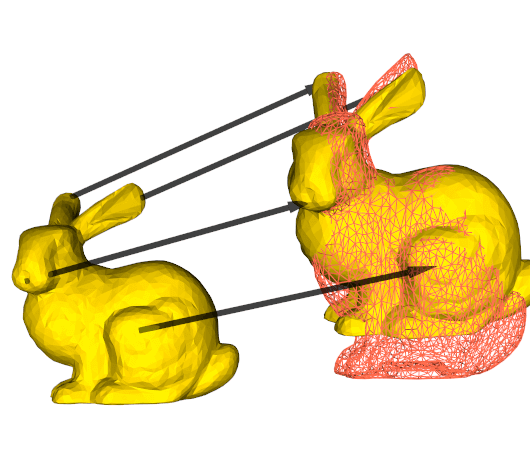
            - [align5.py](https://github.com/marcomusy/vedo/tree/master/examples/basic/align5.py)

                ![](https://vedo.embl.es/images/basic/align5.png)
        """

        if utils.is_sequence(source_landmarks):
            ss = vtki.vtkPoints()
            for p in source_landmarks:
                ss.InsertNextPoint(p)
        else:
            ss = source_landmarks.dataset.GetPoints()
            if least_squares:
                source_landmarks = source_landmarks.coordinates

        if utils.is_sequence(target_landmarks):
            st = vtki.vtkPoints()
            for p in target_landmarks:
                st.InsertNextPoint(p)
        else:
            st = target_landmarks.GetPoints()
            if least_squares:
                target_landmarks = target_landmarks.coordinates

        if ss.GetNumberOfPoints() != st.GetNumberOfPoints():
            n1 = ss.GetNumberOfPoints()
            n2 = st.GetNumberOfPoints()
            vedo.logger.error(
                f"source and target have different nr of points {n1} vs {n2}"
            )
            raise RuntimeError()

        if int(rigid) + int(affine) + int(least_squares) > 1:
            vedo.logger.error(
                "only one of rigid, affine, least_squares can be True at a time"
            )
            raise RuntimeError()

        lmt = vtki.vtkLandmarkTransform()
        lmt.SetSourceLandmarks(ss)
        lmt.SetTargetLandmarks(st)
        lmt.SetModeToSimilarity()

        if rigid:
            lmt.SetModeToRigidBody()
            lmt.Update()

        elif affine:
            lmt.SetModeToAffine()
            lmt.Update()

        elif least_squares:
            cms = source_landmarks.mean(axis=0)
            cmt = target_landmarks.mean(axis=0)
            m = np.linalg.lstsq(
                source_landmarks - cms, target_landmarks - cmt, rcond=None
            )[0]
            M = vtki.vtkMatrix4x4()
            for i in range(3):
                for j in range(3):
                    M.SetElement(j, i, m[i][j])
            lmt = vtki.vtkTransform()
            lmt.Translate(cmt)
            lmt.Concatenate(M)
            lmt.Translate(-cms)

        else:
            lmt.Update()

        self.apply_transform(lmt)
        self.pipeline = utils.OperationNode("transform_with_landmarks", parents=[self])
        return self

    def normalize(self) -> Self:
        """Scale average size to unit. The scaling is performed around the center of mass."""
        coords = self.coordinates
        if not coords.shape[0]:
            return self
        cm = np.mean(coords, axis=0)
        pts = coords - cm
        xyz2 = np.sum(pts * pts, axis=0) / len(pts)
        scale = 1 / np.sqrt(np.sum(xyz2))
        self.scale(scale, origin=cm)
        self.pipeline = utils.OperationNode("normalize", parents=[self])
        return self

    def mirror(self, axis="x", origin=True) -> Self:
        """
        Mirror reflect along one of the cartesian axes

        Args:
            axis (str):
                axis to use for mirroring, must be set to `x, y, z`.
                Or any combination of those.
            origin (list):
                use this point as the origin of the mirroring transformation.

        Examples:
            - [mirror.py](https://github.com/marcomusy/vedo/tree/master/examples/basic/mirror.py)

                ![](https://vedo.embl.es/images/basic/mirror.png)
        """
        sx, sy, sz = 1, 1, 1
        if "x" in axis.lower():
            sx = -1
        if "y" in axis.lower():
            sy = -1
        if "z" in axis.lower():
            sz = -1

        self.scale([sx, sy, sz], origin=origin)

        self.pipeline = utils.OperationNode(
            "mirror", comment=f"axis = {axis}", parents=[self]
        )

        if sx * sy * sz < 0:
            if hasattr(self, "reverse"):
                self.reverse()
        return self

    def flip_normals(self) -> Self:
        """Flip all normals orientation."""
        rs = vtki.new("ReverseSense")
        rs.SetInputData(self.dataset)
        rs.ReverseCellsOff()
        rs.ReverseNormalsOn()
        rs.Update()
        self._update(rs.GetOutput())
        self.pipeline = utils.OperationNode("flip_normals", parents=[self])
        return self

    def add_gaussian_noise(self, sigma=1.0) -> Self:
        """
        Add gaussian noise to point positions.
        An extra array is added named "GaussianNoise" with the displacements.

        Args:
            sigma (float):
                nr. of standard deviations, expressed in percent of the diagonal size of mesh.
                Can also be a list `[sigma_x, sigma_y, sigma_z]`.

        Examples:
            ```python
            from vedo import Sphere
            Sphere().add_gaussian_noise(1.0).point_size(8).show().close()
            ```
        """
        sz = self.diagonal_size()
        pts = self.coordinates
        n = len(pts)
        ns = (np.random.randn(n, 3) * sigma) * (sz / 100)
        vpts = vtki.vtkPoints()
        vpts.SetNumberOfPoints(n)
        vpts.SetData(utils.numpy2vtk(pts + ns, dtype=np.float32))
        self.dataset.SetPoints(vpts)
        self.dataset.GetPoints().Modified()
        self.pointdata["GaussianNoise"] = -ns
        self.pipeline = utils.OperationNode(
            "gaussian_noise", parents=[self], shape="egg", comment=f"sigma = {sigma}"
        )
        return self

    def project_on_plane(self, plane="z", point=None, direction=None) -> Self:
        """
        Project the mesh on one of the Cartesian planes.

        Args:
            plane (str, Plane):
                if plane is `str`, plane can be one of ['x', 'y', 'z'],
                represents x-plane, y-plane and z-plane, respectively.
                Otherwise, plane should be an instance of `vedo.shapes.Plane`.
            point (float, array):
                if plane is `str`, point should be a float represents the intercept.
                Otherwise, point is the camera point of perspective projection
            direction (array):
                direction of oblique projection

        Note:
            Parameters `point` and `direction` are only used if the given plane
            is an instance of `vedo.shapes.Plane`. And one of these two params
            should be left as `None` to specify the projection type.

        Examples:
            ```python
            s.project_on_plane(plane='z') # project to z-plane
            plane = Plane(pos=(4, 8, -4), normal=(-1, 0, 1), s=(5,5))
            s.project_on_plane(plane=plane)                       # orthogonal projection
            s.project_on_plane(plane=plane, point=(6, 6, 6))      # perspective projection
            s.project_on_plane(plane=plane, direction=(1, 2, -1)) # oblique projection
            ```

        Examples:
            - [silhouette2.py](https://github.com/marcomusy/vedo/tree/master/examples/basic/silhouette2.py)

                ![](https://vedo.embl.es/images/basic/silhouette2.png)
        """
        coords = self.coordinates

        if plane == "x":
            coords[:, 0] = self.transform.position[0]
            intercept = self.xbounds()[0] if point is None else point
            self.x(intercept)
        elif plane == "y":
            coords[:, 1] = self.transform.position[1]
            intercept = self.ybounds()[0] if point is None else point
            self.y(intercept)
        elif plane == "z":
            coords[:, 2] = self.transform.position[2]
            intercept = self.zbounds()[0] if point is None else point
            self.z(intercept)

        elif isinstance(plane, vedo.shapes.Plane):
            normal = plane.normal / np.linalg.norm(plane.normal)
            pl = np.hstack((normal, -np.dot(plane.pos(), normal))).reshape(4, 1)
            if direction is None and point is None:
                # orthogonal projection
                pt = np.hstack((normal, [0])).reshape(4, 1)
                # proj_mat = pt.T @ pl * np.eye(4) - pt @ pl.T # python3 only
                proj_mat = np.matmul(pt.T, pl) * np.eye(4) - np.matmul(pt, pl.T)

            elif direction is None:
                # perspective projection
                pt = np.hstack((np.array(point), [1])).reshape(4, 1)
                # proj_mat = pt.T @ pl * np.eye(4) - pt @ pl.T
                proj_mat = np.matmul(pt.T, pl) * np.eye(4) - np.matmul(pt, pl.T)

            elif point is None:
                # oblique projection
                pt = np.hstack((np.array(direction), [0])).reshape(4, 1)
                # proj_mat = pt.T @ pl * np.eye(4) - pt @ pl.T
                proj_mat = np.matmul(pt.T, pl) * np.eye(4) - np.matmul(pt, pl.T)

            coords = np.concatenate(
                [coords, np.ones((coords.shape[:-1] + (1,)))], axis=-1
            )
            # coords = coords @ proj_mat.T
            coords = np.matmul(coords, proj_mat.T)
            coords = coords[:, :3] / coords[:, 3:]

        else:
            vedo.logger.error(f"unknown plane {plane}")
            raise RuntimeError()

        self.alpha(0.1)
        self.coordinates = coords
        return self

    def warp(self, source, target, sigma=1.0, mode="3d") -> Self:
        """
        "Thin Plate Spline" transformations describe a nonlinear warp transform defined by a set
        of source and target landmarks. Any point on the mesh close to a source landmark will
        be moved to a place close to the corresponding target landmark.
        The points in between are interpolated smoothly using
        Bookstein's Thin Plate Spline algorithm.

        Transformation object can be accessed with `mesh.transform`.

        Args:
            sigma (float):
                specify the 'stiffness' of the spline.
            mode (str):
                set the basis function to either abs(R) (for 3d) or R2LogR (for 2d meshes)

        Examples:
            - [interpolate_field.py](https://github.com/marcomusy/vedo/tree/master/examples/advanced/interpolate_field.py)
            - [warp1.py](https://github.com/marcomusy/vedo/tree/master/examples/advanced/warp1.py)
            - [warp2.py](https://github.com/marcomusy/vedo/tree/master/examples/advanced/warp2.py)
            - [warp3.py](https://github.com/marcomusy/vedo/tree/master/examples/advanced/warp3.py)
            - [warp4a.py](https://github.com/marcomusy/vedo/tree/master/examples/advanced/warp4a.py)
            - [warp4b.py](https://github.com/marcomusy/vedo/tree/master/examples/advanced/warp4b.py)
            - [warp6.py](https://github.com/marcomusy/vedo/tree/master/examples/advanced/warp6.py)

            ![](https://vedo.embl.es/images/advanced/warp2.png)
        """
        parents = [self]

        try:
            source = source.coordinates
            parents.append(source)
        except AttributeError:
            source = utils.make3d(source)

        try:
            target = target.coordinates
            parents.append(target)
        except AttributeError:
            target = utils.make3d(target)

        ns = len(source)
        nt = len(target)
        if ns != nt:
            vedo.logger.error(f"#source {ns} != {nt} #target points")
            raise RuntimeError()

        NLT = NonLinearTransform(sigma=sigma, mode=mode)
        NLT.source_points = source
        NLT.target_points = target
        self.apply_transform(NLT)

        self.pipeline = utils.OperationNode("warp", parents=parents)
        return self

add_gaussian_noise(sigma=1.0)

Add gaussian noise to point positions. An extra array is added named "GaussianNoise" with the displacements.

Parameters:

Name Type Description Default
sigma float

nr. of standard deviations, expressed in percent of the diagonal size of mesh. Can also be a list [sigma_x, sigma_y, sigma_z].

1.0

Examples:

from vedo import Sphere
Sphere().add_gaussian_noise(1.0).point_size(8).show().close()
Source code in vedo/pointcloud/transform.py
315
316
317
318
319
320
321
322
323
324
325
326
327
328
329
330
331
332
333
334
335
336
337
338
339
340
341
342
343
344
def add_gaussian_noise(self, sigma=1.0) -> Self:
    """
    Add gaussian noise to point positions.
    An extra array is added named "GaussianNoise" with the displacements.

    Args:
        sigma (float):
            nr. of standard deviations, expressed in percent of the diagonal size of mesh.
            Can also be a list `[sigma_x, sigma_y, sigma_z]`.

    Examples:
        ```python
        from vedo import Sphere
        Sphere().add_gaussian_noise(1.0).point_size(8).show().close()
        ```
    """
    sz = self.diagonal_size()
    pts = self.coordinates
    n = len(pts)
    ns = (np.random.randn(n, 3) * sigma) * (sz / 100)
    vpts = vtki.vtkPoints()
    vpts.SetNumberOfPoints(n)
    vpts.SetData(utils.numpy2vtk(pts + ns, dtype=np.float32))
    self.dataset.SetPoints(vpts)
    self.dataset.GetPoints().Modified()
    self.pointdata["GaussianNoise"] = -ns
    self.pipeline = utils.OperationNode(
        "gaussian_noise", parents=[self], shape="egg", comment=f"sigma = {sigma}"
    )
    return self

align_to(target, iters=100, rigid=False, invert=False, use_centroids=False)

Aligned to target mesh through the Iterative Closest Point algorithm.

The core of the algorithm is to match each vertex in one surface with the closest surface point on the other, then apply the transformation that modify one surface to best match the other (in the least-square sense).

Parameters:

Name Type Description Default
rigid bool

if True do not allow scaling

False
invert bool

if True start by aligning the target to the source but invert the transformation finally. Useful when the target is smaller than the source.

False
use_centroids bool

start by matching the centroids of the two objects.

False

Examples:

Source code in vedo/pointcloud/transform.py
 71
 72
 73
 74
 75
 76
 77
 78
 79
 80
 81
 82
 83
 84
 85
 86
 87
 88
 89
 90
 91
 92
 93
 94
 95
 96
 97
 98
 99
100
101
102
103
104
105
106
107
108
109
110
111
112
113
114
115
116
def align_to(
    self, target, iters=100, rigid=False, invert=False, use_centroids=False
) -> Self:
    """
    Aligned to target mesh through the `Iterative Closest Point` algorithm.

    The core of the algorithm is to match each vertex in one surface with
    the closest surface point on the other, then apply the transformation
    that modify one surface to best match the other (in the least-square sense).

    Args:
        rigid (bool):
            if True do not allow scaling
        invert (bool):
            if True start by aligning the target to the source but
            invert the transformation finally. Useful when the target is smaller
            than the source.
        use_centroids (bool):
            start by matching the centroids of the two objects.

    Examples:
        - [align1.py](https://github.com/marcomusy/vedo/tree/master/examples/basic/align1.py)

            ![](https://vedo.embl.es/images/basic/align1.png)

        - [align2.py](https://github.com/marcomusy/vedo/tree/master/examples/basic/align2.py)

            ![](https://vedo.embl.es/images/basic/align2.png)
    """
    icp = vtki.new("IterativeClosestPointTransform")
    icp.SetSource(self.dataset)
    icp.SetTarget(target.dataset)
    if invert:
        icp.Inverse()
    icp.SetMaximumNumberOfIterations(iters)
    if rigid:
        icp.GetLandmarkTransform().SetModeToRigidBody()
    icp.SetStartByMatchingCentroids(use_centroids)
    icp.Update()

    self.apply_transform(icp.GetMatrix())

    self.pipeline = utils.OperationNode(
        "align_to", parents=[self, target], comment=f"rigid = {rigid}"
    )
    return self

align_to_bounding_box(msh, rigid=False)

Align the current object's bounding box to the bounding box of the input object.

Use rigid=True to disable scaling.

Examples:

align6.py

Source code in vedo/pointcloud/transform.py
118
119
120
121
122
123
124
125
126
127
128
129
130
131
132
133
134
135
136
137
138
139
140
141
142
143
144
145
146
147
148
149
150
151
152
153
154
155
156
157
158
159
160
161
162
163
164
165
def align_to_bounding_box(self, msh, rigid=False) -> Self:
    """
    Align the current object's bounding box to the bounding box
    of the input object.

    Use `rigid=True` to disable scaling.

    Examples:
        [align6.py](https://github.com/marcomusy/vedo/tree/master/examples/basic/align6.py)
    """
    lmt = vtki.vtkLandmarkTransform()
    ss = vtki.vtkPoints()
    xss0, xss1, yss0, yss1, zss0, zss1 = self.bounds()
    for p in [
        [xss0, yss0, zss0],
        [xss1, yss0, zss0],
        [xss1, yss1, zss0],
        [xss0, yss1, zss0],
        [xss0, yss0, zss1],
        [xss1, yss0, zss1],
        [xss1, yss1, zss1],
        [xss0, yss1, zss1],
    ]:
        ss.InsertNextPoint(p)
    st = vtki.vtkPoints()
    xst0, xst1, yst0, yst1, zst0, zst1 = msh.bounds()
    for p in [
        [xst0, yst0, zst0],
        [xst1, yst0, zst0],
        [xst1, yst1, zst0],
        [xst0, yst1, zst0],
        [xst0, yst0, zst1],
        [xst1, yst0, zst1],
        [xst1, yst1, zst1],
        [xst0, yst1, zst1],
    ]:
        st.InsertNextPoint(p)

    lmt.SetSourceLandmarks(ss)
    lmt.SetTargetLandmarks(st)
    lmt.SetModeToAffine()
    if rigid:
        lmt.SetModeToRigidBody()
    lmt.Update()

    LT = LinearTransform(lmt)
    self.apply_transform(LT)
    return self

align_with_landmarks(source_landmarks, target_landmarks, rigid=False, affine=False, least_squares=False)

Transform mesh orientation and position based on a set of landmarks points. The algorithm finds the best matching of source points to target points in the mean least square sense, in one single step.

If affine is True the x, y and z axes can scale independently but stay collinear. With least_squares they can vary orientation.

Examples:

Source code in vedo/pointcloud/transform.py
167
168
169
170
171
172
173
174
175
176
177
178
179
180
181
182
183
184
185
186
187
188
189
190
191
192
193
194
195
196
197
198
199
200
201
202
203
204
205
206
207
208
209
210
211
212
213
214
215
216
217
218
219
220
221
222
223
224
225
226
227
228
229
230
231
232
233
234
235
236
237
238
239
240
241
242
243
244
245
246
247
248
249
250
251
252
253
254
def align_with_landmarks(
    self,
    source_landmarks,
    target_landmarks,
    rigid=False,
    affine=False,
    least_squares=False,
) -> Self:
    """
    Transform mesh orientation and position based on a set of landmarks points.
    The algorithm finds the best matching of source points to target points
    in the mean least square sense, in one single step.

    If `affine` is True the x, y and z axes can scale independently but stay collinear.
    With least_squares they can vary orientation.

    Examples:
        - [align5.py](https://github.com/marcomusy/vedo/tree/master/examples/basic/align5.py)

            ![](https://vedo.embl.es/images/basic/align5.png)
    """

    if utils.is_sequence(source_landmarks):
        ss = vtki.vtkPoints()
        for p in source_landmarks:
            ss.InsertNextPoint(p)
    else:
        ss = source_landmarks.dataset.GetPoints()
        if least_squares:
            source_landmarks = source_landmarks.coordinates

    if utils.is_sequence(target_landmarks):
        st = vtki.vtkPoints()
        for p in target_landmarks:
            st.InsertNextPoint(p)
    else:
        st = target_landmarks.GetPoints()
        if least_squares:
            target_landmarks = target_landmarks.coordinates

    if ss.GetNumberOfPoints() != st.GetNumberOfPoints():
        n1 = ss.GetNumberOfPoints()
        n2 = st.GetNumberOfPoints()
        vedo.logger.error(
            f"source and target have different nr of points {n1} vs {n2}"
        )
        raise RuntimeError()

    if int(rigid) + int(affine) + int(least_squares) > 1:
        vedo.logger.error(
            "only one of rigid, affine, least_squares can be True at a time"
        )
        raise RuntimeError()

    lmt = vtki.vtkLandmarkTransform()
    lmt.SetSourceLandmarks(ss)
    lmt.SetTargetLandmarks(st)
    lmt.SetModeToSimilarity()

    if rigid:
        lmt.SetModeToRigidBody()
        lmt.Update()

    elif affine:
        lmt.SetModeToAffine()
        lmt.Update()

    elif least_squares:
        cms = source_landmarks.mean(axis=0)
        cmt = target_landmarks.mean(axis=0)
        m = np.linalg.lstsq(
            source_landmarks - cms, target_landmarks - cmt, rcond=None
        )[0]
        M = vtki.vtkMatrix4x4()
        for i in range(3):
            for j in range(3):
                M.SetElement(j, i, m[i][j])
        lmt = vtki.vtkTransform()
        lmt.Translate(cmt)
        lmt.Concatenate(M)
        lmt.Translate(-cms)

    else:
        lmt.Update()

    self.apply_transform(lmt)
    self.pipeline = utils.OperationNode("transform_with_landmarks", parents=[self])
    return self

flip_normals()

Flip all normals orientation.

Source code in vedo/pointcloud/transform.py
304
305
306
307
308
309
310
311
312
313
def flip_normals(self) -> Self:
    """Flip all normals orientation."""
    rs = vtki.new("ReverseSense")
    rs.SetInputData(self.dataset)
    rs.ReverseCellsOff()
    rs.ReverseNormalsOn()
    rs.Update()
    self._update(rs.GetOutput())
    self.pipeline = utils.OperationNode("flip_normals", parents=[self])
    return self

mirror(axis='x', origin=True)

Mirror reflect along one of the cartesian axes

Parameters:

Name Type Description Default
axis str

axis to use for mirroring, must be set to x, y, z. Or any combination of those.

'x'
origin list

use this point as the origin of the mirroring transformation.

True

Examples:

Source code in vedo/pointcloud/transform.py
269
270
271
272
273
274
275
276
277
278
279
280
281
282
283
284
285
286
287
288
289
290
291
292
293
294
295
296
297
298
299
300
301
302
def mirror(self, axis="x", origin=True) -> Self:
    """
    Mirror reflect along one of the cartesian axes

    Args:
        axis (str):
            axis to use for mirroring, must be set to `x, y, z`.
            Or any combination of those.
        origin (list):
            use this point as the origin of the mirroring transformation.

    Examples:
        - [mirror.py](https://github.com/marcomusy/vedo/tree/master/examples/basic/mirror.py)

            ![](https://vedo.embl.es/images/basic/mirror.png)
    """
    sx, sy, sz = 1, 1, 1
    if "x" in axis.lower():
        sx = -1
    if "y" in axis.lower():
        sy = -1
    if "z" in axis.lower():
        sz = -1

    self.scale([sx, sy, sz], origin=origin)

    self.pipeline = utils.OperationNode(
        "mirror", comment=f"axis = {axis}", parents=[self]
    )

    if sx * sy * sz < 0:
        if hasattr(self, "reverse"):
            self.reverse()
    return self

normalize()

Scale average size to unit. The scaling is performed around the center of mass.

Source code in vedo/pointcloud/transform.py
256
257
258
259
260
261
262
263
264
265
266
267
def normalize(self) -> Self:
    """Scale average size to unit. The scaling is performed around the center of mass."""
    coords = self.coordinates
    if not coords.shape[0]:
        return self
    cm = np.mean(coords, axis=0)
    pts = coords - cm
    xyz2 = np.sum(pts * pts, axis=0) / len(pts)
    scale = 1 / np.sqrt(np.sum(xyz2))
    self.scale(scale, origin=cm)
    self.pipeline = utils.OperationNode("normalize", parents=[self])
    return self

project_on_plane(plane='z', point=None, direction=None)

Project the mesh on one of the Cartesian planes.

Parameters:

Name Type Description Default
plane (str, Plane)

if plane is str, plane can be one of ['x', 'y', 'z'], represents x-plane, y-plane and z-plane, respectively. Otherwise, plane should be an instance of vedo.shapes.Plane.

'z'
point (float, array)

if plane is str, point should be a float represents the intercept. Otherwise, point is the camera point of perspective projection

None
direction array

direction of oblique projection

None
Note

Parameters point and direction are only used if the given plane is an instance of vedo.shapes.Plane. And one of these two params should be left as None to specify the projection type.

Examples:

s.project_on_plane(plane='z') # project to z-plane
plane = Plane(pos=(4, 8, -4), normal=(-1, 0, 1), s=(5,5))
s.project_on_plane(plane=plane)                       # orthogonal projection
s.project_on_plane(plane=plane, point=(6, 6, 6))      # perspective projection
s.project_on_plane(plane=plane, direction=(1, 2, -1)) # oblique projection

Examples:
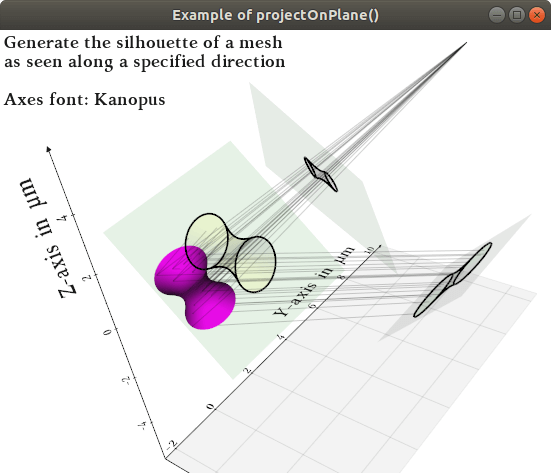
Source code in vedo/pointcloud/transform.py
346
347
348
349
350
351
352
353
354
355
356
357
358
359
360
361
362
363
364
365
366
367
368
369
370
371
372
373
374
375
376
377
378
379
380
381
382
383
384
385
386
387
388
389
390
391
392
393
394
395
396
397
398
399
400
401
402
403
404
405
406
407
408
409
410
411
412
413
414
415
416
417
418
419
420
421
422
423
424
425
426
427
428
429
def project_on_plane(self, plane="z", point=None, direction=None) -> Self:
    """
    Project the mesh on one of the Cartesian planes.

    Args:
        plane (str, Plane):
            if plane is `str`, plane can be one of ['x', 'y', 'z'],
            represents x-plane, y-plane and z-plane, respectively.
            Otherwise, plane should be an instance of `vedo.shapes.Plane`.
        point (float, array):
            if plane is `str`, point should be a float represents the intercept.
            Otherwise, point is the camera point of perspective projection
        direction (array):
            direction of oblique projection

    Note:
        Parameters `point` and `direction` are only used if the given plane
        is an instance of `vedo.shapes.Plane`. And one of these two params
        should be left as `None` to specify the projection type.

    Examples:
        ```python
        s.project_on_plane(plane='z') # project to z-plane
        plane = Plane(pos=(4, 8, -4), normal=(-1, 0, 1), s=(5,5))
        s.project_on_plane(plane=plane)                       # orthogonal projection
        s.project_on_plane(plane=plane, point=(6, 6, 6))      # perspective projection
        s.project_on_plane(plane=plane, direction=(1, 2, -1)) # oblique projection
        ```

    Examples:
        - [silhouette2.py](https://github.com/marcomusy/vedo/tree/master/examples/basic/silhouette2.py)

            ![](https://vedo.embl.es/images/basic/silhouette2.png)
    """
    coords = self.coordinates

    if plane == "x":
        coords[:, 0] = self.transform.position[0]
        intercept = self.xbounds()[0] if point is None else point
        self.x(intercept)
    elif plane == "y":
        coords[:, 1] = self.transform.position[1]
        intercept = self.ybounds()[0] if point is None else point
        self.y(intercept)
    elif plane == "z":
        coords[:, 2] = self.transform.position[2]
        intercept = self.zbounds()[0] if point is None else point
        self.z(intercept)

    elif isinstance(plane, vedo.shapes.Plane):
        normal = plane.normal / np.linalg.norm(plane.normal)
        pl = np.hstack((normal, -np.dot(plane.pos(), normal))).reshape(4, 1)
        if direction is None and point is None:
            # orthogonal projection
            pt = np.hstack((normal, [0])).reshape(4, 1)
            # proj_mat = pt.T @ pl * np.eye(4) - pt @ pl.T # python3 only
            proj_mat = np.matmul(pt.T, pl) * np.eye(4) - np.matmul(pt, pl.T)

        elif direction is None:
            # perspective projection
            pt = np.hstack((np.array(point), [1])).reshape(4, 1)
            # proj_mat = pt.T @ pl * np.eye(4) - pt @ pl.T
            proj_mat = np.matmul(pt.T, pl) * np.eye(4) - np.matmul(pt, pl.T)

        elif point is None:
            # oblique projection
            pt = np.hstack((np.array(direction), [0])).reshape(4, 1)
            # proj_mat = pt.T @ pl * np.eye(4) - pt @ pl.T
            proj_mat = np.matmul(pt.T, pl) * np.eye(4) - np.matmul(pt, pl.T)

        coords = np.concatenate(
            [coords, np.ones((coords.shape[:-1] + (1,)))], axis=-1
        )
        # coords = coords @ proj_mat.T
        coords = np.matmul(coords, proj_mat.T)
        coords = coords[:, :3] / coords[:, 3:]

    else:
        vedo.logger.error(f"unknown plane {plane}")
        raise RuntimeError()

    self.alpha(0.1)
    self.coordinates = coords
    return self

warp(source, target, sigma=1.0, mode='3d')

"Thin Plate Spline" transformations describe a nonlinear warp transform defined by a set of source and target landmarks. Any point on the mesh close to a source landmark will be moved to a place close to the corresponding target landmark. The points in between are interpolated smoothly using Bookstein's Thin Plate Spline algorithm.

Transformation object can be accessed with mesh.transform.

Parameters:

Name Type Description Default
sigma float

specify the 'stiffness' of the spline.

1.0
mode str

set the basis function to either abs(R) (for 3d) or R2LogR (for 2d meshes)

'3d'

Examples:

Source code in vedo/pointcloud/transform.py
431
432
433
434
435
436
437
438
439
440
441
442
443
444
445
446
447
448
449
450
451
452
453
454
455
456
457
458
459
460
461
462
463
464
465
466
467
468
469
470
471
472
473
474
475
476
477
478
479
480
481
482
483
484
def warp(self, source, target, sigma=1.0, mode="3d") -> Self:
    """
    "Thin Plate Spline" transformations describe a nonlinear warp transform defined by a set
    of source and target landmarks. Any point on the mesh close to a source landmark will
    be moved to a place close to the corresponding target landmark.
    The points in between are interpolated smoothly using
    Bookstein's Thin Plate Spline algorithm.

    Transformation object can be accessed with `mesh.transform`.

    Args:
        sigma (float):
            specify the 'stiffness' of the spline.
        mode (str):
            set the basis function to either abs(R) (for 3d) or R2LogR (for 2d meshes)

    Examples:
        - [interpolate_field.py](https://github.com/marcomusy/vedo/tree/master/examples/advanced/interpolate_field.py)
        - [warp1.py](https://github.com/marcomusy/vedo/tree/master/examples/advanced/warp1.py)
        - [warp2.py](https://github.com/marcomusy/vedo/tree/master/examples/advanced/warp2.py)
        - [warp3.py](https://github.com/marcomusy/vedo/tree/master/examples/advanced/warp3.py)
        - [warp4a.py](https://github.com/marcomusy/vedo/tree/master/examples/advanced/warp4a.py)
        - [warp4b.py](https://github.com/marcomusy/vedo/tree/master/examples/advanced/warp4b.py)
        - [warp6.py](https://github.com/marcomusy/vedo/tree/master/examples/advanced/warp6.py)

        ![](https://vedo.embl.es/images/advanced/warp2.png)
    """
    parents = [self]

    try:
        source = source.coordinates
        parents.append(source)
    except AttributeError:
        source = utils.make3d(source)

    try:
        target = target.coordinates
        parents.append(target)
    except AttributeError:
        target = utils.make3d(target)

    ns = len(source)
    nt = len(target)
    if ns != nt:
        vedo.logger.error(f"#source {ns} != {nt} #target points")
        raise RuntimeError()

    NLT = NonLinearTransform(sigma=sigma, mode=mode)
    NLT.source_points = source
    NLT.target_points = target
    self.apply_transform(NLT)

    self.pipeline = utils.OperationNode("warp", parents=parents)
    return self

procrustes_alignment(sources, rigid=False)

Return an Assembly of aligned source meshes with the Procrustes algorithm. The output Assembly is normalized in size.

The Procrustes algorithm takes N set of points and aligns them in a least-squares sense to their mutual mean. The algorithm is iterated until convergence, as the mean must be recomputed after each alignment.

The set of average points generated by the algorithm can be accessed with algoutput.info['mean'] as a numpy array.

Parameters:

Name Type Description Default
rigid

bool if True scaling is disabled.

required

Examples:

Source code in vedo/pointcloud/transform.py
19
20
21
22
23
24
25
26
27
28
29
30
31
32
33
34
35
36
37
38
39
40
41
42
43
44
45
46
47
48
49
50
51
52
53
54
55
56
57
58
59
60
61
62
63
64
65
66
67
def procrustes_alignment(sources: list["vedo.Mesh"], rigid=False):
    """
    Return an `Assembly` of aligned source meshes with the `Procrustes` algorithm.
    The output `Assembly` is normalized in size.

    The `Procrustes` algorithm takes N set of points and aligns them in a least-squares sense
    to their mutual mean. The algorithm is iterated until convergence,
    as the mean must be recomputed after each alignment.

    The set of average points generated by the algorithm can be accessed with
    `algoutput.info['mean']` as a numpy array.

    Args:
        rigid : bool
            if `True` scaling is disabled.

    Examples:
        - [align4.py](https://github.com/marcomusy/vedo/tree/master/examples/basic/align4.py)

        ![](https://vedo.embl.es/images/basic/align4.png)
    """
    from vedo.assembly import Assembly

    group = vtki.new("MultiBlockDataGroupFilter")
    for source in sources:
        if sources[0].npoints != source.npoints:
            vedo.logger.error("sources have different nr of points")
            raise RuntimeError()
        group.AddInputData(source.dataset)
    procrustes = vtki.new("ProcrustesAlignmentFilter")
    procrustes.StartFromCentroidOn()
    procrustes.SetInputConnection(group.GetOutputPort())
    if rigid:
        procrustes.GetLandmarkTransform().SetModeToRigidBody()
    procrustes.Update()

    acts = []
    for i, source in enumerate(sources):
        poly = procrustes.GetOutput().GetBlock(i)
        mesh = vedo.mesh.Mesh(poly)
        mesh.actor.SetProperty(source.actor.GetProperty())
        mesh.properties = source.actor.GetProperty()
        if hasattr(source, "name"):
            mesh.name = source.name
        acts.append(mesh)
    assem = Assembly(acts)
    assem.transform = procrustes.GetLandmarkTransform()
    assem.info["mean"] = vedo.utils.vtk2numpy(procrustes.GetMeanPoints().GetData())
    return assem